

- Knowledge & Events
- Translated with AI
Prof. Dr. Markus Lehmann, Prodekan der Fakultät Life Sciences; Prof. Dr. Benjamin Eilts, Angewandte Reinigung und Hygiene
The Faculty of Life Sciences at the Albstadt-Sigmaringen University of Applied Sciences
Current Developments: Bioanalytics, Cleanroom Technology, Integrative Hygiene
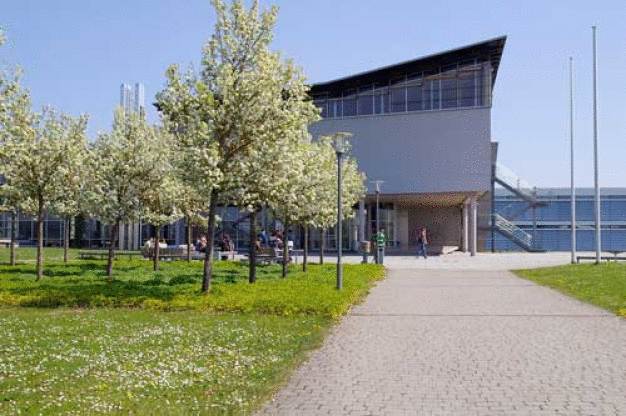
Campus Sigmaringen (Source: University)
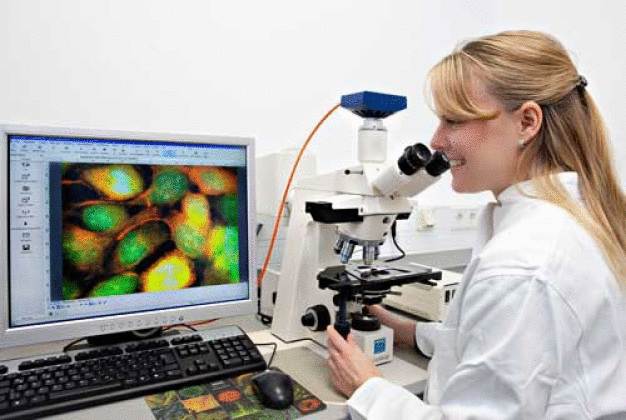
Examinations with the microscope (Source: University)
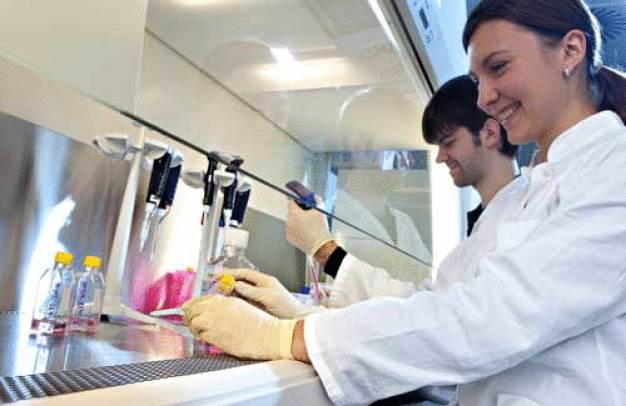
Laboratory analyses (Source: University)
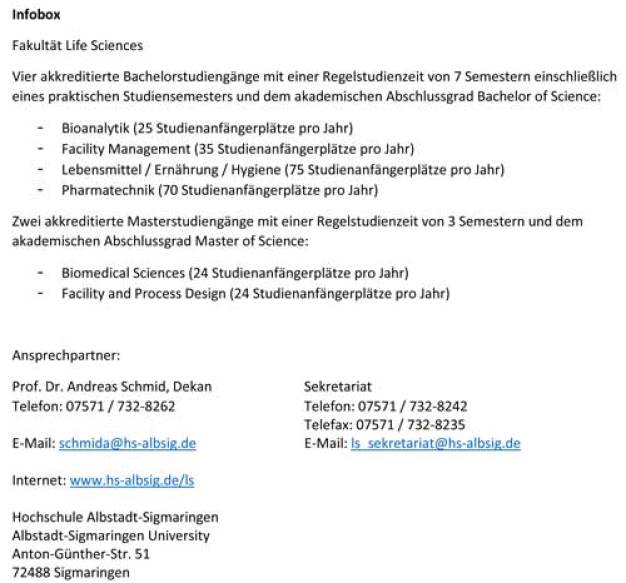
Faculty of Life Sciences
The Faculty of Life Sciences at Albstadt-Sigmaringen University offers qualified students the opportunity to prepare for an attractive career entry across the entire spectrum of the life science industry in its four bachelor's and two master's programs. Beyond the traditional focus on the food and pharmaceutical industries, our graduates of the bachelor's programs in Food, Nutrition, Hygiene, and Pharmaceutical Technology are also highly sought after in the cosmetics, medical device, and biotech industries. Facility Management broadly covers additional areas in industry and business. The focus is on the economic efficiency and preservation of the value of buildings and facilities.
As part of the faculty's further development, the Bioanalytics program was introduced in the winter semester 2017/18. Additionally, graduates of the research-oriented Master's program in Biomedical Sciences and the application-oriented Master's program in Facility and Process Design have scientific and management-oriented career opportunities in industry and academia.
A cornerstone of university education at the Faculty of Life Sciences is the modern laboratories and the content of laboratory practicals, which are continuously adapted to current industry and research requirements. The Faculty of Life Sciences places great importance on exchange with regional and supra-regional companies from various sectors to best prepare students for industry demands. This develops all technical, methodological, and personal skills of the students, guaranteeing a successful start or continuation of a professional career.
This article reports on current important developments at the Faculty of Life Sciences, including the fields of Bioanalytics, Cleanroom Technology, and Integrative Hygiene.
Bioanalytics
What does state-of-the-art bioanalytics with automated laboratory systems look like today? How do modern medical laboratories manage to analyze 100,000 patient samples per day? How are tiny amounts of blood or tissue samples analyzed? Versatile and practical, the nationwide unique Bioanalytics program with a focus on Laboratory Automation addresses these and other similar questions.
In the winter semester 2017/18, the Bioanalytics program successfully started with 25 new students per year. The basic program, culminating in a Bachelor of Science degree, specifically prepares students for areas such as diagnostics, laboratory management, quality control and assurance, biomedical research, laboratory automation and analysis systems, as well as consumer protection. It imparts solid methodological skills for the development, optimization, and application of physicochemical and biological analysis methods, as well as for automating laboratory processes.
Cleanroom Technology
The teaching in the area of Cleanroom Technology, in conjunction with Process Engineering and Quality Management, has undergone an important change. The related modules are now offered in the 3rd and 4th semesters of the Food, Nutrition, Hygiene, and Pharmaceutical Technology programs.
Fundamentals of cleanroom technology are also taught in the Bioanalytics program. The transfer to the first part of the main studies is essential for the practical semester in the 5th semester. Students will bring solid knowledge and skills in this important field by then.
Integrative Hygiene
In the winter semester 2017/18, Prof. Dr. Benjamin Eilts was appointed to the university for teaching and research in Applied Cleaning and Hygiene. Integrative Hygiene in the Food, Nutrition, and Hygiene program is a content focus of his work and that of his research group in Integrative Hygiene and Microbiology.
In the module on Integrative Hygiene, the focus areas of hygiene and microbiology in medical, public, and food sectors are covered through lectures, seminars, and practicals. Students also deal with aspects of environmental protection and occupational safety. Current issues from business, standards, science, and research are directly incorporated into teaching. In seminars, students learn to address critical questions of hygiene across borders. The acquired expertise is complemented by practical aspects to illustrate the connection between theory and practice of the complex topic of hygiene. This prepares and supports students ideally for the demands of science and industry.
The research group on Integrative Hygiene and Microbiology has laboratories for microbiological investigations as well as testing laboratories for examining cleaning efficacy and equipment performance. The group's scientific focus includes research projects on hygiene in medical and public sectors, such as the development of test bodies and efficacy testing for cleaning and disinfection. Procedures for testing the performance of household appliances and professional devices are also researched.
An application of the scientific expertise of the group involves participation in the development of DIN standards. Prof. Dr. Benjamin Eilts is involved as deputy chair in the working committee "Hospital Cleaning," which deals with the development of the corresponding standard.
Quality, competence, and ongoing development and optimization play a major role in healthcare. These success factors are not limited to medical, nursing, and therapeutic care. High-quality cleaning and disinfection are equally important in hospitals to ensure maximum patient safety and protect staff.
There are no specific guidelines for disinfecting cleaning in healthcare facilities. The KRINKO (Commission for Hospital Hygiene and Infection Prevention) of the Robert Koch Institute (RKI) has published general guidelines for surface cleaning and disinfection. These are fundamental and focus on infectiological-epidemiological aspects of disinfecting cleaning. Procedure guidelines for detailed, standardized execution of disinfecting cleaning cannot be directly derived from the KRINKO guidelines.
The importance of disinfecting cleaning for the prevention of nosocomial infections in hospitals is recognized. A nosocomial or hospital-acquired infection is an infection that develops in the hospital, meaning it was neither present nor incubating upon admission. In 2014, the German Society for Hospital Hygiene (DGKH) estimated 900,000 nosocomial infections, leading to approximately 30,000 to 40,000 deaths in Germany.
Consequently, health insurance companies and hospitals, and thus insured persons, must bear costs in the billions annually due to nosocomial infections. Additional costs include lost productivity and long-term disability, not to mention the human suffering of patients. Due to the increasing importance of nosocomial infections, hygiene deficiencies caused by process and quality shortcomings due to different procedures and structures of the organizations and service providers involved can no longer be tolerated.
This issue has nationwide significance. To establish generally binding guidelines for disinfecting cleaning in healthcare, the Dernbacher Group Katharina Kasper, together with the Healthcare Services Interest Group (IKS), submitted an application in August 2016 to the German Institute for Standardization (DIN) for the development of a uniform standard for cleaning and surface disinfection in healthcare.
After the constitutive meeting of the committee at DIN's "Rescue Service and Hospital" standards committee (NARK), experts from various fields were invited to participate in the development work. With more than 50 experts from science and research, hygiene institutes, service companies, and suppliers, the committee is broadly composed and ensures a comprehensive perspective on the topic. Additionally, expertise from the Robert Koch Institute, the German Hospital Federation, the German Society for Hygiene and Microbiology, the German Society for Hospital Hygiene, the Federal Environment Agency, and the DIN Consumer Council is available. Representatives from science, research, and politics also support the development of cleaning guidelines for healthcare. Melanie Reese was appointed chairwoman, with Christine Sudhop from the Federal Innungs Association of Building Cleaners and Prof. Dr. Benjamin Eilts serving as deputies.
The insights and experiences from standardization work and applied research feed into practical teaching activities. Tasks arising for companies from the new standard can be addressed with the support of students in the Bachelor's program in Food, Nutrition, and Hygiene. This can take place through internships, projects, and final theses (Bachelor's thesis).
Such mutually beneficial cooperation—beneficial for both companies and the university—is possible and desired across all programs and disciplines. The Faculty of Life Sciences looks forward to further expanding its professional contacts with relevant industries.
Hochschule Albstadt-Sigmaringen
Fakultät Life Sciences
Anton-Günther-Str. 51
72488 Sigmaringen
Germany
Phone: +49 7571 7328242
Fax: +49 7571 7328235
email: schmida@hs-albsig.de
Internet: http://www.hs-albsig.de/Seiten/homepage.aspx