




- Science
- Translated with AI
Promising approach to improve colorectal cancer therapy discovered
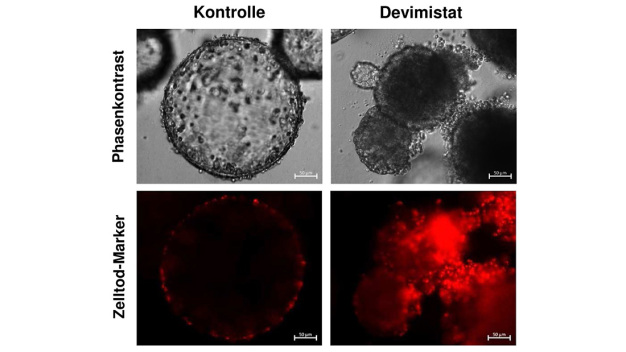
Intestinal tumor organoids after treatment with Devimistat (right) and untreated (left). The tumor organoids are shown in phase contrast and after staining with a red cell death marker. © Jörg Fahrer, TU Kaiserslautern
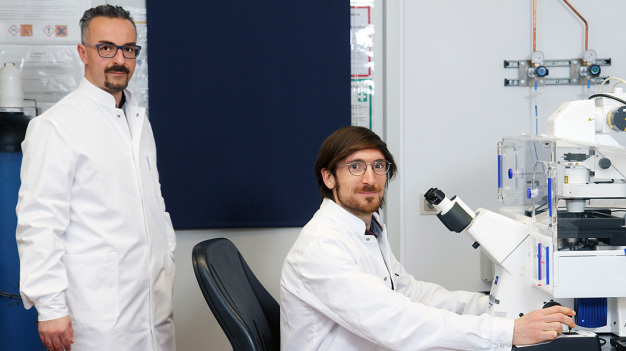
Prof. Dr. Jörg Fahrer (left) with Philipp Demuth (right) at the confocal laser scanning microscope in the laboratory of the Department of Chemistry at TU Kaiserslautern. © Thomas Koziel/TU Kaiserslautern
Colon cancer often progresses to a fatal stage in its late stages. Therefore, new therapeutic approaches are necessary. A research team from TU Kaiserslautern led by toxicologist Prof. Dr. Jörg Fahrer has succeeded in identifying the active compound Devimistat as a drug candidate that can improve colon cancer therapy. The team demonstrated within a research project funded by the Wilhelm Sander Foundation that Devimistat exerts its toxic effect primarily in colon cancer cells by attacking the mitochondria as the cell's power plants. This increases the sensitivity of the cancer cells to chemotherapeutic agents and improves the response to tumor therapy.
Colon cancer is one of the most common cancers worldwide, with an increasing number of young people affected. Despite advances in surgery and the development of targeted biological cancer medications, this malignant disease accounts for about ten percent of all cancer-related deaths in Western industrialized nations. "This figure highlights the need for new therapeutic approaches and active substances in the treatment of colon cancer," says Prof. Dr. Jörg Fahrer, who conducts research with his team in the Department of Chemistry at TU Kaiserslautern.
The team around Fahrer used the active compound Devimistat for their investigations. "This is derived from the naturally occurring compound α-lipoic acid and inhibits two important metabolic enzymes in the so-called citric acid cycle," explains Fahrer. This is a central metabolic pathway in the mitochondria that is essential for the energy production of cells.
As part of the study funded by the Wilhelm Sander Foundation, a variety of colon cancer models were used — ranging from established human colon cancer cells to short-term cultures from colon cancer patients, as well as mouse models and so-called colon tumor organoids. These are artificially created, organ-like microstructures. This was made possible through close collaboration with scientists from the University Medical Centers in Mainz and Rostock, as well as the universities in Constance, Gießen, and Marburg.
Initially, the research team demonstrated that Devimistat was equally effective across all tested colon cancer cell models, regardless of their genetic alterations, while healthy colon cells were minimally affected. "It was important for us to confirm these findings using organoids from healthy intestinal mucosa as well as from colon tumors," explains Philipp Demuth, a doctoral student in Jörg Fahrer’s research group. Together with Dr. Carina Arnold, who also completed her doctorate in this research group on this topic, he conducted key experiments of the study. The team demonstrated how Devimistat exerts its toxic effect: the compound damages the mitochondria in cancer cells and inhibits their energy production, leading to the death of the cancer cells.
Furthermore, the researchers showed through a combination of cell culture experiments and mathematical models that Devimistat acts synergistically with clinically used chemotherapeutic agents. "This finding piqued our curiosity about the mechanism by which Devimistat, together with chemotherapeutics, enhances cell death in cancer cells," says Jörg Fahrer. Using molecular genetic and cell biological investigations, they demonstrated that a protein called Bim plays a key role by promoting the mitochondrial form of programmed cell death, apoptosis.
Finally, the research team transferred and confirmed their central findings in colon cancer mouse models. Even there, Devimistat worked synergistically with a chemotherapeutic agent, significantly slowing tumor growth and markedly prolonging survival. "Our preclinical findings show that Devimistat is a promising candidate for colon cancer therapy and increases the response of colon cancer cells to chemotherapeutic agents in cell and mouse models," summarizes Fahrer. These results were recently published in the renowned journal Molecular Cancer Therapeutics.
The next step is to verify the promising results in clinical trials involving colon cancer patients.
Publication
Arnold C, Demuth P, Seiwert N, Wittmann S, Boengler K, Rasenberger B, Christmann M, Huber M, Brunner T, Linnebacher M, Fahrer J. The mitochondrial disruptor devimistat (CPI-613) synergizes with genotoxic anticancer drugs in colorectal cancer therapy in a Bim-dependent manner. Mol Cancer Ther. 2021, in press. doi: 10.1158/1535-7163.MCT-21-0393.
Technische Universität Kaiserslautern
67663 Kaiserslautern
Germany