


- Systems
- Translated with AI
Timo Gramann, M.Sc.
Plug & Monitor: Simple, flexible GMP monitoring
Radio-based sensors simplify installation and ensure that important environmental data is reliably monitored—even for smaller GMP applications.

Timo Gramann, M.Sc., Managing Director RETEL Neuhausen AG
Continuous monitoring of temperature, humidity and other important environmental conditions is an essential part of quality assurance in the pharmaceutical industry as well as in many laboratories and warehouses. The measured values must not only be recorded accurately, but also monitored, documented and stored securely over a long period of time.
Particularly for smaller applications or the retrofitting of existing facilities, however, the question often arises as to whether extensive installations with additional control cabinets, cabling and automation components are required for this purpose.
Modern monitoring systems with wireless sensors open up new possibilities. The «Plug & Monitor» concept combines simple installation with the functions of a professional GMP monitoring platform.
Less installation effort through modern sensor technology
Traditional monitoring installations are often based on hard-wired sensors, additional input/output modules and central control or data acquisition components.
This architecture is particularly useful for extensive or high-availability production facilities. For smaller or spatially distributed applications, however, the associated installation effort may be disproportionately high.
By using modern wireless and Ethernet-based sensors, numerous measuring points can be implemented with significantly less effort. For suitable applications, complex cable installations, additional electrical control cabinets or separate controllers for data acquisition are no longer required.
The sensors communicate directly with the monitoring system or via corresponding gateways. Especially in existing buildings, this reduces structural interventions and allows new measuring points to be integrated flexibly.
Plug & Monitor – from the sensor to central monitoring
The basic idea behind Plug & Monitor is simple: the technical installation and integration of measuring points should be as straightforward as possible, without foregoing the functions required for GMP monitoring.
After installation and connection, the sensors are set up in the monitoring system and the application-specific parameters are configured. These include, among other things, measuring intervals, limit values, alarms and the assignment to the respective monitoring areas.
The measured values are then available for central monitoring, visualisation and analysis. Regulated operation begins after the required testing, qualification and release.
The real strength of this approach lies in the combination of simple sensor integration and a central software platform designed in accordance with GMP requirements.
This means that smaller applications can also benefit from functions that were previously often associated with more extensive monitoring installations.
Typical applications for wireless GMP monitoring
Plug-and-monitor concepts are particularly suitable for applications with a limited number of measuring points and for expanding existing installations.
Typical areas of application include:
– Pharmaceutical warehouses and pharmacies: monitoring of temperature and humidity to ensure storage conditions.
– Laboratories: continuous recording of relevant environmental parameters in controlled areas.
– Refrigeration and freezing systems: temperature monitoring with alarms in the event of limit value deviations.
– Incubators and climatic chambers: monitoring of defined environmental and operating conditions.
– Controlled production areas: recording of temperature and humidity.
– Museums and critical infrastructures: recording of temperature and humidity
The suitability of the wireless technology and sensors used must be assessed individually for each application. Critical cleanroom areas in particular may generate specific requirements regarding measuring frequency, availability and failure safety, thereby making a different system architecture necessary.
Simple installation – without compromising GMP requirements
Reduced installation complexity does not mean that the requirements for data integrity and GMP-compliant documentation are lower.
Even with a wireless monitoring system, the relevant requirements of the EU GMP Guide, in particular Annex 11 and, where applicable, Annex 1, must be taken into account. For corresponding applications, the requirements of FDA 21 CFR Part 11 may also be relevant.
These include, among other things, the traceable recording and long-term retention of measured values, regulated user authorisations, audit trails and suitable functions for alarm handling.
Modern monitoring platforms support these processes through central alarm overviews, trend displays, electronic documentation and automated reports.
GMP suitability always depends on the qualified overall system consisting of sensors, data transmission, software and the associated operating processes.
Data security even in the event of system failures
An important aspect of wireless monitoring solutions is ensuring the most complete data recording possible, even in the event of temporary communication or system failures.
Modern sensors can have integrated data storage for this purpose. The sensors used by RETEL, for example, enable the temporary local storage of measured values if the connection to the central monitoring platform is interrupted.
Once the connection has been restored, the temporarily stored data can be transmitted to the monitoring system and incorporated into the historical record. This helps prevent data gaps during temporary interruptions, provided that the storage capacity and functionality of the sensors remain ensured.
This function supports the completeness and traceability of the measurement data and is therefore particularly important for GMP applications. A prerequisite is correct time stamping as well as appropriately tested and qualified data transmission.
However, local data storage does not replace the measures required to ensure system availability and alarm notification.
Consider flexibility and expandability
A key advantage of modular monitoring solutions is the ability to start with a manageable installation and expand it as required.
Additional measuring points or monitoring areas can be integrated into an existing platform. Different sensor technologies can also be combined within the system, depending on requirements.
This means that an initially wireless installation can later be supplemented with wired measuring points and data from existing automation systems.
This avoids the need to set up a separate monitoring system with its own data storage and user interface for every new application.
When selecting a solution, it is therefore worthwhile to consider not only current requirements but also possible future expansions.
Plug & Monitor with FactoryLayer FL-EMS
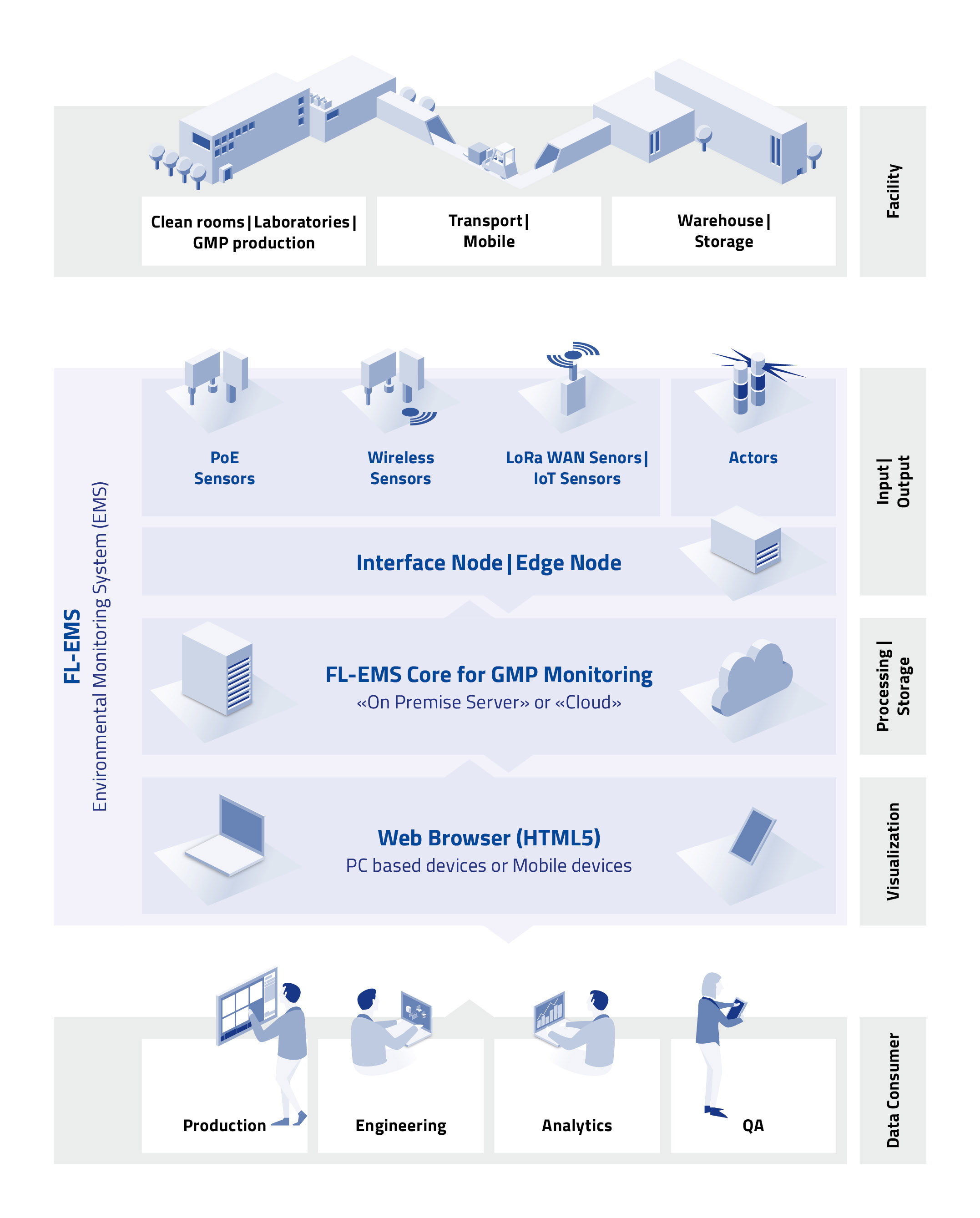
An example of this approach is the FL-EMS Environmental Monitoring System from RETEL Neuhausen AG.
With the Plug & Monitor concept, suitable monitoring applications are implemented using selected wireless and Ethernet sensors with reduced installation effort.
The sensors used also enable the temporary local storage of measured values in the event of temporary communication problems.
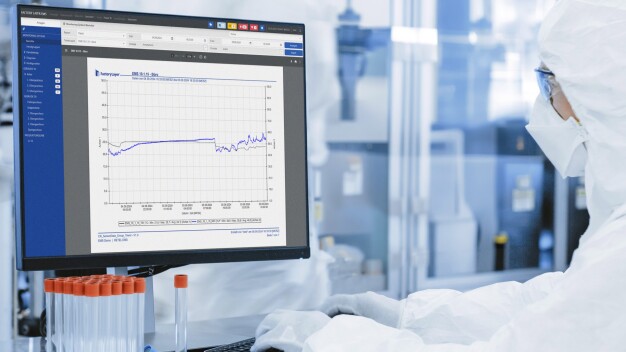
The measured values are read into the central FL-EMS platform. This offers functions such as long-term data storage, limit value monitoring, alarm management, audit trail, visualisation and reporting.
Thanks to its modular system architecture, the solution can be adapted to different application sizes and requirements. If requirements become more extensive, additional measured variables, interfaces or more comprehensive monitoring functions can be integrated.
The approach therefore combines the simple implementation of standardised monitoring tasks with the ability to map more complex GMP applications within a shared system environment.
System architecture of FL-EMS
Conclusion: as simple as possible, as comprehensive as necessary
Monitoring critical environmental parameters does not necessarily have to involve complex installations.
Modern wireless and Ethernet sensors enable an economical and flexible implementation, particularly for smaller applications and the retrofitting of existing facilities.
The decisive factor is integration into a suitable monitoring system that, in addition to recording measured values, provides the necessary functions for alarm management, data integrity and documentation.
Temporary local storage of measured values helps prevent data loss in the event of communication interruptions.
Plug & Monitor therefore represents an approach that simplifies technical implementation while leaving the requirements for reliable and qualified GMP operation unchanged.

RETEL Neuhausen AG
Rundbuckstrasse 6
8212 Neuhausen
Switzerland
Phone: +41 52 5339630
email: wanner.walter@retel.ch
Internet: http://www.retel.ch