




- Cleaning | procedures, devices, agents, media (Wipers, Swaps,...)
- Translated with AI
Forty years were planned. Then came the thorough cleaning
How pad and brush determine the lifespan of PU coatings
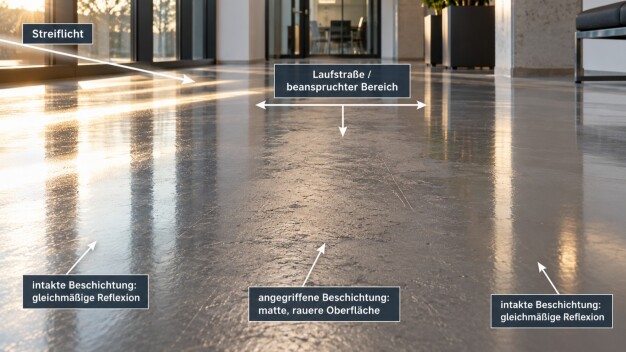
In the spotlight of a flashlight, a PU coating shows where it still shines and where it no longer does. (© G+C Facility GmbH)

Ewgeni Jussufov

Ewgeni Jussufov
A PU floor is built to last for decades, its top layer often for significantly less. How long it lasts depends heavily on the basic cleaning. If the wrong pad is used during cleaning, it will roughen the surface that is supposed to stay clean. A flashlight test shows whether this has already happened.
The basic cleaning is on Friday, and by Monday the floor is uniformly matte. Only in the corners and under the cabinets does it still shine, exactly where the machine couldn't reach.
This is typically what it looks like when a too-hard pad has been run over a sealant. No dirt is visible, and even the next wipe won't change that. It becomes most apparent in oblique light when the light falls flat across the floor.
Two numbers from a table
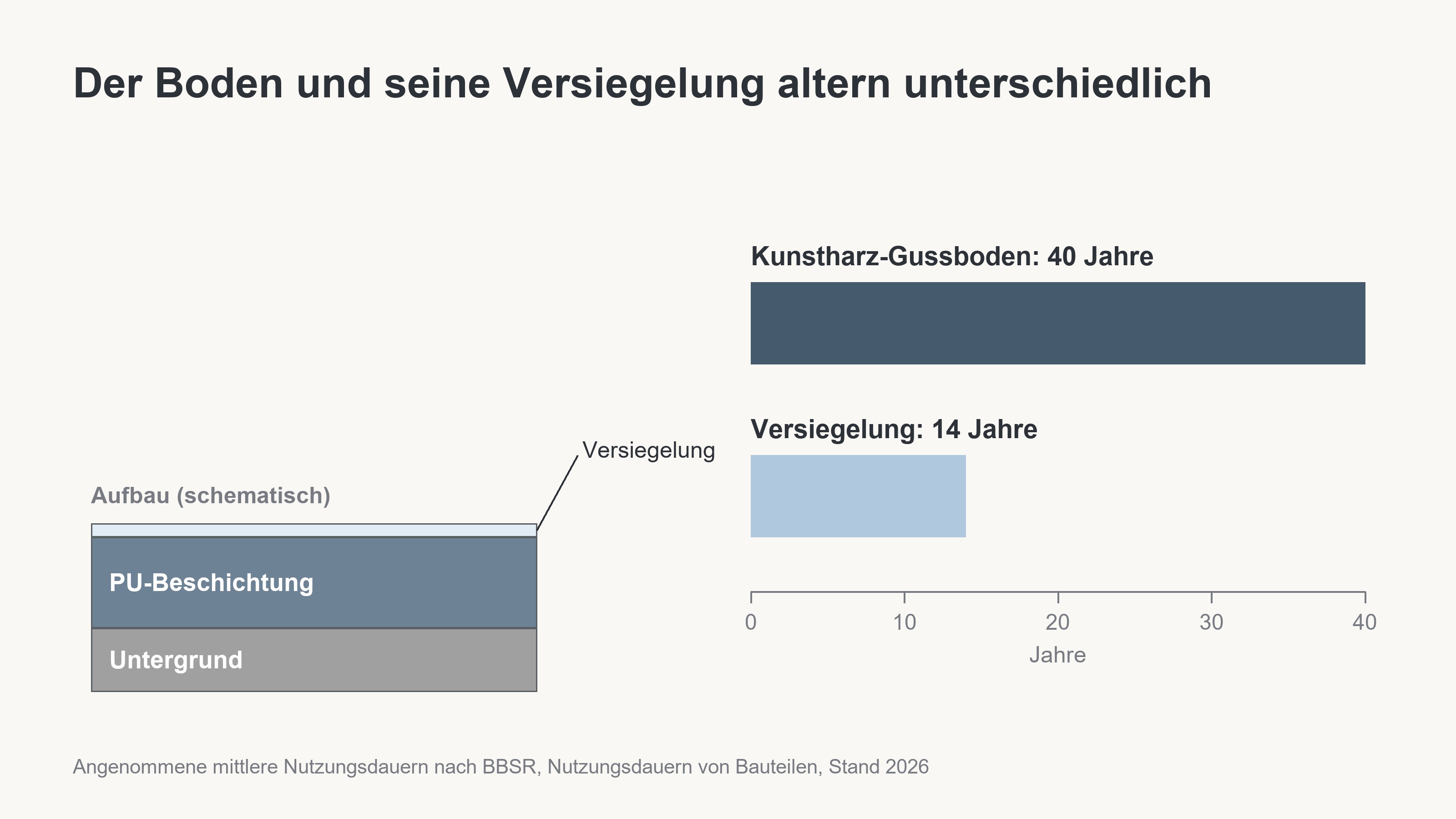
The Federal Institute for Building, Urban and Spatial Research (BBSR) lists the service life of building components in its table, with floors and their surfaces in separate rows. It estimates a resin-bound floor, including PU and epoxy systems, at 40 years, and sealants as surface treatments generally at 14 years (as of 2026). Many PU floors have such a thin sealant as the top layer.
If only the sealant is worn out, it can be renewed. If the coating underneath is also compromised, renovation begins: block off the area, recoat, let cure, recheck the room, and release it. Production waits as long as necessary.
Why a rough spot becomes expensive
For the production of sterile pharmaceuticals, Annex 1 of the EU-GMP guideline (2022) requires open surfaces to be smooth, impermeable, and undamaged so that as few particles and microorganisms as possible are released or accumulated. 'Smooth' has little to do with a rough spot.
In everyday use, it first shows during wiping. The mop leaves streaks as it dries, and the mop itself runs heavy, leaving fibers behind on rough areas. In a cleanroom, each of these fibers is a particle that wasn't there before. Dirt settles in the indentations, and manufacturer instructions for reactive resin floors describe that old, ingrained contaminants can additionally roughen the surface. To remove the dirt, more force or a harder pad is needed.
From then on, cleaning works against the floor. Each pass intended to clean the rough spot can make it slightly rougher.
The pad makes the difference
Cleaning works through four factors summarized by the Sinners' circle: chemistry, mechanics, temperature, and time. They can substitute for each other. However, mechanics is the factor that directly abrades the surface.
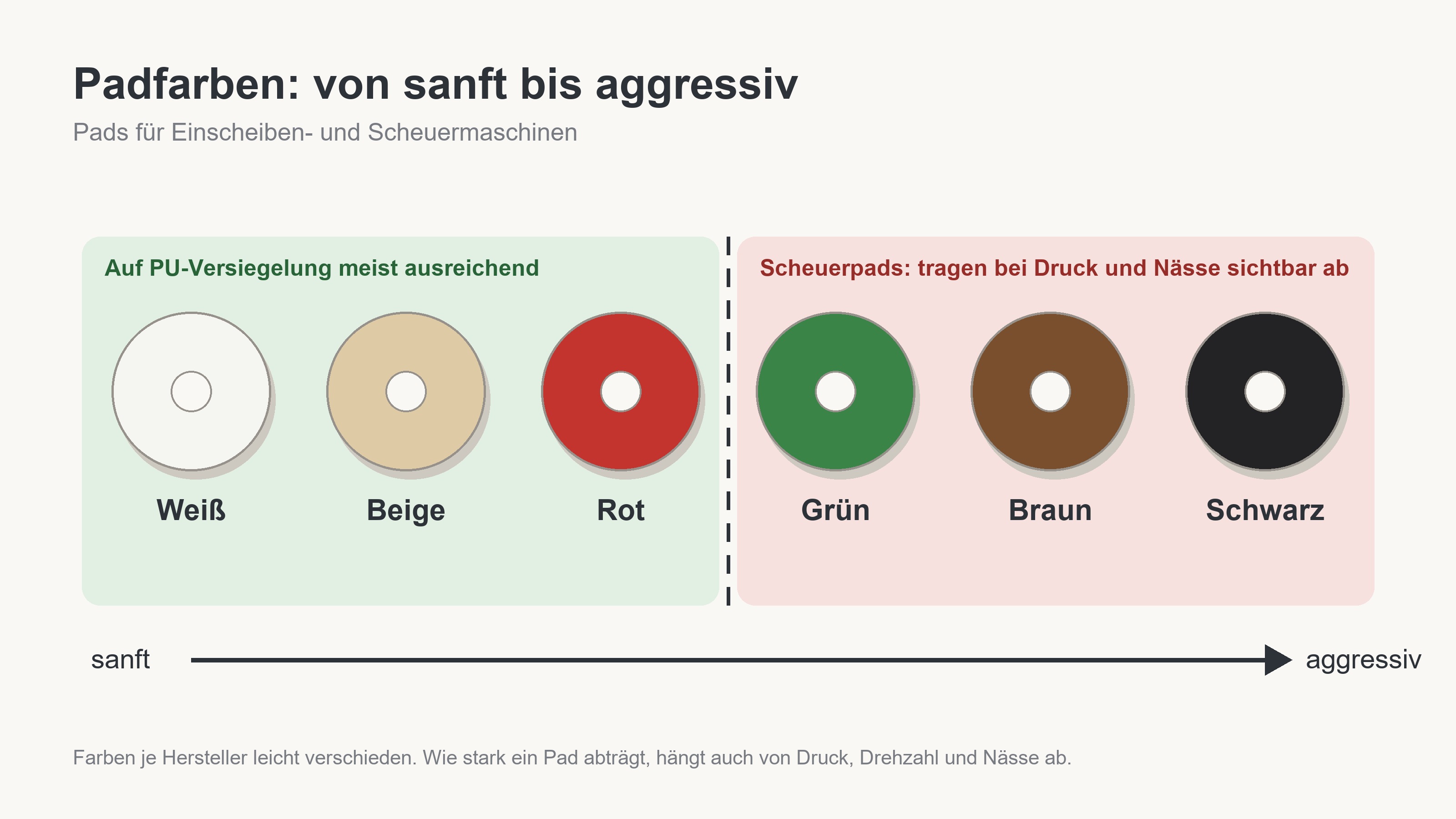
In cleanrooms, wiping is usually performed during ongoing cleaning. When a machine and pad are used for thorough cleaning, the pad color determines the aggressiveness. The colors range from gentle to aggressive: white, beige, red, green, brown, and black, slightly varying by manufacturer. Green and darker are scouring pads. On a sealant, they visibly abrade under pressure and moisture; beige or red usually suffice. The material removed by the pad then becomes particles in the room.
Manufacturer instructions for brushes recommend soft to medium-hard types because hard fibers slide over elevations and leave dirt in the indentations. This does not make the floor cleaner, only older.
Additionally, chemistry plays a role, as the cleanroom is regularly disinfected. Manufacturer instructions for reactive resin coatings warn that disinfectants and bleaching agents with chlorine, peroxide, or sodium hypochlorite can bleach the color and cause microcracks, which is typical for these floors. A spore-killing agent, which also kills spores, usually cannot be omitted. Therefore, the coating must match the disinfection plan, best clarified with the manufacturer.
The flashlight test
Hold a flashlight just above the floor so that the light falls almost horizontally across the surface. An intact surface reflects evenly. Rough spots appear matte and often slightly different in color.
The key is where the matte appears. A matte strip on walkways and where carts brake or turn results from walking and driving. If the entire surface is matte and only the corners still shine, it was the machine. The corners are reliable indicators. No one was there, not even a machine.
Repeating the test at the same spots after each basic cleaning allows you to see changes before someone else notices them during an inspection.
When the sealant is worn out
A matte surface is not yet a reason for a new floor. As long as the coating underneath is intact, it will be cleaned, lightly sanded, and re-sealed. A specialist company with the system manufacturer's material handles this. Afterwards, the room is rechecked and released, with a measurement of the electrical conductivity for dissipative floors.
During the next basic cleaning, a different pad is used on the machine. Otherwise, wear begins anew, this time on a fresh sealant.
Practical tip: The pad type should be specified in the cleaning instructions and in the order to the external company: beige or red, nothing from green. Before starting, it's worth checking under the machine to see if it matches what's written on the paper. It takes ten seconds and costs no sealant.
Forty years are possible
The matte surface with shiny corners rarely develops in a single Friday. It accumulates over several basic cleanings, each with the same pad, because the instructions didn't specify otherwise. The pad's role is clarified with a line in the cleaning instructions. The remaining forty years, as estimated by the BBSR, the floor manages on its own.
The next step: check the cleaning instructions to see which pad is specified for this floor.
About the author:
Evgeni Jussufov is a master building cleaner. He runs G+C Facility GmbH in Berlin, a master company specializing in office cleaning, maintenance cleaning, and building cleaning, including the cleaning of coated floors in clinics, daycares, and offices. www.gc-facility.de
G+C Facility GmbH
14193 Berlin
Germany