
- Translated with AI
Who is afraid of 4.0 in tool and mold making?
VDWF-VDMA User Forum in Schmalkalden
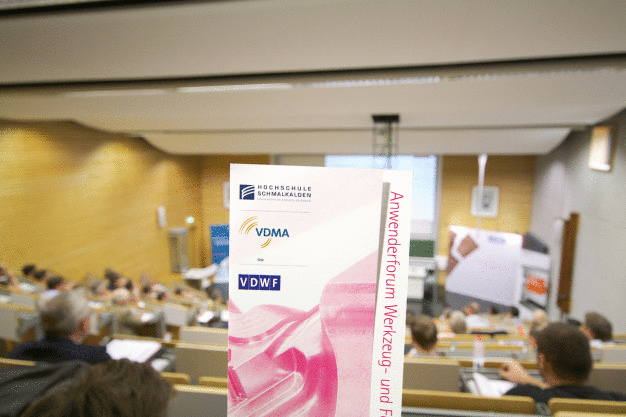
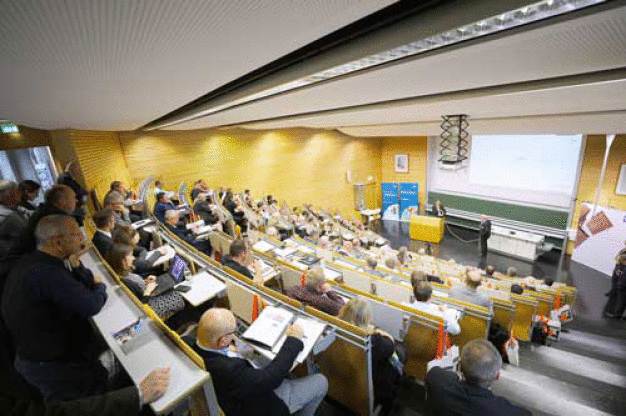
These are burning questions that entrepreneurs in tool and mold making face when tackling Industry 4.0: How do I implement digitalization and standardization of processes in my company? What special aspects must I consider during implementation? And how do I ignite enthusiasm for the opportunity for change among my employees so I can take them along on the journey into the future? With their joint user forum, the German Association of Tool and Mold Makers (VDWF) and the German Association of Machinery and Plant Engineering East (VDMA East), in cooperation with Schmalkalden University of Applied Sciences (Applied Plastics Engineering), have found the right format to find answers to all these questions. After successful events over the past four years, the three organizers invited on September 12th to the 5th edition of the forum for tool and mold making. More than 130 participants from all parts of Germany gathered at Schmalkalden University of Applied Sciences. A high-caliber discussion developed around the topic of Industry 4.0.
"After five years, you can already call the user forum a tradition," said VDWF President Professor Thomas Seul at the opening of the event. VDWF and VDMA share responsibility for organizing in alternating years with the common goal of providing impulses for the future-proof development of tool and mold making in Germany.
Seul, Vice Rector for Research and Transfer at Schmalkalden University of Applied Sciences, opened the discussion: "Smart technologies are driving decision-makers in our industry to a high degree." The challenge is to achieve both flexibility and compliance in manufacturing at the same time. "When tasks previously performed by humans are digitally and automatically handled, it is not about saving resources, but about deploying employees' capacities more effectively," said Seul, who also critically noted: "If we no longer produce, we don't need to switch to Industry 4.0! Higher costs in global comparison must be offset by higher productivity." The good integration of humans and technology is a fundamental prerequisite for this. "German industry must remain world leaders in production, but companies must also make use of the latest technologies." Only then can tool and mold makers in Germany stay exactly where they are now – at the top globally," Seul summarized.
Seeing the forest with all its trees
Seul received support for his thesis from Udo Staps. The Managing Director of FKT Formenbau und Kunststofftechnik from Triptis, who is a board member of VDMA East and VDMA Toolmaking, explained in his keynote: "The future starts now! And only those who recognize upheavals early and tackle them decisively ultimately have a future." Taking certain risks, daring to try something new, are necessary virtues in entrepreneurship for Staps. "One should not ask whether one is taking a new path – rather, one should ask whether one has to go it alone or if there are allies and cooperation partners with whom the challenge is easier to master," said Staps. A new culture of innovation is needed. "In line with the motto: Together we are strong!"
For smaller companies, the path to digitalization is difficult. The challenge is akin to searching for the forest that one cannot see because of all the trees. Many toolmakers see no way to carry out change while running their daily business. "An important step here is to exchange experiences with each other based on best-practice examples," advised Thomas Seul. "It helps to see that success stories exist. Even small measures can have a big impact." Because Industry 4.0 in toolmaking does not only exist on strategy papers but is already being practiced by many companies. Udo Staps goes a step further. For him, "the biggest mistake" would be not to deal with Industry 4.0 – and this applies especially to smaller companies. Change occurs step by step but at high speed. Products, services, and technologies must be continuously developed: "The qualification of our employees is essential so they can meet the increasing demands of the working world 4.0."
Future tasks in tool and mold making in focus of the lectures
The 5th user forum was characterized by eight highly interesting technical presentations, which addressed both technical and management topics. Focus areas included innovations in injection molding and toolmaking, but also creative measures for securing skilled labor. The stimulating discussions after the lectures, the exchange among participants during breaks, and conversations at the exhibition in the foyer of the university with staff from the Laboratory for Applied Plastics Engineering at Schmalkalden University or with company representatives were just as important parts of the event as the contributions themselves.
And so, Thomas Seul also drew an enthusiastic conclusion: "The user forum, packed with valuable information, was not only the perfect opportunity to gather impulses for one's own company but also to network with industry players that one had not known before." The most beautiful indication of the event's relevance was, however, the fact that the lectures in the evening were just as well attended as those in the morning..."
The speakers:
Jens Lüdke, Tebis, Göppingen, Intelligent Technologies in the "Digital Factory":
"In Toolmaking 4.0, there are no templates, no models that can be imposed on companies. Solutions must always be planned specifically for each enterprise. A clear goal and the integration of people are the basis for this. Without a strategy, nothing works here. Because as long as the benefits of Industry 4.0 are not recognized, it is very difficult to even deal with this topic."
Stephan Berz, HRSflow, Frankfurt am Main, Quality Improvement through Servo Drive in Hot Runner Technology:
"The needle valve technology with servo drive enables precise, reproducible injection molding processes. The screw's task is limited to delivering material consistently – especially in family molds. The injection profile, i.e., the time-controlled injection volume at a defined point in time, is then regulated separately at each nozzle. This allows the process parameters to be precisely adjusted for an optimized surface and less warping in the part, or the clamping force of a tool can be reduced. Family molds with a dedicated servo needle valve per cavity can also be efficiently realized."
Dr. Uwe Hilpert, Wenzel Group, Wiesthal, Rapid Prototyping of Plastic Injection Parts with CT:
"Computed tomography as a measurement technique is well suited for additive manufacturing because it can image both the interior and exterior of a component equally well. As a relatively new manufacturing process, there are still no standardized test specimens or testing procedures for the quantitative and reproducible evaluation of different methods. However, combining CT with additive manufacturing can still lead to new and fast process chains."
Marco Reichle, Reichle, Bissingen, Laser Texturing – 100 Percent Reproducible with High Precision and Short Processing Times:
"A paradigm shift is underway: I call on everyone involved in the planning and implementation of a plastic part to move away from what has been done on tool surfaces in recent decades, away from manual work. To achieve quality standardization, digital laser processes are indispensable. Only then can multiple identical parts produced at different times be truly identical. This approach is not only more efficient but also offers better quality and economic benefits; it is the foundation for Toolmaking 4.0!"
Georg Paulus, Traumfirma, Holzkirchen, The Path to a Secure Future as a Toolmaker:
"We cannot predict the development of the global economy and the toolmaking industry. But we can prepare ourselves with enthusiastic employees. Employees and managers therefore need not only technical skills but also social and emotional competence on the way into Industry 4.0. Because only when interpersonal relationships are right does everything else almost fall into place! The opportunity lies in the collective strength of our employees."
Ulf Herfurth, Unternehmenskontor for Germany, Dresden, Succession Planning: Process, Purchase Price, and Key Disputes:
"Succession planning is a private and often very complex task. Few entrepreneurs master the handover. Emotions often run high, and decisions are made less rationally. The valuation depends on the earnings situation – the passion that a predecessor has invested in the business does not count. However, your gut feeling often tells senior managers something different. The process can take up to 2 years externally or up to 10 years within families. Many underestimate this."
Roland Emig, Samag Saalfelder Maschinenbau, Products and Processes for Industry 4.0:
"There are no classic machine concepts in the sense of 'The workpiece is clamped into the corresponding setup machine!' anymore, but instead, workstations incorporate identification and processing tasks within the material flow and are operated by flexible robots with interchangeable tools, working together with universal and flexibly positionable workpiece holders, or supplemented additively."
Thorsten Müller-Schmetz, Contura MTC, Menden, Contour-Following Temperature Control as a Basis for Efficient, Variotherm Process Management:
"Tool temperature control today is a product that, like a hot runner system, should be designed and installed by specialists. Collaboration with experts guarantees access to the latest technology and allows direct benefit from ongoing developments."
Verband Deutscher Werkzeug- und Formenbauer (VDWF)
88477 Schwendi
Germany