

- Translated with AI
Well equipped for the future: Modular laboratory information and management system integrates all workflows and is customizable
Digitalization and Automation in the Food Sector
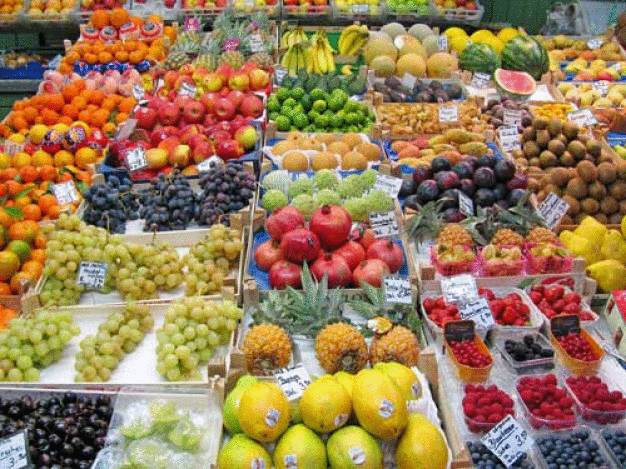
According to a report from the GIT Laboratory Portal, approximately 1,800 new food products are introduced to the market each year. The production and sale of these products – ranging from raw goods like fruits and vegetables to meat and processed foods like dairy products – are subject to strict national and international regulations, whose compliance must be regularly tested by independent testing laboratories. (Source: Thommy Weiss / pixelio.de)
The production and sale of food of all kinds – from raw commodities like fruits and vegetables, meat, through processed foods to dairy products – are subject to strict national and international regulations. In addition, retail food merchants also define specific quality criteria that are regularly checked. Accordingly, the responsible testing laboratories must consider not only the generally applicable standards but also the requirements of the trading chains during analysis and tailor their test reports accordingly. Even when using a standard Laboratory Information and Management System (LIMS), these tasks are only manageable with considerable effort, as most systems are designed very statically and can only be adapted to lab-specific processes by the software manufacturer itself. Therefore, the Upper Palatinate-based Friedle GmbH laboratory sought a more flexible solution. A needs-based software is offered by INTEGRIS LIMS GmbH: The company developed a modular, comprehensive system (ERP for laboratories) that can be easily pre-configured and also meets the requirements of trading chains. If necessary, all workflows from CRM through sample management to invoicing can be mapped without additional interfaces.
According to a report from the GIT Laboratory Portal, approximately 1,800 new food products are introduced to the market each year. Not only the trading chains but also the responsible testing laboratories, which regularly check the quality of products, must therefore respond more flexibly to market demands. "Here, the standards set by the EU or national authorities represent only one side of the challenge. For example, we managed to solve this through online connection to the EU pesticide database," explains Bernd Koschitzki, Managing Director of INTEGRIS LIMS GmbH. "The requirements of food retail chains also play a significant role: each company sets its own conditions for food quality and limits for ingredient levels. Additionally, test reports must be prepared according to the specifications of the trading chains and customers." This includes not only specific formatting requirements but also the use of proprietary formulations. Furthermore, interfaces are increasingly demanded to enable quick and secure data transfer from trading chains to the laboratory.
Also, the Friedle GmbH laboratory, which conducts food analyses for various retailers, previously worked with a conventional LIMS. "In recent years, it became increasingly difficult for us to meet the requirements of the trading chains with our system," explains Albrecht Friedle, Managing Director of Friedle GmbH. Changes to the system could only be made by the old LIMS provider. "Fundamentally new settings were often associated with additional costs," Friedle continues. "Therefore, we decided to acquire a more flexible alternative."
System easily adaptable to internal requirements
A major challenge in searching for a new LIMS was that many software developers tend to develop very static systems and rarely address changing requirements. After extensive research, Friedle Laboratory found INTEGRIS LIMS at analytica in Munich: there, the iLIMS software was presented. The special feature of this development is mainly its modular approach, allowing the software to be customized like a building block system to meet the company's specific needs. It was particularly important to the software engineers that many internal processes—often carried out with different programs, so-called island solutions—could now be integrated into a single system without the need for additional interfaces. These include, among others, Customer Relationship Management (CRM), procurement, financial accounting, inventory and material management, as well as project and quality management.
Initially, Friedle decided to use iLIMS solely as a laboratory system and for invoicing; automation of the laboratory and subsequent expansion of additional functions was planned gradually over the following years. To ensure the software meets all customer-specific requirements from the start of operation, the responsible project manager from INTEGRIS LIMS first held detailed discussions with employees from various departments at Friedle Laboratory. Since most of the software provider's staff have years of experience working in laboratories themselves, they are very familiar with the requirements different personnel groups impose on a LIMS. "Many developers of laboratory software are almost exclusively IT specialists and programmers. This can lead to misunderstandings or miscommunications between developers and scientists in the labs," reports project manager Kathleen Knöschke. In contrast, all project managers at INTEGRIS LIMS have both a scientific background and a strong technical understanding. Knöschke, for example, is an ecotrophologist and a specialist chemist for analytics and spectroscopy, familiar with processes in food laboratories from personal experience. This allowed the project planning to already identify which requirements the LIMS needed to fulfill from the lab's perspective—and whether and how these could be technically implemented.
Changes possible without programming knowledge
After INTEGRIS LIMS clarified all technical details with the Friedle laboratory team, the software provider assembled the suitable package. With iLIMS, the analysis laboratory can now quickly and easily meet the requirements of trading chains. "Interfaces are provided to simplify data transfer from the client to the laboratory. Additionally, planned orders from trading chains or customer-specific file formats can be imported quickly and securely at any time," explains Knöschke. "Various steps of sample preparation and result evaluation can also be accelerated. For example, limits from the EU pesticide database are automatically updated, or the limits stored for products are assigned accordingly. Each step can always be traced."
Furthermore, sample registration and documentation via RFID, barcode, or QR code are possible, significantly reducing the likelihood of errors—such as sample mix-ups. Once the content analysis results are available, test reports can be automatically generated in a customer-specific layout and sent via email, fax, or mail according to predefined rules to recipients such as customers, trading chains, or authorities. "To make simple adjustments—such as to test reports or the layout of forms—no programming knowledge is required. If the customer has an in-house IT department, custom functions can also be created using an integrated scripting language," explains Koschitzki. "We also conduct reporting training," he adds. "This means that Friedle employees can implement changes themselves—such as layout adjustments or data entries—without the help of our software specialists."
Training and comprehensive customer support as needed
INTEGRIS LIMS has also developed a solution for another challenge: "Apart from the standard languages—our LIMS is currently available in German and English—different laboratories use different terminology," explains Koschitzki. For example, the terms 'sample material' and 'matrix' refer to the same thing; however, laboratories and companies often prefer only one expression. "To ensure that test reports are written with a uniform vocabulary, we integrated the 'Laboratory Language' functions and a corresponding dictionary: here, users can store the technical terms for colloquial expressions. Certain terms are then automatically replaced in forms, tables, and reports depending on the language setting," Koschitzki continues.
To ensure lab staff have the necessary know-how for making required system changes, INTEGRIS LIMS conducts training sessions on software operation. If needed, the company also offers comprehensive after-sales service and can respond quickly and personally to customer inquiries. The designated project manager acts as a direct contact, familiar with the specifics of the installed system and able to provide timely assistance. "The new system has been in use since February. Our staff are managing the LIMS very well. The personal support for questions also works smoothly," reports Friedle. The Friedle laboratory expressed high satisfaction with the project's progress and the software's flexibility. To keep pace with ongoing automation in the laboratory sector, both companies will continue to work closely in the future. They will gradually optimize laboratory workflows so that Friedle Laboratory can respond quickly and flexibly to changing requirements.
Labor Friedle GmbH
93105 Tegernheim
Germany