



- Standards
- Translated with AI

Norbert Otto
VDI 2083 Part 3:2020-02 - Draft versus DIN EN ISO 14644-3:2020-08
Technical article on cleanroom measurement technology

Logos_16x9
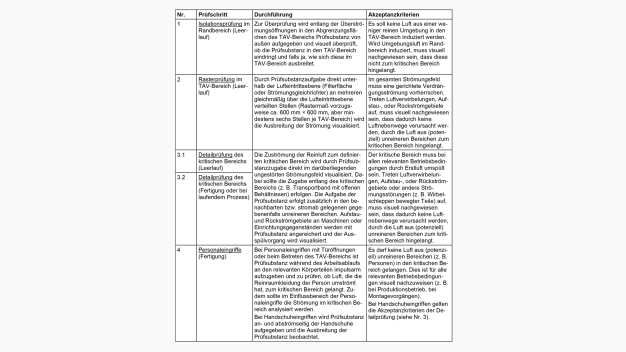
Table 1
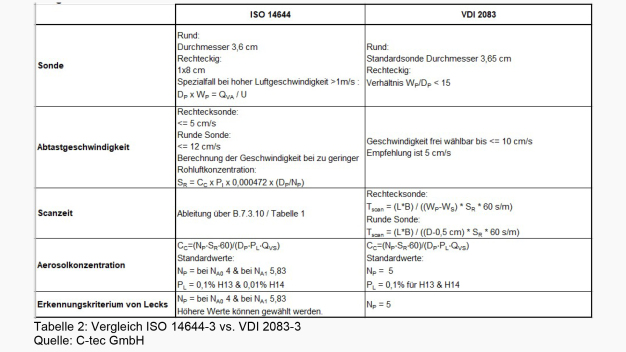
Table 2
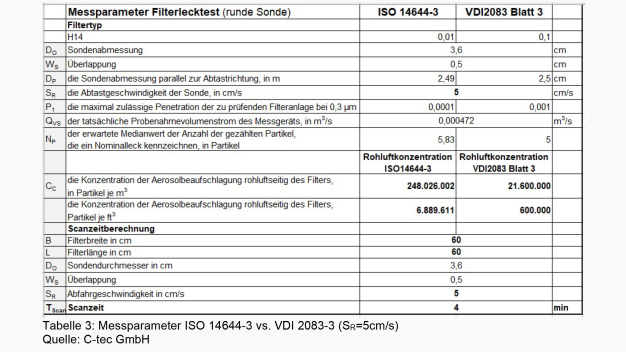
Table 3
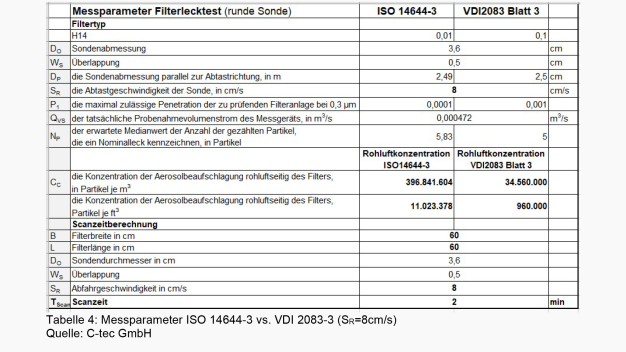
Table 4
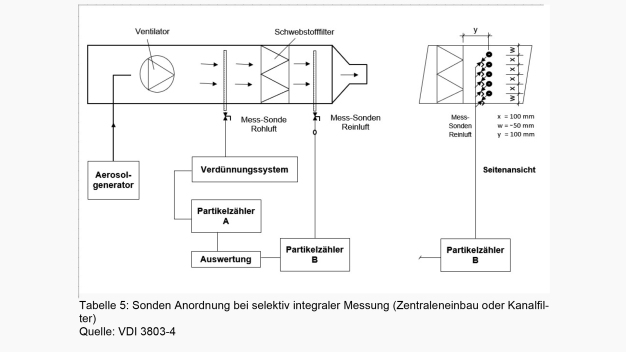
Table 5
VDI 2083 Part 3:2020-02 - Draft
Cleanroom Technology - Measurement Technology
versus
DIN EN ISO 14644-3:2020-08
Cleanrooms and associated controlled environments - Part 3: Test methods (ISO 14644-3:2019, corrected version 2020-06); German version EN ISO 14644-3:2019
Summary
The standards and guidelines VDI 2083-3:2020 & ISO 14644-3:2020-08 are well known as regulatory frameworks for the measurement verification of cleanrooms, for example in the context of qualification and requalification by professionals.
ISO 14644-3 was first revised by the international committee until 2019, followed by the VDI 2083-3 guideline by the national committee.
Introduction
Typically, 6-10 nations participate in the ISO committee meetings. A compromise must be reached among these nations regarding amendments, extensions, etc., until the final text— and this must be unanimous!
In addition, there is currently immense time pressure, making an almost unavoidable error rate likely.
In all sections, or their annexes, more or less significant changes & corrections to previous versions occurred.
A notable error appears in ISO 14644-3:2020-08 in section B.7.3, which describes procedures for leak testing of installed filter systems via continuous sampling using an LSAPC (particle counter), and is described separately.
The VDI guideline should be made more practical in this regard. Only the DACH countries with their respective appointed members are involved in this committee, and decisions are made jointly and unanimously.
Which changes are now relevant for cleanroom operators?
1) In section VDI 2083-3: paragraph 6.2.2
Measurements regarding the homogeneity of air velocity at work height are mentioned in the TAV area, which are not specified in ISO 14644-3.
Notes explain that the requirements at a nominal air velocity of 0.45 m/sec (+/-20%) of the airborne particle filter at a work height, typically 0.5 m - 2 m from the air outlet, are physically impossible to meet. It then refers to an alternative measurement method for directed airflow.
a. Briefly, section 6.7.5, which describes the essential testing steps, is mentioned in this context.
Table 1
b. Flow visualization using test fog or test substances is employed as a qualitative method to assess flow conditions in real installed systems. It aims, among other things, to convince auditors that flow conditions under all relevant operational conditions meet the required protection functions. Not only is the methodological approach new and clearly described, but also an extensive description of acceptance criteria for product protection requirements.
The possibilities of test substances, or the possibility of testing without the required test fog, have been expanded with the "Schlieren system." It is based on the deflection of light rays by refractive index gradients in transparent media. Variations in the refractive index can be caused by thermal currents or gas mixtures with different refractive indices. Thermal currents can thus be made visible without adding gas.
Another option is 3D velocity measurement with position and orientation detection. The flow field under investigation is continuously recorded with an anemometer in three directions (x, y, z) using a specialized camera system.
In section VDI 2083-3: paragraph 6.3.3
The leak test of the final filter via scanning (scantest) is described, as well as in the counterpart of ISO 14644-3: paragraph B.7.3, which describes procedures for leak testing of installed filter systems via continuous sampling using an LSAPC.
a. ISO 14644-3 paragraph: B.7.3 describes the filter leak test using a particle counter.
Another method for this measurement is the photometer, which is not used in the DACH countries due to the high test aerosol rate, and therefore is not mentioned in VDI 2083-3 either.
b. Returning to the error rate mentioned in the introduction, paragraph B.7.2.4 "Acceptance criteria" is briefly described:
"The acceptance criterion for filter systems with an overall efficiency of MPPS ≥ 99.95% and less than 99.995% is 0.1%"
This sentence appeared in one of the many previous versions until the official FDIS (draft) and should have been correctly changed to MPPS ≥ 99.95% and ≤ 99.997% before the norm was approved. The fact now is that the H14 filter falls outside the leak rate with 0.1% and falls into the same acceptance criterion as ULPA filters.
On the one hand, the mathematical symbol: ≥ (greater than or equal to) at the beginning of the acceptance criterion is correct. At the end of the acceptance criterion, referring to "less than" is incorrect. The correct symbol should be: ≤ (less than or equal to)!
c. Both during sampling and leak detection, a statistical calculation formula is used in ISO 14644-3. A detection value (NP) is specified in VDI 2083-3. In this context, the significantly higher test aerosol concentration in the ISO framework should be mentioned, which I would like to illustrate with two examples with different scan speeds:
Table 2: Comparison ISO 14644-3 vs. VDI 2083-3, Source: C-tec GmbH
Table 3: Measurement parameters ISO 14644-3 vs. VDI 2083-3 (SR=5cm/s), Source: C-tec GmbH
Table 4: Measurement parameters ISO 14644-3 vs. VDI 2083-3 (SR=8cm/s), Source: C-tec GmbH
d. A new aspect is that the raw air concentration in both guidelines is now only +/- 15%, making the parallel measurement of raw and clean air concentration essential. This makes sense especially with large air volumes and central test aerosol tasks at different room pressures, etc. Whether this method is also suitable for filter leak testing of safety cabinets should at least be agreed upon in writing between the client and contractor.
e. The literature references include VDI 3803-4:2021-09 draft (final draft), which should not be missing in connection with the filter leak test. Section 8.3.5 describes "Sealing test and filter leak test using in-situ scan method" for airborne particle filters in the installed ventilation system. Section 8.3.6 discusses an "Integral measurement (integrity test)," and section 8.3.7 describes a "Selective integral measurement," which means a selective integrity test of the airborne particle filter with the same parameters as in VDI 2083-3.
Drawings for installing measurement probes at the respective distances are also very practical—see example in the references.
Table 5: Probe arrangement for selective integral measurement (central installation or duct filter), Source: VDI 3803-4
Conclusion
ISO 14644-3 is mathematically correct in section B 7.3.3. In application, it is very complex and, in my opinion, not very practical, especially considering the high number of particles in the test aerosol task—which is not desirable in a cleanroom environment.
VDI 2083-3 is very practical and easy to understand. All contributors to this version come from practical experience.
In this context, I would like to sincerely thank all the staff for their time, the high financial effort, and their commitment as the chairman of the guideline.
References:
VDI 2083-3: 2021-08 draft
VDI 3803-4: 2021-09 draft
DIN EN ISO 14644-3: 2020-08
DIN EN ISO 29463-4: 2019-4
Annex 1: 2020-02 draft
FDA, Guidance for Industry – Sterile Drug Products Produced by Aseptic Processing – Current Good Manufacturing Practice (cGMP), September 2004
______________________________________
The author
Norbert Otto has been active in plant engineering for over thirty years, specializing in cleanroom and compressed air technology for qualification measurements, and is involved in associations (un. gen.):
SwissCCS Board Member (formerly President)
Chairman of VDI 2083-3
Contributor to VDI 3803-4
German delegate for DIN EN ISO 14644-3
Delegate for FARRT (Cleanroom Technology Committee)
Member of ISPE

C-tec
Cleanroom-Technology GmbH
Tübinger Straße 47
72127 Kusterdingen
Germany
Phone: +49 7071 6887180
Fax: +49 7071 688718700
email: norbert.otto@c-tec.de
Internet: http://www.c-tec.de