
- Disinfection | procedures, devices, agents, media (Wipers, Swaps,...)
- Translated with AI
Dipl. Ing. (FH) Margarete Witt-Mäckel
Validation of manual processes in cleanroom cleaning
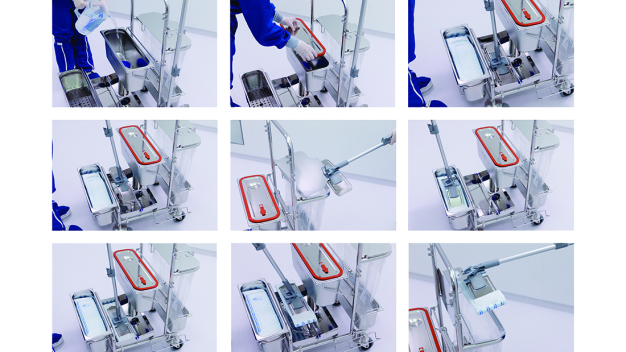
Figure 1: Self-explanatory workflow prevents incorrect operation
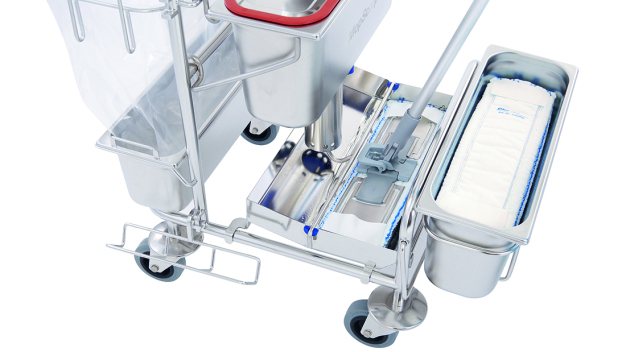
Figure 2: Impregnation of a wiping cover with a predefined amount of active ingredient solution.
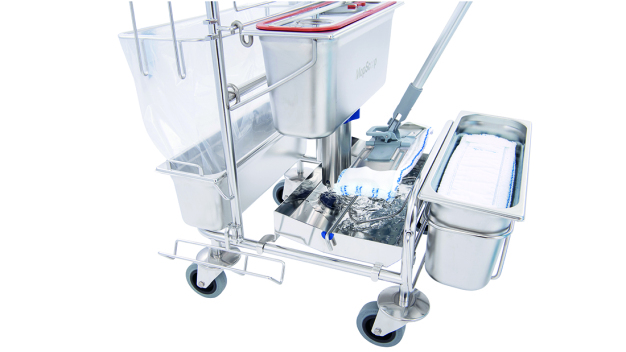
Figure 3: Automatic provision of the active ingredient solution for the next wiping process prevents incorrect operation.
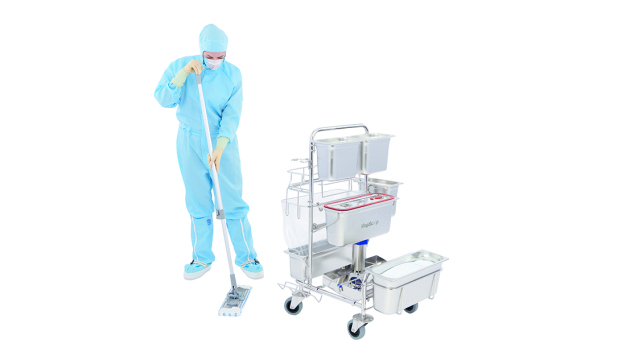
Figure 4: Validatable processes despite manual execution. Trained users and suitable operating resources make it possible.
For all manual processes – including the manual implementation of wiping procedures for larger surfaces – the question remains whether a process performed by humans can be reproduced and thus validated.
Validation refers to providing documented evidence that a process or system consistently meets the previously defined requirements, i.e., always producing the same result in practical use.
Even if the execution of a task varies from employee to employee, manual wiping procedures can be validated if certain prerequisites are met. The principle is: the lower the risk of incorrect application of the procedure, the more reproducible and reliable it becomes when performed by users.
Goal: Simple and reliable implementation free of user errors
To achieve this goal, it is especially important to provide the user with a device that is easy to operate and logically and structurally organized within the workflow (Fig. 1). Based on this device, a standard operating procedure is developed. This work instruction is precisely specified for the described process and understandable for every employee working with this device, ensuring that the workflow is carried out reliably and consistently.
Example: Validation of a wiping disinfection process
Specification of requirements through the process
Before developing a standard operating procedure, the requirements for the process or the expected disinfection results must be defined. The goal of disinfection is to reduce unwanted microorganisms to a defined level so that the disinfected surface poses no threat to the product, the process, or human health. To achieve this, an adequate amount of active substances must be present on the surface to inactivate the unwanted microorganisms. This, in turn, means that for wiping disinfection, the wipe must absorb enough active substances and also release them in sufficient quantity back onto the surface. The aim is always to achieve even wetting of the surface. Fundamental parameters for successful wiping disinfection are thus:
– Amount of active solution absorbed by the wipe,
– Amount of active solution released by the wipe,
– Amount of active solution used to wet the surface, and
– Uniform and continuous distribution of active substances on the wetted surface.
If requirements for validation and reproducibility are added, these parameters must remain as consistent as possible for each wiping process. This can only be achieved with a dosing and transfer system that allows precise and uniform transfer of the wipe. To ensure validatable results, the system should be combined with a high-performance wipe whose liquid management is calculable.
Transfer and dosing system
The primary task of the dosing and transfer system is to provide a predefined amount of liquid for absorption by a wipe, enabling precise and reproducible saturation of the textile (Fig. 2 and Fig. 3). Besides ease of handling, other criteria must be considered to ensure the system is suitable for use in a cleanroom. These include, among others, good cleanability, chemical resistance against common cleaning and disinfecting agents, and minimal particle generation.
During the development phase of such a system, practical tests repeatedly verify the desired properties to ensure that the developed system achieves the defined goal. These test results support the later qualification of the equipment and the validation of the process.
Wipe
During disinfection, active substances are applied via the wipe onto contaminated surfaces to inactivate microbial cells. The task of the wipe is to consistently absorb the liquid supplied by the dosing and transfer system and to evenly release the active solution onto the surface to be disinfected.
Uneven application of active substances would result in inadequate disinfection, so thorough wetting with sufficient active substance is crucial. To achieve this, enough active solution must be absorbed by the wipe and transferred to the surface. Possible interactions between chemistry and textile, as well as liquid retention in the capillaries of the textile fibers, must be considered. The disinfection efficacy depends heavily on the wipe itself, but also on how it is prepared. This critical interplay of system components is therefore examined and tested during the development phase of the equipment.
Validation
To ensure process and performance safety in practical application, standard operating procedures are developed, and staff are trained accordingly. Once staff are qualified to apply the processes, the disinfection procedure can be validated. This is done through process-accompanying microbiological monitoring. After successful validation, the implementation of manual disinfection becomes part of microbiological hygiene monitoring.
Conclusion
A manual process can be validated if the variability of the "human" factor is addressed. The implementation of the process should be as self-explanatory, reliable, and free of user errors as possible. This requires a well-thought-out development of the work equipment necessary for application. The guiding principle is: the simpler the execution, the safer the implementation.

Pfennig Reinigungstechnik GmbH
Heubachstr. 1
87471 Durach
Germany
Phone: +49 831 561220
Fax: +49 831 61084
email: info@pfennig-reinigungstechnik.com
Internet: http://www.pfennig-reinigungstechnik.com