



- Furnishing & equipment
- Translated with AI
Two cleanroom productions, one shared logistics
Medical Innovation Center of Paul Hartmann AG
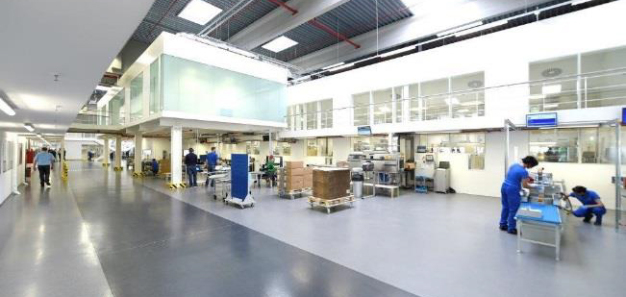
Provisioning zone for finished products for modern wound dressings.
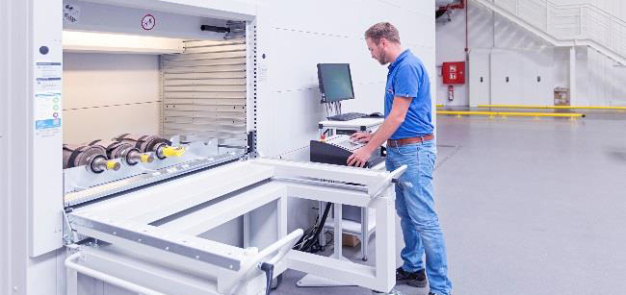
The Lean Lift is a storage and material buffer in one.
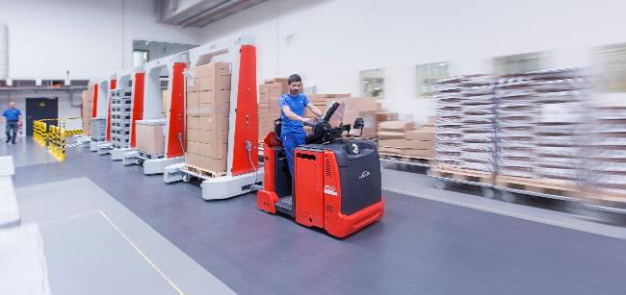
The shuttle train supplies the clean rooms with raw materials and semi-finished products every 20 minutes on the outbound journey and picks up finished goods on the return trip.
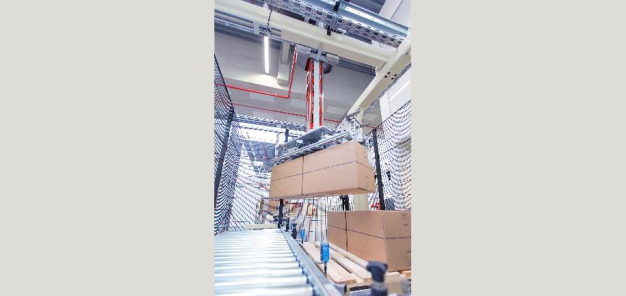
Provisioning zone for finished goods for customer-specific operating room sets. A packing robot takes over the stacking of pallets, which was previously done manually, and supports ergonomics at the workstation.
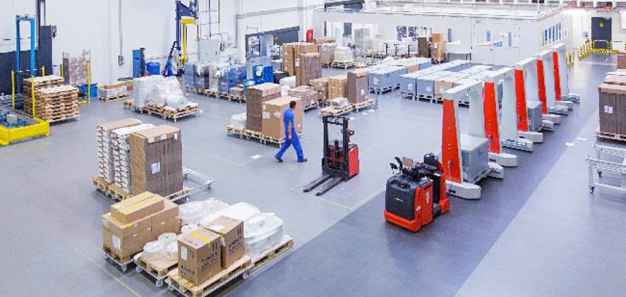
The "marketplace" serves as a buffer for raw materials for the next manufacturing orders as well as for finished goods on their way to sterilization and storage.
What began as a completely gutted factory hall for products for incontinence hygiene has since July 2014 become one of the most modern cleanroom manufacturing facilities for wound dressings and custom surgical sets at the headquarters of Paul Hartmann AG in Heidenheim. Two completely different manufacturing methods - the Make-to-stock principle for wound dressings and the Make-to-demand principle for custom surgical sets - are connected to a common logistics process. From the very beginning, the design of the Medical Innovation Center focused on establishing lean processes and engaging in dialogue with customers in the "Glass Manufacturing."
"We recycled an existing building, analyzed the production and material flow in detail, and designed it as simply as possible according to the principles of Lean Manufacturing. Accordingly, we planned the Medical Innovation Center consistently from the processes, from the inside out," explained Dr. Felix Fremerey, Chief Process Officer on the Board of Paul Hartmann AG. Connecting two completely independent manufacturing operations with a shared logistics system is an innovative approach in the production of medical devices.
The production of modern wound dressings and ointment compresses is carried out in a stock-based manufacturing process according to the Make-to-stock principle. With minimal changeover times, eleven different brands are produced in 280 configurations through a multi-stage process on four machines. This creates flexibility and minimizes inventory levels. Numerous quality assurance elements are integrated into the production process in the form of "Quality Gates," such as incoming goods inspection based on the Zero Defects principle, sensor-controlled control points, and seamless batch tracking from raw materials and pre-fabricates to finished products.
The manufacturing of custom surgical sets is based on customer demand and follows the Make-to-demand principle. From approximately 3,500 qualified component parts, the company produces around 2,500 different custom sets. To ensure smooth surgical procedures, not only the components of a set but also the appropriate packaging sequence are discussed with customers. This results in a clearly timed multi-stage production process.
A connecting element of these two manufacturing processes is a shuttle train that supplies the cleanrooms with raw materials and pre-fabricates every 20 minutes on the outbound trip and picks up finished goods on the return trip. A so-called marketplace serves as a buffer for raw materials for upcoming production orders as well as for finished goods on their way to sterilization and storage. Specially developed software manages the order-based supply of the shuttle train.
As a storage and material hub in one, the Lean Lift ensures the transportation of spare parts and product-specific tool modules into the cleanroom with this innovative approach, enabling a smooth workflow. In front of the cleanrooms are staging zones through which raw materials are fed in the required quantities and finished palletized goods are removed.
Through the "LEAN – CLEAN – GREEN" approach with a clear planning philosophy, the company pursues a clear goal: to enable simple, clean, and sustainable work in the Medical Innovation Center. For example, the company achieved a productivity increase of 70% in the area of surgical sets, and a 35% productivity increase in modern wound care. Through efficient and transparent workflows, it was possible to reduce throughput time by 25% and even cut the consumption of spare parts by 50%.
General Information about the Medical Innovation Center
At the Medical Innovation Center, around 260 employees produce approximately 93 million wound dressings and about 700,000 custom surgical sets annually. The hygiene concept is reflected in three areas: the Black Zone with marketplace and offices, the Gray Zone with staging areas and sluices for personnel and materials into the cleanroom, and the White Zone as the purest area, where manufacturing takes place under cleanroom conditions. The hygiene concept includes, among other things, a two-stage changing system for production staff and manufacturing in particle-free air. The air in the cleanrooms is completely exchanged 12 times per hour, i.e., every five minutes.
The Medical Innovation Center has created a direct spatial proximity between production, logistics, administrative, and development functions. A good working environment for employees is ensured through bright, efficient, and ergonomic room design. The transparent layout of the production hall, where all process steps are visible, demonstrates the company's efficient, hygienic, and clean working methods. Customers can also observe the manufacturing process up close: from a largely accurately reconstructed operating theater, which is part of the visitor concept and where training sessions are held, they gain insight into the production of custom surgical sets. Hartmann also uses the demonstration operating theater to engage in direct dialogue with customers to further optimize surgical workflows.
PAUL HARTMANN AG
89522 Heidenheim
Germany