
- Trade fair
- Translated with AI
Topics & Trends in Preview of COMPAMED 2021: Around 500 exhibitors are on their way back to normality in Düsseldorf
Pandemic consequences, supply bottlenecks, Medical Device Regulation, and a host of new developments create exciting topics on the agenda
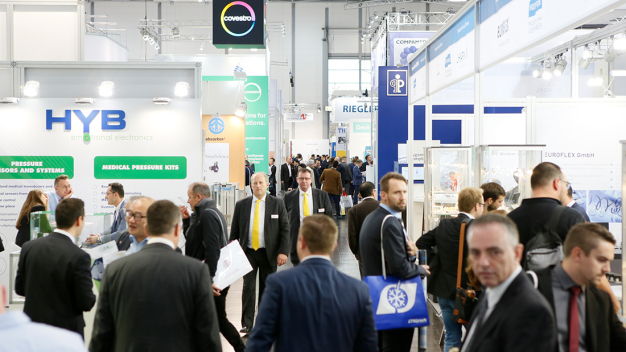
After COMPAMED, the international leading event for medical technology suppliers, was held digitally last year due to the pandemic, it will take place again in a face-to-face format from November 15 to 18, in close parallel to the world-leading MEDICA medical trade fair. Nearly 500 exhibitor registrations demonstrate the strong interest of medical technology suppliers to take a significant step towards normality. Following the hybrid event concept, key program components such as the COMPAMED HIGH-TECH FORUM by IVAM, with a special focus on microtechnology and nanotechnology, as well as the COMPAMED SUPPLIERS FORUM by Devicemed, covering the entire area of development and manufacturing in medical technology, will be offered with appropriate tickets both in person and online via livestream. Unlike previous years, this year's COMPAMED will be held in halls 13 and 14 (not in halls 8a and 8b).
Aside from the omnipresent COVID-19 pandemic, its consequences are also a topic of discussion: "Due to the impacts of the coronavirus crisis, supply bottlenecks have arisen: the suspension of flights and maritime transport has led - especially for electronic products - to major delivery shortages. During the crisis, these were also fueled by 'hoarding'. Companies have prudently purchased and stored more components than necessary - out of fear of supply gaps," explains Dr. Dietrich Thomas R. Dietrich, CEO of the IVAM Microtechnology Association. Raw materials and individual components have also become scarce because industry recovered faster than many suppliers initially expected. However, this will soon normalize again.
Computer chips became scarce during the crisis because medical technology manufacturers suddenly had a much higher demand. Dr. Meinrad Lugan, Chairman of the BVMed, recently contextualized the situation: it was not a quantity problem but a distribution issue in many areas. Lugan notes a "tendency towards massive over- and multiple orders." The resulting supply shortages should be addressed "with smart digital solutions based on existing e-standards." According to IVAM, internationalization of the economy remains sensible, as global supply chains cannot and should not be halted. European manufacturers need the possibilities of cheaper production in other countries to stay competitive. These countries, in turn, need European customers to keep their economies running. However, IVAM advocates for local supply chains for critical components—especially for sensitive products that are vital for basic supply to the general population, such as in healthcare.
A topic continues to cause significant upheaval
Another issue has also caused considerable unrest in the industry: Since May 26, 2021, the new European Medical Device Regulation (MDR) and the new In-Vitro Diagnostic Regulation (IVDR) have come into force. As the trade magazine Devicemed points out in a detailed overview article, companies are prepared but also under significant pressure. A survey by the software company Climedo Health shows that 81 percent of 115 companies across Europe still find the MDR very challenging. Major hurdles include increased resource and cost requirements, lack of clarity, and necessary clinical trials. 31 percent estimate that MDR will incur additional costs of five to ten percent of annual turnover; 13 percent believe it will be more than ten percent. Companies are also dissatisfied with Brussels on other points: 75 percent desire clearer directives from the EU Commission, 50 percent want more expert support, and 30 percent request training or informational events. "The survey results show that the EU MDR remains very challenging, costly, and time-consuming for companies," says Veronika Schweighart, member of the management board at Climedo Health. The IVDR also increases effort: in addition to new products, all existing, approved products must undergo re-certification according to the new regulation. Furthermore, the 'Notified Bodies' must undergo a new designation process, which is not yet completed. The IVDR also covers a broader scope than the previous directive and introduces higher and new requirements in many areas for companies and oversight bodies. This provides plenty of discussion material for exchange at COMPAMED 2021.
Medical Device Regulation – as difficult as cold fusion?
Therefore, the COMPAMED SUPPLIERS FORUM (in Hall 14) will revisit this topic in its lecture series. "Often, dealing with MDR or IVDR gives the impression that we are working on cold fusion or faster-than-light propulsion. The fundamentals are missing in all three topics. I can't say which will be solved first, but at least with MDR and IVDR, we can be more concrete. There have been many difficult points but also well-resolved issues – cumbersome guidance, which is almost a bad joke, and clever solutions," summarizes Stefan Bolleininger, CEO of the consulting firm be-on-quality. His presentation (on November 17) will show concrete examples from consulting practice and solution options for various problem scenarios. This includes handling non-harmonized standards or state-of-the-art issues.
Current developments along the entire process chain
Beyond that, the COMPAMED SUPPLIERS FORUM has much more to offer in terms of content. Current developments along the entire process chain will be presented practically: mechanical and electronic components are just as much in focus as innovative materials, manufacturing processes, all types of contract manufacturing, design and usability aspects, as well as quality assurance. Impulse lectures on new markets round off the diverse program. Other focus topics include additive manufacturing, electronics, and regulatory affairs.
For example, Dr. Benedikt Janny, Managing Director of USE-Ing., responsible for usability engineering and user research, will speak about human-centered development of medical devices, better known as 'Usability Engineering': This is not only a regulatory requirement for medical device approval but also offers manufacturers the opportunity to differentiate their products by early consideration of relevant user needs in the product development process and translating them into innovations. The keynote (on November 15) will address the regulatory requirements concerning usability engineering and explore ways to establish human-centered development processes and create real added value for product users through increased usability—aimed at user-centered innovations. The usability engineering process is closely linked with quality management and requirements engineering. Additionally, expert Janny will demonstrate the types of usage-related risks that exist and need to be analyzed during product development. Furthermore, it will be discussed which prototypes companies can generate easily to validate their medical devices early with real users.
Additive manufacturing for patient-specific implants
An exciting topic remains additive manufacturing and robotics in medical technology. Toolcraft AG sees itself as a pioneer in forward-looking technologies such as additive manufacturing and the construction of custom robotic cells. As a partner for complete solutions, the company offers the entire process chain from idea to manufacturing to qualified precision parts in additive manufacturing, machining, injection molding, electrical discharge machining, and mold making. In the field of robotics, tailored, fully programmed integration solutions are implemented. Daniel Distler and Patrick Meyer (heads of robotics and technical sales at Toolcraft) will draw on over 30 years of industry experience in their presentation (on November 15) at the COMPAMED SUPPLIERS FORUM, discussing the advantages of additive manufacturing with various application cases for medical technology. For example, Toolcraft AG produces patient-specific implants additively. Additionally, the medium-sized company developed an automated complete solution for manufacturing and packaging a cerumen filter for hearing aids (protecting against contamination from earwax and moisture).
Holger Frank, Managing Director of Mechatronic, has chosen the topic "IoT in Medical Technology – Potentials exemplified by the AED" for his forum presentation (also on November 15). The abbreviation AED stands for Automated External Defibrillator, a portable medical device that can be used even by people without medical training. "For the future development of important IT technologies, 80 percent of respondents believe that the Internet of Things will play a significant role – according to a PwC study," explains Frank. Mechatronic supplies essential devices for IoT developments in the medical environment, handling communication between the device and the cloud. Essentially, two solutions are possible: integrated device and communication system or separate units. An important factor in all versions is the question of which radio standard they must be certified for. These standards differ in Europe and the USA and also have additional national variations. Large countries like China, Russia, or Canada also have their own standards. Mechatronic advocates strongly for AEDs that perform daily self-tests and has developed corresponding hardware to monitor the test status via cloud solutions. The background is that around 30 percent of devices in public spaces do not function properly due to maintenance and service issues.
Many highlights from IVAM in Hall 13
Among the cooperation partners and largest exhibitors at COMPAMED is again the IVAM Microtechnology Association. This year, 42 companies and institutes from nine nations are represented at the joint booth (in Hall 13), with a strong European presence. The technologies represented include various microcomponents (microelectronics, optoelectronics, micro-optics, microfluidics), sensors, actuators, sensor systems, micropumps, coatings, smart textiles, as well as manufacturing and processing methods and services. The COMPAMED HIGH-TECH FORUM offers (also in Hall 13) international presentations on all four trade fair days and will again showcase a broad range of topics in 2021. These include, in particular, printed electronics and next-generation highly integrated diagnostics, "Equipment Manufacturer meets Component Manufacturer," laser and photonic applications, smart sensor solutions, and microfluidics for challenges in point-of-care diagnostics and life sciences.
Measuring blood pressure with an optical sensor
Highlights at the IVAM booth include new sensor developments. Cardiovascular diseases are among the leading causes of death in industrialized nations. An important indicator is hypertension, which is currently diagnosed and monitored mainly through regular mechanical pressure measurements using an upper arm cuff. This uncomfortable method restricts patients' daily lives and provides only a few point-in-time measurements. An optical sensor can provide a remedy. Based on the principle of photoplethysmography (PPG), the sensor records the temporal course of the blood vessel filling state in the skin. From the captured contour curve (pulse waves), relevant time points for determining the pulse wave travel time in the aorta can be identified using a patented method, enabling conclusions about changes in central blood pressure. Beyond an alternative to traditional cuff measurement, the method provides a blood pressure value for each heartbeat. Analysis of short- and medium-term fluctuations offers clinicians a new diagnostic approach for early detection of various diseases across different patient groups (e.g., preeclampsia). The sensor developed at the CiS Research Institute can be worn in the ear, offering physiological advantages for signal quality and stability, as well as everyday comfort. In addition to blood pressure, numerous other vital parameters such as heart rate, heart rate variability, and blood oxygen saturation can be measured.
Within the framework of the COMPAMED HIGH-TECH Forum, Dr. Martin Schädel, head of MOEMS at the CiS Research Institute for Microsensorics, will discuss this development.
High-tech for body communication with modern IT
With the next-generation electrode design, CorTec is creating new pathways for communication between the body's electrical signals and modern information technology. The young medical technology company specializes in developing efficient technologies for active implants for long-term recording and stimulation of neural activity. The technology includes customized components such as electrodes for conduction and stimulation in the central and peripheral nervous system. With the patented 'AirRay' electrode technology, CorTec overcomes previous limitations in electrode design through flexible mechanical properties and highly precise manufacturing conditions. The production process, utilizing ultrashort pulse lasers, ensures high reproducibility at very small sizes of up to 25 μm and high densities of electrical contacts. The flexibility of the technology allows adjustments of various product features such as thickness, number of contacts, spacing, shape, and overall size of the electrode.
The components can, for example, help localize the epileptogenic focus in certain types of epilepsy patients for surgical removal. CorTec's vision is to be a leading partner in developing innovative therapies. Their design flexibility makes the 'AirRay' electrode technology a key component in the approach to communicate with the human nervous system and connect it with artificial intelligence. This specialized electrode technology, along with hermetic sealing on a ceramic basis, is part of 'CorTec Brain Interchange,' a technology platform for innovative neurotherapies across various applications such as epilepsy, Parkinson's disease, and bioelectronic medicine.
World innovation for stoma care
Optima Life Science and Optima Automation jointly present a world innovation at COMPAMED 2021 – the first continuous manufacturing machine for stoma flanges. These are used for the care of artificial bowel outlets (stomas). This now provides stoma producers with a suitable machine solution. The central advantage is the integration of two separate converting processes into one line. Process stations have been developed for this line, which previously could only operate in a timed sequence.
Innovative microtechnology serving the pharmaceutical industry
Another high-tech example that impressively demonstrates the expertise of COMPAMED exhibitors is the micro gear pumps from HNP Mikrosysteme. Microencapsulation is increasingly important in the pharmaceutical industry. Precise dosing techniques in the low-dose range are essential for manufacturing and processing APIs (Active Pharmaceutical Ingredients). Producing these APIs is demanding because water-based or oily substances must be processed very gently. Microencapsulation is a suitable method to protect these active substances from premature release and to preserve their bioactivity. The capsules are made from polymeric or inorganic materials. Depending on permeability and biodegradability, the active ingredients are released gradually. Continuous release improves the tolerability and handling of medicinal therapies. The delivered amount ranges from a few microliters per minute up to 140 ml/min. The precision of the dosing is crucial for capsule quality, with tolerances of only plus/minus one percent. For this demanding task, HNP Mikrosysteme's micro gear pumps are used. The pumps can be heated or, in the case of very small quantities, additionally equipped with a gear mechanism.
Messe Düsseldorf GmbH
40001 Düsseldorf
Germany