




- ANNEX 1
- Translated with AI
The new Annex 1 – Impact on Cleanroom Qualification
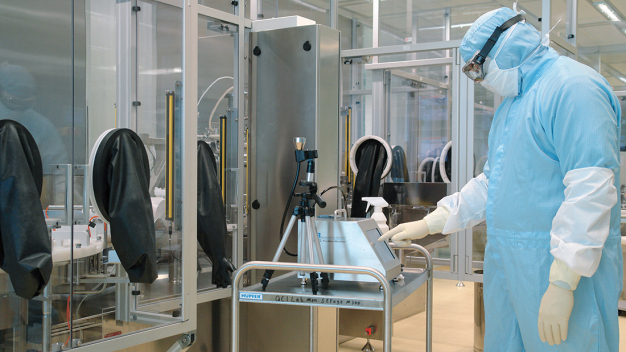
(Image credit: Testo Industrial Services GmbH)
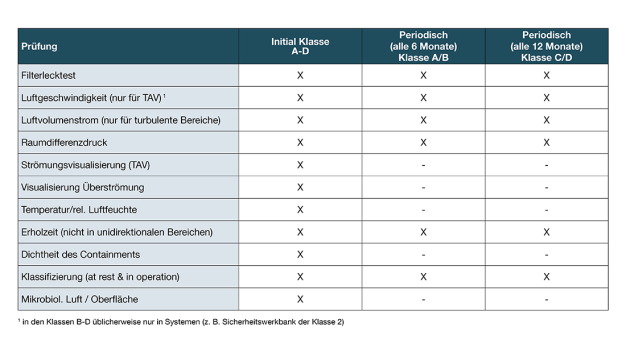
Table 1: Minimum scope of cleanroom measurements according to Annex 1 of 2022 (Testo Industrial Services GmbH)
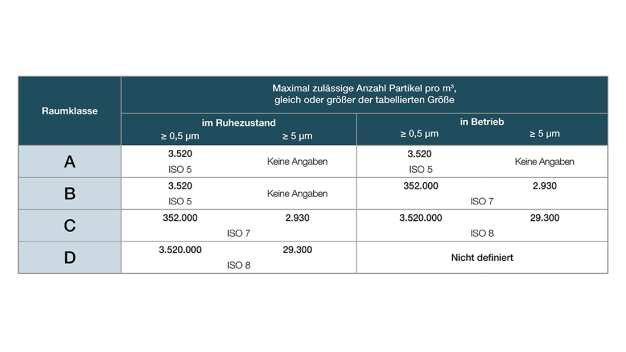
Table 2: Classification thresholds according to Annex 1 of 2022 (Testo Industrial Services GmbH)
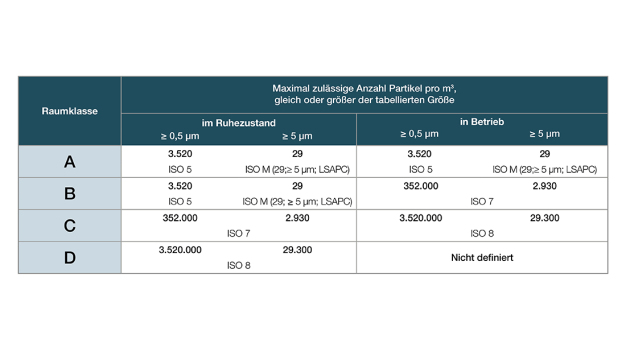
Table 3: Limit values for particle monitoring according to Annex 1 of 2022 (Testo Industrial Services GmbH)
In August 2022, the European Commission published the revised Annex 1 "Manufacture of Sterile Medicinal Products" of the "Volume 4 EU Guidelines for Good Manufacturing Practice for Medicinal Products for Human and Veterinary Use." This includes, among other things, changes and clarifications in the area of cleanroom qualification as well as regarding the maintenance of the qualified state and cleanroom monitoring, which are examined in more detail here.
After the past harmonization of relevant regulations and standards, new challenges have arisen with the publication of DIN EN ISO 14644-1:2016. For example, the limit value for particles of size 5.0 µm was eliminated in the mentioned standard, which previously played no role within the FDA framework but was explicitly specified in Annex 1 with a limit of 20 particles/m³ sampling volume. A transition period until August 25, 2023 [Annex 1, Foreword] has been defined to implement the requirements of the new Annex 1 – this time must be used by industry to adapt concepts and guiding documents due to requalification cycles.
The new Annex 1 centers around the requirement for a comprehensive contamination control strategy (English: "Contamination Control Strategy," CCS). The term is introduced in Chapter 2.3 for the first time and runs throughout the entire document. It is assumed that appropriate control and monitoring mechanisms are in place for all expected contamination risks, and measures are derived from the interpreted data.
The fundamentals, such as the different cleanroom zones A to D and their assignment to activities in aseptic manufacturing, remain unchanged, ensuring quick familiarization with the new edition and preserving the terminology used by practitioners.
New is the explicit reference to Annex 15 as the basis for the qualification of cleanrooms and ventilation systems [4.24 "Cleanrooms and clean air equipment should be qualified using the requirements of Annex 15"]. This provides clarity regarding the planning and implementation of qualification measures. The approach of "free testing" after implementation is firmly rejected in favor of a planned, risk-based approach – both initially and throughout the lifecycle.
At the same point, the distinction between the two procedures of classification ((re-)qualification) and process monitoring is clearly defined. From a technical, measurement-practical perspective, this requirement is clear and does not require regulatory specifications, as the data from process monitoring and classification mutually demonstrate their appropriateness and effectiveness, which is only possible with organizationally and metrologically autonomous procedures.
Very valuable is the clarity regarding the measurements to be performed both in initial qualification and during periodic requalification, including defined intervals [Chapters 4.25, 4.32].
The following table summarizes the two chapters clearly and presents the minimum scope. Based on risk or derived from the CCS, additional tests or shorter intervals may be indicated:

For the execution of all measurements, except microbiology, reference is made to the specifications of the DIN EN ISO 14644 series of standards.
In the area of classification, the discrepancy regarding the limit for ISO Class 5 was eliminated with the revision of Part 1 of DIN EN ISO 14644-1:2016.
Both in Annex 1 (2009) and in the future, classification refers entirely to DIN EN ISO 14644-1 [4.28], and during the 2016 revision, the limit for 5 µm particles in ISO 5 was eliminated. Since then, classification in areas A (in operation & at rest) and B (at rest) must be documented with an additional limit value indicated by an M-Descriptor, and a count value for 5 µm particles must be determined with high effort, which was no longer found in the underlying technical standard.
The table of classification limits [4.27] now looks as follows and, similar to the ISO standard, no longer specifies a 5 µm limit for classes corresponding to ISO 5. The systematics of the table has been changed compared to the old Annex 1, which is familiar to users. Therefore, the following table reverts to the previous presentation, as it is structured according to room class and operational state:
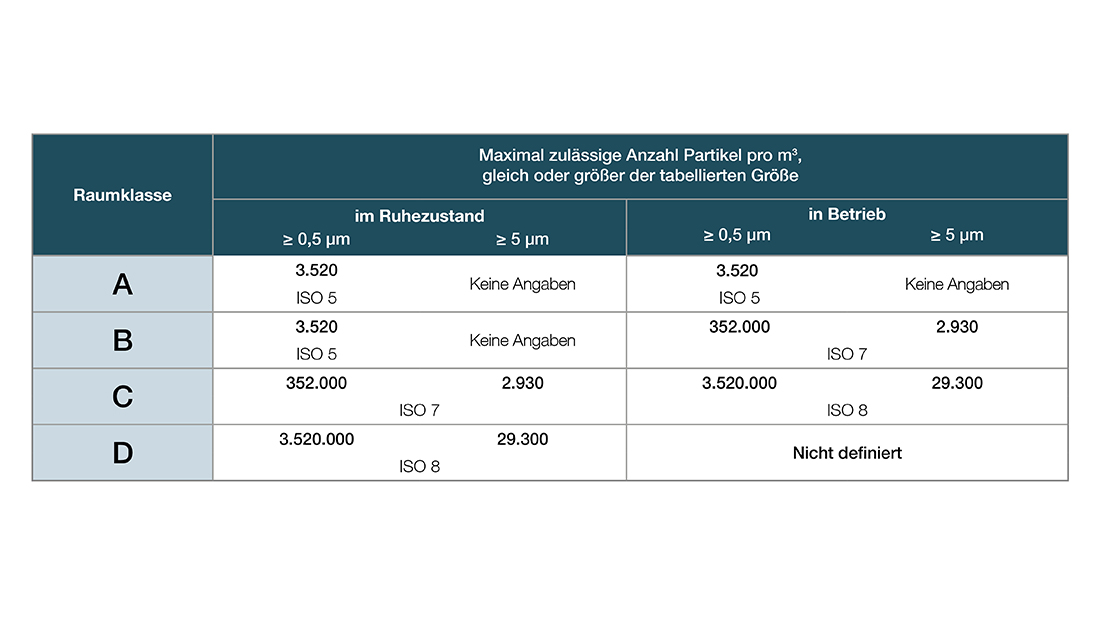
The fixed requirement for sampling volume in Class A of 1 m³ is also no longer included. This leads to the need for an unwieldy description of the limit for 5 µm as "ISO Class 4.8" and results in very long measurement times (36 minutes per classification point when using a 1 ft³ particle counter).
Regarding measurement time, the following formula now applies in Class A, rounded up to the next full minute:
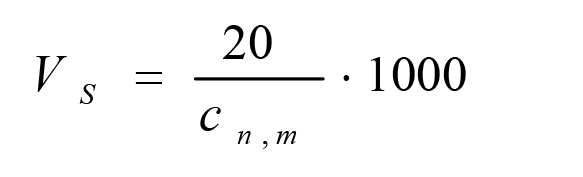
Vs = Sampling volume in liters
cn, m = Limit value for the largest particle size considered
The resulting volume divided by the particle counter's sampling volume (usually 1 ft³ or 28.3 l/min) yields the measurement time in minutes, rounded up.
With the removal of the above limit values, the measurement time for all classifications is uniformly reduced to 1 minute, significantly saving measurement time in highly clean areas. Especially in Class A, where the expected count value is 0 and a "sudden" count event is technically not to be expected due to the unidirectional airflow below the HEPA filter after several minutes, this does not entail a loss of safety. Additionally, "additional" measurement points are required in aseptic filling areas to better represent critical processes (e.g., filling stations).
It remains to be seen how the pharmaceutical industry will handle these changes in practice. Because later in the document, the eliminated classification limit values are reintroduced into process monitoring [9.15]:
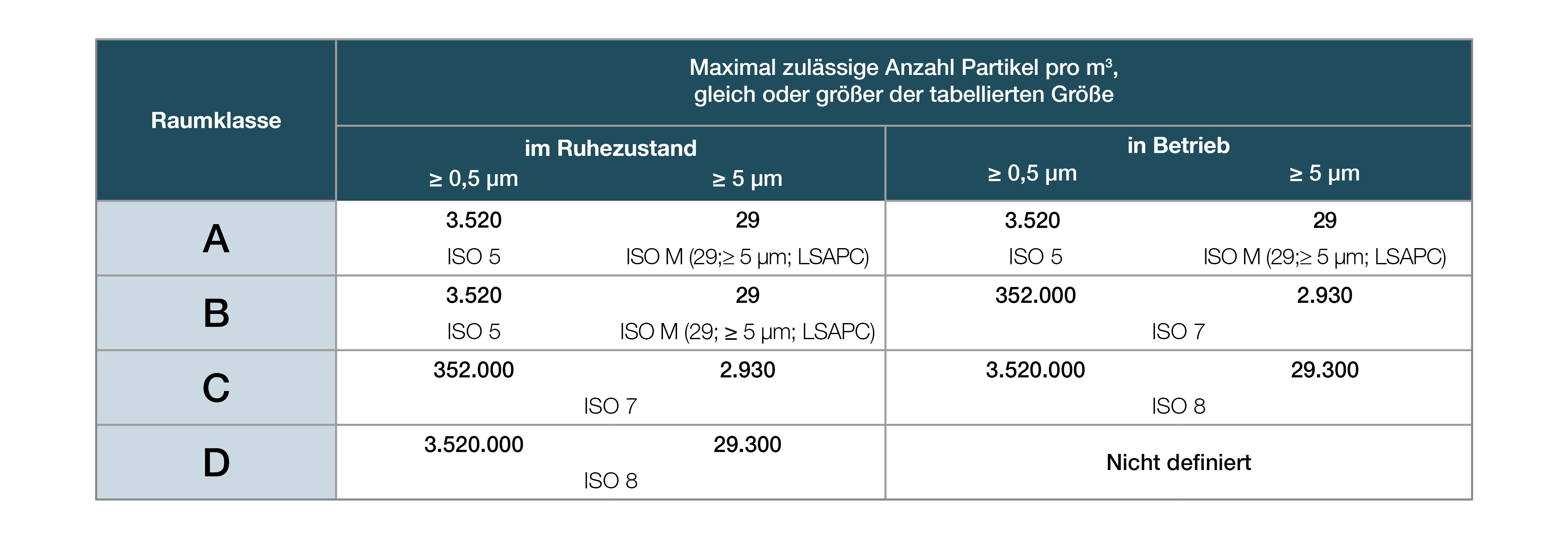
Since continuous trend analysis is required within the CCS, it seems inappropriate not to record the initial value and subsequently include 5 µm particles in monitoring evaluations. The argument in the monitoring section of Annex 1 [9.15, Note 2], that 5 µm particles could indicate damage to filters, would also apply equally to initial and requalification. Therefore, the rationale for the difference in definition is not clear. It is therefore recommended to define a limit value for 5 µm particles during classification in A and B at rest, at least to count these particles. Since the document does not specify a limit, applying the monitoring limit of 29 P/m³ appears appropriate.
It should be noted that this increases the measurement time back to approximately 25 minutes, and at least the consecutive sampling procedure (see DIN EN ISO 14644-1:2016, Annex D) must be applied. Besides the longer measurement time and the increased documentation effort, there is a particular risk in Class B, where turbulent airflow early in the measurement process can cause occasional counting events, leading to false OOS results. For example, nine counts of 5 µm particles within 5 minutes could lead to a falsely exceeded limit. This requires the measurement technician to exercise utmost care in flushing the measurement equipment and cleaning the room after setup.
An additional, interpretively relevant change is found in Chapter 5.9, which states that particle counters, including sampling tubes, must be qualified. The requirement for short sampling tubes is already known from Annex 1 (2009) and is based on the risk that particle deposition on the inner tube wall could negatively influence the count.
In qualification measurements, the risk is considered theoretical, as the maximum tube lengths are limited to a few meters. Especially where very low particle counts are involved, such as in the classification of highly clean areas, in practice, no tube is often used; instead, the isokinetic sampling probe is directly attached to the particle counter's intake port. Additionally, the airflow velocity in the tubes is about 6 m/s, so gravitational deposition effects are not expected to be relevant. Bends are considered critical but can be minimized through good technician training and background knowledge.
Since there are no detailed specifications regarding the scope and objectives of qualification, practice will show which standards will be established here. The function of the particle counter is comprehensively secured through calibration, with a risk-based focus on the influence of the tube.
Summary
Operators of cleanrooms in the aseptic environment do not face entirely new requirements, and the existing terminology remains largely unchanged. Nevertheless, it is important to carefully compare the details of the new version of Annex 1 with established qualification and monitoring procedures.
It will be interesting to see how industry handles unclear specifications, such as the qualification of particle counters or the discrepancy in the 5 µm particle limit between classification and monitoring.
The clearer requirements in qualification regarding the tests to be performed and their intervals are commendable – but it must be kept in mind, given the central role of the Contamination Control Strategy in quality risk management, that a procedure detached from the lifecycle of individual cleanroom facilities based solely on these specifications will not be sufficient.
During the transition period when both versions are valid, there will be increased need for clarification for operators and service providers regarding which version of Annex 1 underpins the measures.
Testo Industrial Services GmbH
79199 Kirchzarten
Germany



