
- Temperature
- Translated with AI
Christian Glosse
The mapping from the refrigerator to the storage room
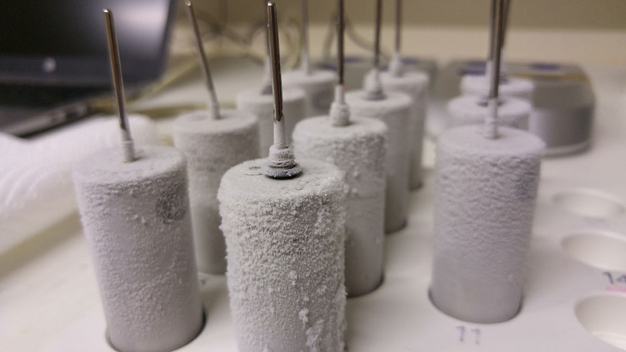
Cooling cabinets and storage rooms are important facilities in the manufacturing process of medicines and active pharmaceutical ingredients. Not only raw materials and other starting products, but also finished products are stored temporarily in refrigerators and storage rooms until delivery. Many of these products are temperature-sensitive, and accordingly, these devices and rooms should be designed and qualified. With the help of this report, we want to provide an insight into such qualification, a so-called temperature mapping.
1. Qualification or Validation?
Anyone involved in the manufacturing of active pharmaceutical ingredients and medicines is familiar with regulatory requirements as part of their daily routine. These regulations use various terms. In particular, the terms qualification and validation are frequently encountered. But what do they mean? What is the difference?
Validation confirms that a previously described process leads to the expected result. Qualification, on the other hand, verifies whether an object fulfills its intended purpose. Qualification is divided into different steps, namely: Design Qualification, Installation Qualification, Operational Qualification, and Performance Qualification, commonly known as DQ, IQ, OQ, and PQ. Temperature mapping is part of the OQ and PQ of the respective devices and rooms. To maintain the qualified status of the equipment later on, qualification or temperature mapping must be repeated regularly.
2. Refrigerators
Many active ingredients and medicines need to be stored refrigerated. Various cooling devices are available for this purpose. "Normal" refrigerators are designed for a temperature range of 2°C to 8°C, deep-freezers for temperatures of -20°C, and ultra-low freezers even down to -80°C. Additionally, there are cooling devices for laboratory needs, which operate within specific temperature ranges. Unlike household refrigerators or freezers, these devices are very temperature-stable. This means that the "same" temperature exists throughout the refrigerator, and only minimal deviations are permissible. To demonstrate the temperature distribution, these devices are qualified. Different scenarios must be simulated. These scenarios are reflected, for example, in the loading. A half-full refrigerator behaves differently than a fully loaded or empty one. The duration of temperature mapping for the various loading states should be 24 hours but can be adjusted based on risk. The behavior of the refrigerator during door openings, the recovery time after door closure, and the behavior during power failures must be tested and recorded accordingly.
Regardless of which scenario is tested, it is important to place a sufficient number of measurement points inside the refrigerator. The interior is divided into 3 levels, and 1 to 5 measurement points are defined per level as reference values. The exact number should be determined through a risk assessment.
Since refrigerators are usually located in more or less temperature-controlled zones, seasonal qualifications can generally be omitted. What this means will be explained in the next section.
3. Cold Rooms
Cold rooms usually differ from refrigerators mainly in size. However, this difference also brings new challenges. Airflow changes depending on the size and design of the cold room. Additionally, many open surfaces and shelves are found in a cold room.
The temperature ranges of these cold rooms are usually either 2°C to 8°C or around 20°C. When selecting the number of measurement points, the challenge is to determine the "correct" number. If too few measurement points are chosen, important information may be missing at the end. If too many are chosen, higher effort (and costs) will not yield additional information about the temperature distribution. As reference values, the following have become established: For small storage rooms up to 20 m³, 15 measurement points should be distributed in a uniform horizontal and vertical grid. For larger storage rooms, the vertical grid for the distribution of measurement points should be between 4 and a maximum of 10 meters. Since cold rooms usually have a standard ceiling height, 2 levels may suffice. If the ceiling height exceeds 3 meters, additional levels should be added. It is also important to check the storage areas themselves; a risk-based approach is recommended for this purpose.
Since cold rooms are mostly located inside a building without contact to an exterior wall, in a more or less controlled environment, seasonal temperature fluctuations generally have no impact on the cold rooms. However, if these assumptions do not apply, a seasonal review of the cold rooms is advisable. This means conducting temperature mapping once in summer and once in winter.
The cold rooms should, if possible, be qualified both in an empty and a loaded state, with each qualification lasting at least 72 hours. Additionally, the influences of door openings, power failures, loading and unloading should also be checked and documented.
4. Storage Rooms
After dealing with refrigerators and cold rooms, we now turn to storage rooms. Here, we will focus specifically on ambient temperature storage, since the same points as for cold rooms apply to cooled storage.
Of course, mapping in such storage rooms only makes sense if temperature-sensitive materials are stored. These storage rooms are usually very large. The same grid for placing measurement probes as in cold rooms applies. Storage rooms are often quite high, so multiple levels for temperature mapping should be established. In such storage rooms, attention should also be paid to the influence of structural features such as windows and doors. Solar radiation can cause significant temperature changes. The storage room should, if possible, be qualified once in an empty state. The mapping should last at least 72 hours. Qualification in a loaded state is essential and should last at least one week. Since outdoor temperatures are likely to influence the storage temperatures, seasonal temperature mappings are recommended.
5. What Else?
This article can only give you a small insight into part of our services. Every qualification requires much more than described in this article. For example, the selection of sensors is crucial. Depending on the room and requirements, different sensors with various accuracies can be used.
Another point is repeat testing. It is essential to conduct a risk assessment for each qualification, which among other things determines the cycles for repeat measurements.
The points listed above and the temperature mapping itself are complex and time-consuming. Therefore, it is highly recommended to rely on an experienced partner who can handle the work for you. Particle Measuring Systems (PMS) has been active in this field for over 30 years. With regular training and state-of-the-art equipment, PMS is well-equipped for temperature mapping. With highly experienced staff, risk analyses and other qualification tasks can also be covered. Do not hesitate to contact us.
Contact
The described service is offered by PMS in Switzerland and Austria:
Reinluftweg 1
9630 Wattwil, Switzerland
+41 71 987 01 01
pmsswitzerland@pmeasuring.com
Am Euro Platz 2
A-1120 Vienna, Austria
+43 171 728 285
pmsaustria@pmeasuring.com

Particle Measuring Systems Germany GmbH
Im Tiefen See 45
64293 Darmstadt
Germany
Phone: +49 351 88963850
email: pmsgermany@pmeasuring.com
Internet: http://www.pmeasuring.de