



- New building
- Translated with AI
The "Learning Factory" is scheduled to be operational in spring 2024.
New facility for pharmaceutical production at Bayer
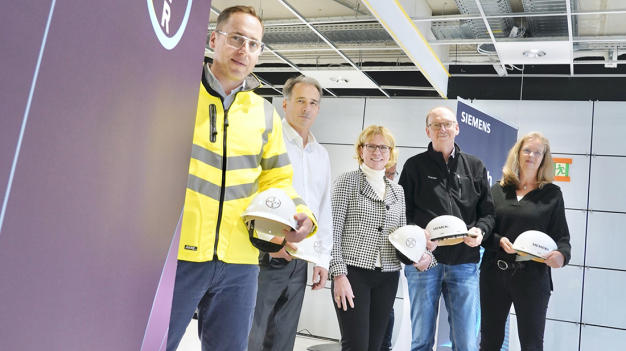
m Service buildings on the construction site: Dr. Enrico Hanusa, Operations Manager Bayer AG; Dr. Jürgen Wiedemann, Project Manager Bayer AG; Dr. Carola Pörtner, Site Manager Supply Center Leverkusen Bayer AG; Dieter Steffes-Tun, Overall Project Manager Siemens AG; Ulrike Lehnhof, Corporate Account Manager Siemens AG (from left).
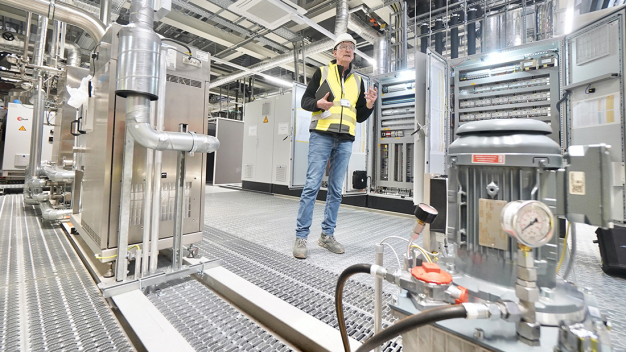
In the technical area above the production rooms: Dieter Steffes-Tun, overall project manager Siemens AG.
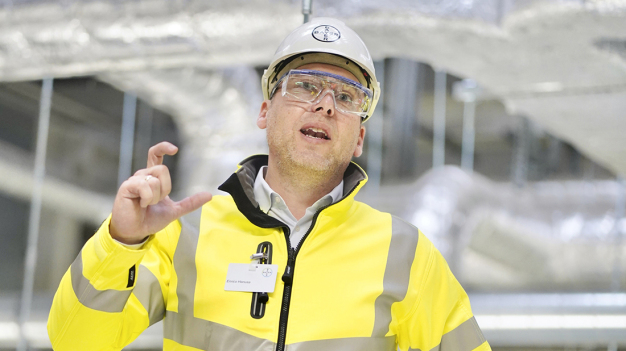
In the technical department above the production rooms: Dr. Enrico Hanusa, Operations Manager Bayer AG.
Next spring, it is expected to be operational: Solida 1 (SOL-1) in Leverkusen will become one of the most modern pharmaceutical manufacturing facilities worldwide. It is part of a multi-billion euro investment program through which Bayer AG is strengthening its pharmaceutical production network and its own innovation capacity. Among other things, medications for the treatment of cancer and cardiovascular diseases are produced here.
The company is investing around 275 million euros in the facility as part of the Leverkusen Supply Center. It is thus the core of the new global competence center for the production of solid dosage forms. It sets standards for efficiency, quality, delivery reliability, and sustainability, and uses the advantages of digitalization as a "Learning Factory." This means that data streams are analyzed with the help of artificial intelligence, and actionable recommendations are derived from them.
Key components of the single-story factory include a central building element with connected modular functional buildings, a high degree of automation in production, and highly efficient expandability.
"Despite some difficulties – for example, due to the impacts of COVID-19 and the Ukraine war – we were able to meet our ambitious schedule. This was only possible thanks to a dedicated Bayer project team and our competent external partners. Furthermore, I thank our team at the Leverkusen Supply Center, which will operate Solida 1 later and has worked successfully every day for our future as a Center of Excellence. Overall, up to 300 people worked together on the construction site," emphasizes Dr. Carola Pörtner, head of the Leverkusen Supply Center.
A large part of the production facilities will later no longer be accessible to visitors, as they are maintained under cleanroom conditions. This means that the rooms must be nearly free of airborne particles. Advanced technology ensures that the concentration of particles in the air remains very low. This is one of many special challenges that had to be considered even during the ongoing construction phase.
"Solida 1 will contribute to sustainably improving the lives of patients. For example, the results of scientific research can be transferred into products more quickly," explains Jürgen Wiedemann, one of the two project managers. Bayer AG is implementing the project with several partner companies.
One of these partners is Siemens AG, with its Digital Industries and Smart Infrastructure divisions, which contribute to the concept of the "Learning Factory" with their automation systems and machine controls for process optimization, resource efficiency, energy and time savings. "The SOL-1 project is innovative and challenging in many ways for us, not only in terms of digitalization and process technology implementation," states Stephan Drouvé, head of Siemens' Cologne branch. "The unusually collaborative approach to planning, implementation, and construction of the new manufacturing facility has proven to be extremely beneficial for all involved Bayer AG partners in terms of progress and results."
An example of Siemens AG's contribution to the "Learning Factory" is process automation. In the pharmaceutical industry, process steps such as sampling and analysis are often monitored. This extends production time and reduces interference with the process. The SIPAT software monitors quality in real-time during production and can optimize it if necessary. Besides improved quality, time-consuming manual inspections can be eliminated, and incorrect batches avoided.
Furthermore, sophisticated building automation technology makes a significant contribution to energy efficiency and flexibility. It continuously monitors and documents the indoor climate, and the production environment can be flexibly adjusted depending on the medication being produced. To this end, numerous automation components, ventilation systems, heating, cooling, and steam technology are installed in the new building, centrally controlled by a building management platform. Hundreds of sensors and thousands of data points constantly provide measurements, which are analyzed with digital services during operation to detect irregularities and derive recommendations. Last but not least, Siemens automation technology also ensures smooth and digitally controlled processes within the factory logistics.
"The comprehensive automation of processes will significantly increase the flexibility of pharmaceutical production in Leverkusen in the future," says Drouvé. "Automation and digitalization are key to keeping industrial production in Germany competitive in the future. Bayer AG demonstrates this convincingly with its new 'Learning Factory.' It also takes on an important pioneering role in this regard. At Siemens, we are very pleased to contribute our industry-specific expertise in digitalization and process automation to shape this flagship project."
Optimal flexibility is not only focused on production workflows: the modular design of SOL-1 – and thus, for example, the possibility of expansions – also creates many options for future developments in the pharmaceutical sector. The facility has a gross floor area of 15,000 square meters. Around 100 employees will start working in the building, whose topping-out ceremony was celebrated in May 2022 in the presence of Federal Chancellor Olaf Scholz.
The "Learning Factory" is also intended to set standards in terms of sustainability. The energy demand of the plant is largely covered by a modern geothermal system, which reduces CO2 emissions by around 70 percent compared to conventional operations.
BAYER AG
51373 Leverkusen
Germany



