

- Disinfection | procedures, devices, agents, media (Wipers, Swaps,...)
- Translated with AI
Success story: 1500 m² pharmaceutical cleanroom with fully automated H₂O₂ room decontamination
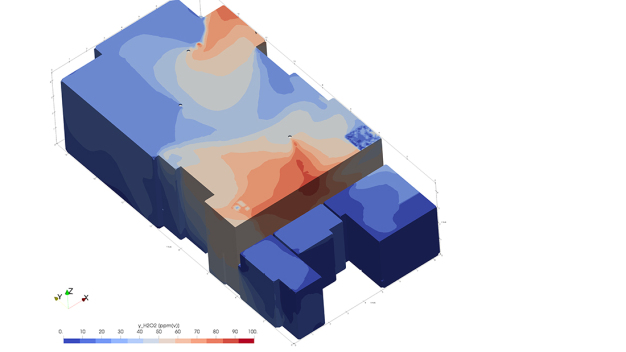
CFD flow simulations of nozzle technology based on risk analysis.
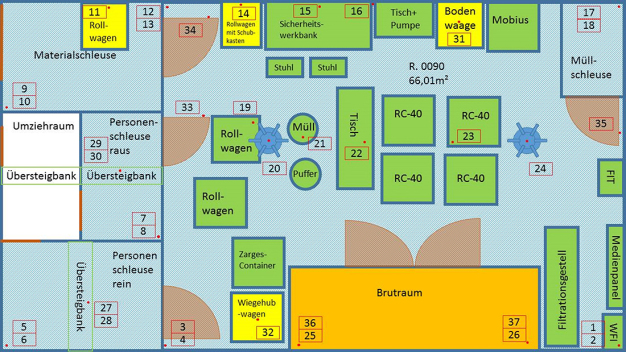
Example of a room layout with focal points for a fully automated H2O2 decontamination.
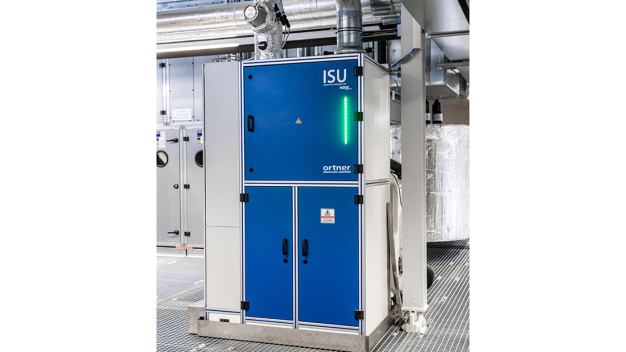
A high-performance H2O2 gas generator was installed in the technical center
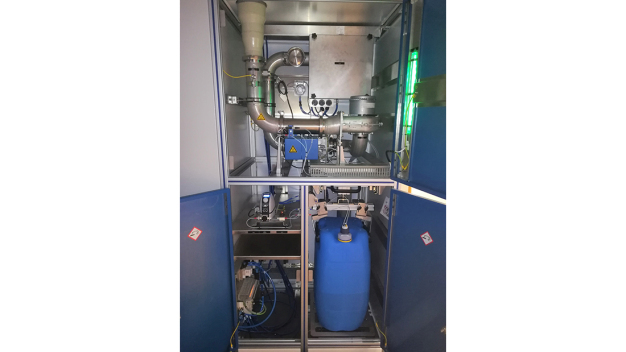
60-liter H₂O₂ reservoir of the fully automated H₂O₂ gas generator system.
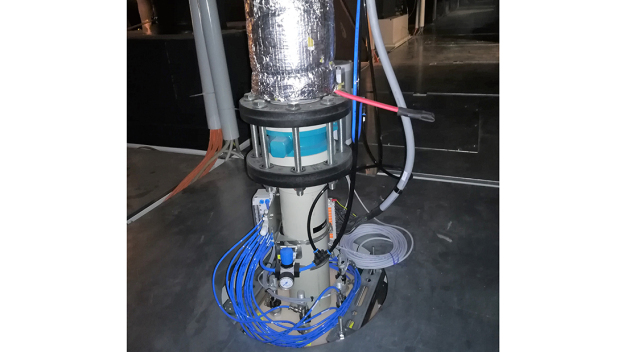
Infrastructure installation for H2O2 dosing with approximately 460 meters of auxiliary heating.
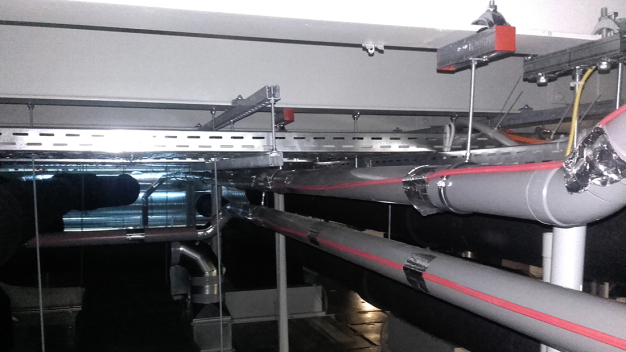
Infrastructure installation for H2O2 dosing with approximately 460 meters of auxiliary heating.
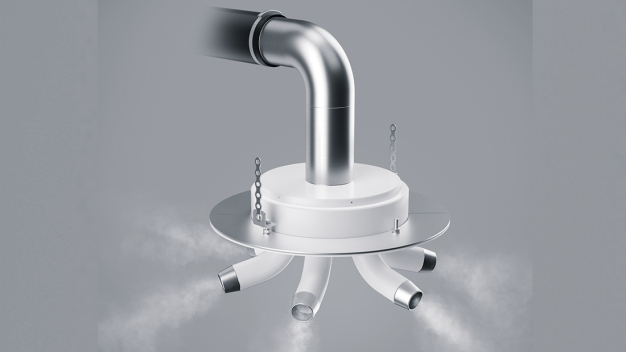
Infrastructure installation for the H2O2 dosing with approximately 460 meters of auxiliary heating.
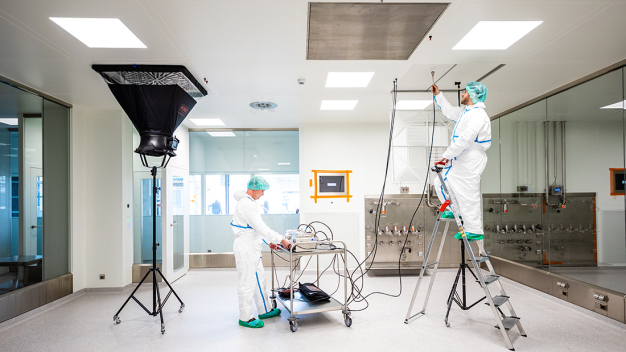
Pharmaceutical production cleanroom with integrated spray technology. (Photo © www.3undzwanzig.com)
A German pharmaceutical company decided to build a new production facility based on the latest standards and pioneering technology. The existing production sites had primarily been focused on decontamination with formaldehyde and qualified accordingly. The specific requirement for the new building was the most advanced automation and process technology for room decontamination. The goal was to make room decontamination faster, safer, and more environmentally friendly. The result is a flagship project from which numerous insights for innovations across the entire industry have been gained.
The Task
The objective for the new production building was, alongside a series of manufacturing-related and environmentally relevant innovations, to implement fully automated hydrogen peroxide decontamination technology for all relevant rooms and lock systems.
The Contribution of Ortner Cleanroom Technology GmbH
Ortner was commissioned to develop and implement a central, automated decontamination system for approximately 1500 m2 of cleanroom space in the new production building.
Specifically, the task was to install a central H2O2 gas generator system in the technical floor with a distribution network to all entry points and to develop automated, verifiable processes. This included calculating the necessary vaporization amount, regulating and controlling gas distribution, and preventing condensate formation in the gas lines, as well as coordinating the process with the users. A new nozzle technology had to be developed for gas introduction through the cleanroom ceilings.
Project Implementation including Installation and Qualification
The development and installation of the decontamination infrastructure system took nearly a year.
The main challenge was to demonstrably achieve the required Log-6 microbial reduction via H2O2 decontamination, based on viral indicators. Prior to this, the pharmaceutical company conducted numerous trials at their own expense with support from Ortner and external experts: tests with various viruses, bacteria, and pathogens; practical tests for H2O2 vaporization and distribution technology; and for H2O2 neutralization. The cycles developed formed the basis for conception and planning. For the complex simulations, Ortner relied on the support of proven scientific partners who created the necessary CFD flow simulations and contributed to a comprehensive risk analysis.
During the installation and integration of decontamination systems, interface management during assembly, commissioning, and qualification posed the greatest challenge. During this phase, measurement technicians, equipment installers, commissioning technicians, electricians, decontamination specialists, and cycle developers often worked simultaneously within the cleanrooms.
During commissioning and qualification, it was clearly demonstrated that the prior simulations, calculations, and detailed planning kept the effort for commissioning, cycle development, and qualification within limits, and the results matched the calculations almost exactly in nearly all rooms.
After cycle development, validation, and achieving the Log-6 reduction for viral indicators, the decontamination system was handed over to the company.
The project resulted in a stationary gas generator system with a H2O2 storage volume of 60 liters, gas transported via heated gas lines approximately 200 meters long, gas introduction through controlled and timed 6-nozzle jets, reliable gas and concentration distribution even in the most remote areas and niches, measurement technology, monitoring system, and cycle development based on verifiable processes.
The H2O2 large system has been used for about two years to decontaminate several production rooms, including associated storage, corridors, waste locks, material locks, and personnel locks. The project has led to significant innovations for the cleanroom industry, providing valuable foundations for future H2O2 decontamination applications.
This reference project offers a range of innovations and insights:
– Achieving Log-6 reduction for viral indicators via H2O2 decontamination is now scientifically proven and demonstrably achievable.
– Large gas generator systems can treat entire factories: The centerpiece is the central H2O2 gas generator system developed by Ortner, combined with a 60-liter container and a distribution network to all entry points.
– With a dynamic nozzle technology, rooms with complex furnishings and long corridors can be safely gassed: A new nozzle technology had to be developed for gas introduction through the cleanroom ceilings. The result: the new "Star" nozzle technology, a controlled and timed 6-nozzle jet. Unlike previous nozzles, these are no longer controlled by compressed air but by an electric drive. This makes them more flexible and easier to operate.
– The necessary gas transport over heated gas lines approximately 200 meters long required the development of a new system: PVC lines with specially adapted insulation to prevent H2O2 condensation within the lines.
– The prevailing belief that processes with high concentrations minimize process times and create better, safer processes has been disproved. Based on calculations, simulations, and numerous practical applications, it has been proven that cycles with low concentrations of around 300 to 500 ppm are much more targeted and practical than concentrations near 1000 ppm.
– While in the past—up to today—H2O2 decontaminations used mobile devices with performance parameters of 8 to 10 g/min evaporator capacity and gas flows of 60 to 100 m³/h for room gassing, this reference project demonstrated a significant advancement: With modern technology and innovative solutions, stationary generators can deliver performance parameters of 40 g/min vaporizer capacity and gas flows of 500 to 600 m³/h. This allows entire room complexes to be decontaminated fully automatically with short cycle times.
Conclusion
Planning a pharmaceutical factory with new manufacturing and safety-related systems presents a challenge for all involved. The responsible partner for decontamination technology must work holistically: The existing variety of interfaces and necessary calculations require special attention and interconnected thinking. This complexity demands a professional who not only accompanies the entire process but takes 100 percent overall responsibility and delivers 100 percent of the solutions. This comprehensive approach makes Ortner unique in the market. In combination with a customer who conducts extensive research and is exemplary in innovation, groundbreaking innovations for the entire cleanroom industry can emerge from a single project.

Ortner Reinraumtechnik GmbH
Uferweg 7
9500 Villach
Austria
Phone: +43 4242 3116600
Fax: +43 4242 3116604
email: reinraum@ortner-group.at
Internet: http://www.ortner-group.at