




- R+D & Community of Interest
- Translated with AI
Smarter robots thanks to ROS
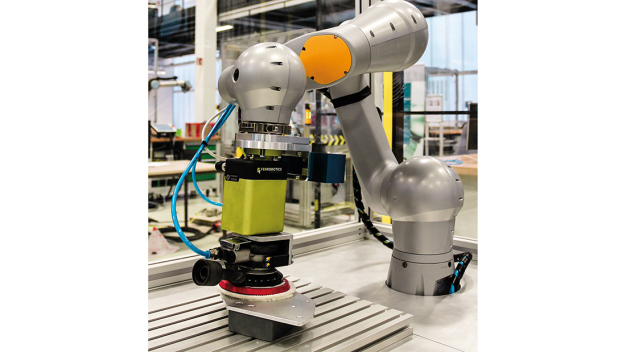
The Fraunhofer IPA has implemented this polishing application using ROS-based path planning, for example. (Source: Fraunhofer IPA / Photo: Harshavardhan Deshpande)
On December 15 and 16, 2020, Fraunhofer IPA will host the eighth ROS-Industrial Conference, which will be held virtually this time. It offers current developments from science and industry around the open "Robot Operating System" (ROS). The conference also serves as the closing event for the EU project "ROSIN," which concludes after more than 70 pilot projects.
"Dare to use more open source!" headlined the "Frankfurter Allgemeine Zeitung" a few days ago, highlighting the added value that open-source software offers to the economy and society. In robotics, one can no longer ignore the free, manufacturer-independent operating system "Robot Operating System" (ROS) – and this applies not only to research or the quick development of prototypes for complex robotic tasks but increasingly also to industrial continuous operation.
"ROS provides fundamental yet complex capabilities for robots such as navigation, motion planning, or image processing, and enables robots to be used economically even for small batch sizes," explains Christoph Hellmann Santos, group leader at Fraunhofer IPA and manager of the ROS-Industrial consortium in Europe.
News about ROS
Already the eighth time – and for the first time virtually due to Corona – Fraunhofer IPA is hosting the conference. The globally active consortium promotes the use of ROS in industrial applications and now has over 80 members. All support the goal of transforming industrial robots into intelligent machines using ROS, replacing previously fixed programmed motion sequences with sensor data processing and dynamically calculated motion planning.
The conference provides insights into research activities related to ROS, presents industrial applications, and facilitates exchange within the community. In dedicated program blocks, topics such as software quality, simulation, safety, and real-time applications are discussed. Additionally, there is a video competition for ROS-based applications. Participants could submit videos about professional ROS software until November 30, 2020. Voting on the favorites is now available online. An expert committee will select the best-rated videos, and the winner will be awarded at the conference.
ROSIN project presents results
This year's conference also serves as the final event for the EU project ROSIN, which ends in December. Several European research institutions, along with end-users and robot manufacturer ABB, are working together with Fraunhofer IPA to create a digital platform for robotics using open-source software. "The project has given ROS a real boost in three ways," summarizes Hellmann.
The first was on a technical level. In 71 "Focused Technical Projects," the project financially supported the development or adaptation of ROS components. This further simplified entry into ROS, as drivers for numerous robots and components, such as Universal Robots or SICK, were created within the project. Today, ROS natively supports many robots and sensors. Moreover, almost all major robot manufacturers are now members of the ROS-Industrial consortium. The reach of ROS has thus increased significantly.
Secondly, ROSIN worked on improving software quality, for example through new tools for quality assurance or automatic code testing. The third focus was on training. In this context, the project partners established 19 new training centers across Europe and trained students and professionals. The project will present its results at the conference.
The ROSIN project is funded by the European Union under the Horizon 2020 research and innovation program, grant number 732287.

Fraunhofer-Institut für Produktionstechnik und Automatisierung IPA
Nobelstraße 12
70569 Stuttgart
Germany
Phone: +49 711 970 1667
email: joerg-dieter.walz@ipa.fraunhofer.de
Internet: http://www.ipa.fraunhofer.de