

- Translated with AI
#ShowYourRare on International Rare Disease Day
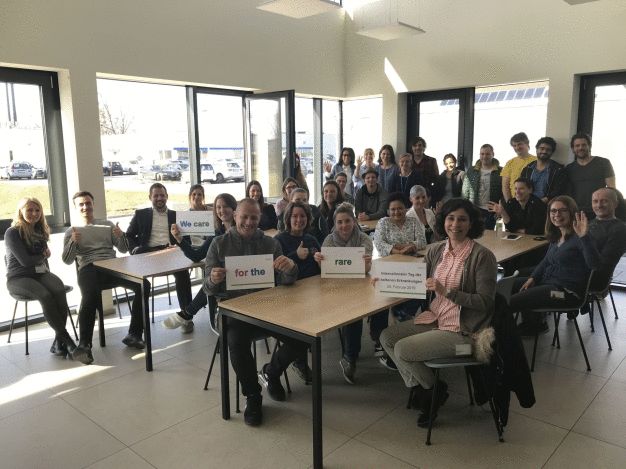
With the slogan “We care for the rare,” the employees of Rentschler Fill Solutions GmbH demonstrated solidarity with people suffering from rare diseases. On February 28, 2019, the International Rare Disease Day (#RareDiseaseDay), the focus was placed on adults, children, and their difficulties. Currently, 6,000 to 8,000 rare diseases are known.2,5 In Austria, more than 400,000 people are affected. In Germany, approximately four million people suffer from a rare disease, and in the European Union, about 30 million individuals are affected.1,2,5
At the biopharma company Rentschler Fill Solutions in Rankweil, Austria, modern medicines are filled in small to medium quantities under aseptic conditions in a cleanroom. Some of these are so-called orphan drugs, used to treat rare diseases.
Limited treatment options for rare diseases
A disease is classified as rare if fewer than five out of 10,000 people in the EU are affected.3 Due to their rarity, an accurate diagnosis is often only made after many years. They are often severe or life-threatening illnesses, and in 50% of cases, children are affected.5 80% of the diseases are genetically caused, meaning they are congenital, but there are also rare autoimmune diseases, infections, or tumors.4 As orphan children of medicine, rare diseases are also called orphan diseases.
Currently, there is only a treatment option for about 5% of rare diseases.5 This number highlights the need and urgency to advance research into rare diseases and develop appropriate medications. The small number of patients on one side and the high costs of drug development and manufacturing on the other pose economic and practical challenges for pharmaceutical companies, such as finding enough patients for clinical trials. However, the development is positive, aided by EU funding. After thorough review, research companies are facilitated in the approval process and receive a ten-year market exclusivity for their orphan drugs. In 2017, approximately every fifth newly approved medication was used to treat rare diseases, demonstrating the commitment of pharmaceutical companies in this area.5 Currently, 110 drugs with orphan drug status are approved in the European Union. Additionally, 48 more drugs have lost their preferential status after ten years on the market but are still largely available. Furthermore, 1,900 additional products are in development, but ultimately only a small portion will receive approval (as of February 2019).6
Aseptic filling of orphan drugs at Rentschler Fill Solutions
As a 100% service provider, Rentschler Fill Solutions supports innovative biotech and global pharmaceutical companies from the testing of their active ingredients in clinical trials to market approval and develops efficient filling processes. With an experienced team and state-of-the-art technical equipment, the biopharma company accelerates the pathway of the medication to market approval and thus improves patient access to new treatment options. By filling already approved medications, including orphan drugs, Rentschler Fill Solutions, as a highly specialized company, ensures the availability of highly specific and vital medications for patients. As the last link in the production chain with direct product contact, employees carry a high responsibility for ensuring the highest quality standards and sterility. With the goal of improving patients’ health worldwide, it is worth giving your best every day.
Support groups and events on Action Day
In addition to advances in diagnosis, therapy, and medication supply, people with rare diseases and their families find support in self-help groups. On International Rare Disease Day, interested individuals can also learn about and network at events. The nearest activities are taking place, for example, in Ulm (Germany) and Salzburg.
References:
1) Achse (2019): Rare Disease Day 2019, https://www.achseonline.de/de/Aktuelles/2019/20190228_Tag_der_Seltenen_Erkrankungen_2019.php,
Accessed 20.02.19
2) Federal Ministry of Health (2015): National Action Plan for Rare Diseases. NAP.se / 2014-2018,
https://www.sozialministerium.at/cms/site/attachments/0/6/5/CH4055/CMS1492947094676/nap_selteneerkrankungen_2015.pdf, Accessed 19.02.19
3) European Commission: Rare diseases, https://ec.europa.eu/health/non_communicable_diseases/rare_diseases_en, Accessed 19.02.19
4) Orphanet: About rare diseases, http://www.orpha.net/national/ATDE/index/about-rare-diseases/, Accessed 19.02.19
5) Pharmig (2017): Factsheets, http://www.pharmig.at/DE/Der%20Verband/Fachbereiche/Seltene%20Erkrankungen/Seltene+Erkrankungen.aspx, Accessed 19.02.19
6) Vfa bio (2019): Approved orphan drugs, https://www.vfa.de/de/arzneimittelforschung/datenbanken-zu-arzneimitteln/orphan-drugs-list, Accessed 18.02.19
Rentschler Fill Solutions GmbH
6830 Rankweil
Austria