




- Science
- Translated with AI
Barbara Halstenberg
Science in a shoebox
Technical University of Berlin invites: Launch of the InnoCube satellite on January 14, 2025, in a live stream event
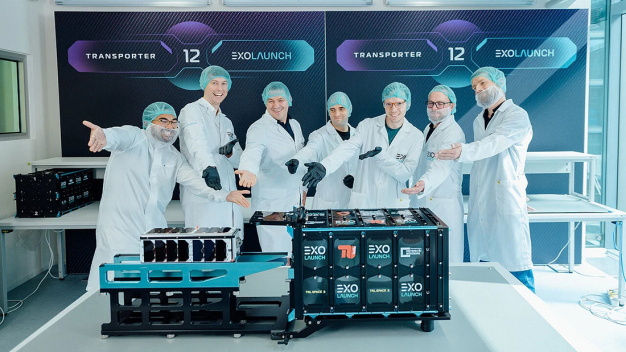
The InnoCube team is pleased: The satellite is ready for installation in the deployment container, for the journey to the launch site, and finally into orbit.
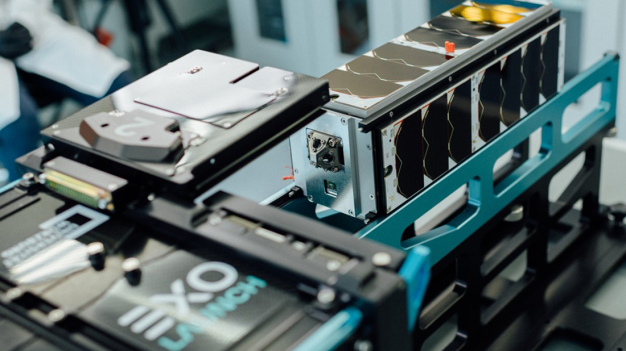
The CubeSat during integration into the deployment container. On the front side, the pyramid-shaped laser-ranging reflector of the EPISODE payload can be seen.
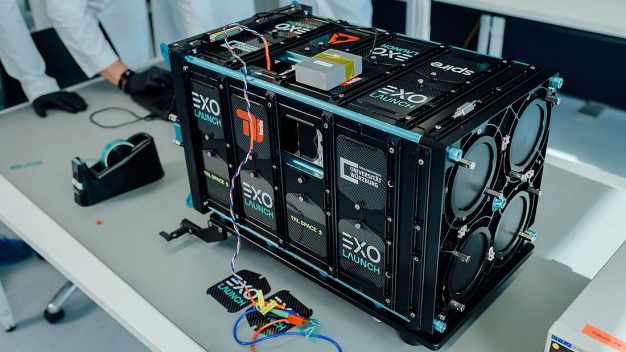
The ejector container is being prepared.
The TU Berlin InnoCube satellite makes spaceflight history: It is the first satellite to perform all its internal data traffic wirelessly via radio. The new technology reduces weight and sources of error and opens up entirely new possibilities for satellite integration and development. On Tuesday, January 14, 2025, the InnoCube satellite will be launched into orbit. The launch will take place from Vandenberg Space Force Base in California.
The small satellite will be transported aboard a Falcon-9 rocket into a sun-synchronous orbit. The launch is coordinated by the Berlin-based company ExoLaunch, which was founded in 2010 by scientists and engineers from the space engineering department of TU Berlin.
InnoCube, a 3U+ CubeSat with the dimensions of a small shoebox (34 x 10 x 10 cm) and weighing 4.5 kilograms, is initially intended to operate scientifically for one year. Afterwards, the satellite will be used for educational purposes. Physically, it remains in orbit for about six years before it is completely deorbited. It is the 31st satellite of TU Berlin, which is a global leader in the number of university small satellites in Earth's orbit.
InnoCube serves as a platform for cutting-edge technologies developed at TU Berlin and the University of Würzburg:
– SKITH: A wireless data bus system developed at the University of Würzburg that replaces conventional wiring. This technology reduces weight and sources of error and allows for more flexible integration of satellite modules.
– Wall#E: An innovative solid-state battery, used for the first time as a structural element of a satellite, developed in collaboration with the Institute for Particle Technology at TU Braunschweig and the Institute for Aeronautics and Spaceflight at TU Berlin. The battery saves weight and volume by simultaneously storing energy and serving as a load-bearing component. During the mission, it will be tested in orbit to enable future multifunctional applications in spaceflight.
– EPISODE: Also from TU Berlin, a secondary payload for precise determination of the satellite's position and orbit. It combines a software-based GNSS positioning solution with a laser retroreflector, providing important data for validating the navigation solution. Distance measurements are carried out by TU Berlin's new laser ranging station, which will also go into operation in 2025.
– Additional payloads: Two more experiments are onboard from TU Berlin. One is an experimental beacon (BEECON), based on technologies from the LibreSpace Foundation, which uses energy-efficient spread-spectrum transmission to identify and track the satellite. The other is a reconfigurable amateur radio experiment platform from TU Berlin's amateur radio club. This platform can receive messages from amateur radio operators and transmit them via Slow-Scan Television QSLs (SSTV-QSLs).
Student Involvement
The project was significantly supported by students. Numerous theses and projects contributed especially to the development of the secondary payload EPISODE. After the scientific mission ends, the satellite will be integrated into teaching and operated further by the Student Satellite Operations Group (StudOps).
Invitation to the Live Stream Event
TU Berlin invites all interested parties to follow the launch digitally together. The event begins on January 14, 2025, at 5:30 PM. There will be a live stream on YouTube accessible via the following link: https://youtube.com/live/2m-KFetSNrw?feature=share
The program includes:
– Presentation of the mission and its payloads
– Insights into the development of the satellite
– Live broadcast of the launch
After a successful launch and deployment of the satellite, the event will end around 9:00 PM. The team will then initiate the first steps to establish contact.
Collaboration, Funding, and Project Leadership
The project combines two DLR Challenge overall winners, awarded for the technologies SKITH (2015/16) and Wall#E (2016/17). The German Aerospace Center (DLR) and the Federal Ministry for Economic Affairs and Climate Action have funded the project. The project is led at TU Berlin by Prof. Dr.-Ing. Enrico Stoll and at the University of Würzburg by Prof. Dr. Sergio Montenegro.
Technische Universität Berlin
10587 Berlin
Germany