

- Translated with AI
Joachim Gau
Requirements for a cleanroom monitoring system
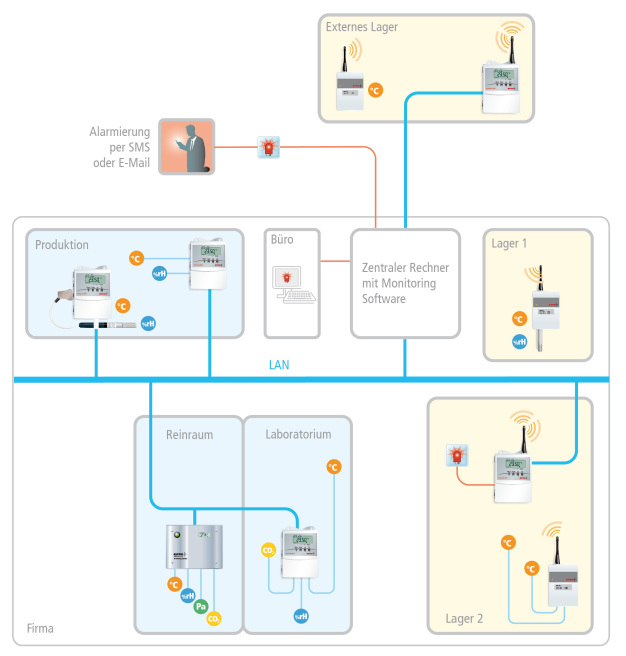
Typical system setup of a central monitoring system
Firstly, the question arises: why is monitoring necessary in a cleanroom at all? Quite simply: for example, incorrect differential pressure can lead to contamination. Continuous recording of data allows deviations to be detected immediately. Necessary measures to prevent damage to stored materials can be implemented right away. This means that monitoring enables early detection of trends in climatic conditions and allows for prompt reactions.
Additionally, there is the legal component: monitoring is mandated by a number of national and international regulations (GLP, GMP, FDA). Irregularities detected during an audit or inspection may lead to recommendations in a one-time case, but repeated violations can result in strict measures. This can include sanctions up to the revocation of production or trade licenses.
Therefore, the main requirements for a central monitoring system are: reliable performance around the clock and high data security. With good systems, you can continuously monitor and record temperature, humidity, CO2, differential pressure, and other parameters.
Optimal overview of all measurement data
With a central monitoring system, you can optimize your workflows. You save yourself the rounds from one data logger to another to download measurement values. You can conveniently monitor and analyze all measurement data from any PC in your operation. Even in the event of a power outage, the system allows for seamless and reliable recording. Another criterion for choosing a system is practical tools for data visualization and the creation of complete measurement reports. The storage and documentation of the values should be carried out via accompanying monitoring software.
Legally required scope of documentation
Monitoring systems for documenting cleanroom and storage conditions are central elements in environments where cGxP guidelines are followed and where climatic conditions must be documented comprehensively and in compliance. The following documents should be possible to generate with the chosen system or provider:
1. Qualification documentation
(DQ/IQ/OQ/PQ)
Risk analyses, software validations, wiring diagrams, installation instructions, alarm lists, conformity declarations, etc.
2. Traceable certificates and proof of compliance with legal regulations (calibration certificates, FDA 21 CFR 11 white paper, additional GMP documentation)
3. SOPs and user manuals for system operation
(Work instructions, protocols)
To ensure that the central monitoring system meets all legal requirements for cleanrooms, it should be compliant with the standards of 21 CFR Part 11, GMP, GAMP 5, GLP, and Annex 11.
Sensors in the cleanroom
When deploying monitoring systems in cleanrooms, not only documentation but also the sensors themselves are subject to particularly high requirements. In addition to the controlling design and material specifications for use in sterile or ultra-clean environments, signal function, compactness, as well as ease of installation and service are expected. For example, ELPRO's cleanroom panels are developed based on the experience of many cleanroom installations and customer feedback. The transmitters for pressure, temperature, and humidity are integrated into a cleanroom-compatible stainless steel front, along with an alarm horn and its acknowledgment. The display instruments for the relevant parameters feature prominent backlighting in green (OK), yellow (Warning), and red (Alarm). The front-replaceable combination sensor for temperature and humidity, as well as the calibration port for differential pressure, ensure quick and cost-effective maintenance cycles. Different variants with various display options (e.g., only differential pressure or particle concentration display) should be available.
Selection of a monitoring system
When preparing your User Requirement Specifications for selecting a central monitoring system, you should define the following points in advance:
- Purpose of the monitoring system
- List of measurement points and information about sensor placement
- Measurement range and required accuracy for each point
- Information about service and calibration requirements
- Required alarm behavior / behavior in case of power failure
- Requirements for data security / archiving
- Any additional specific requirements
It is important to clarify the requirements for a new monitoring system beforehand. Existing requirements should be reviewed and updated to focus the project on essentials and adapt to the current situation (scope, measured parameters, alarm requirements). Please consider the following points:
1. Careful project planning. Define as many details as possible
(installation procedures, placement, timing coordination)
2. Consider interfaces to IT systems (involving personnel, IP addresses, existing alarm servers)
3. Devices must be "cleanroom-compatible" and easy to calibrate (sensors, cleaning cycles, edges, materials)