

- Renting/Leasing
- Translated with AI
Barbara Fischer-Reineke
Rent or buy?
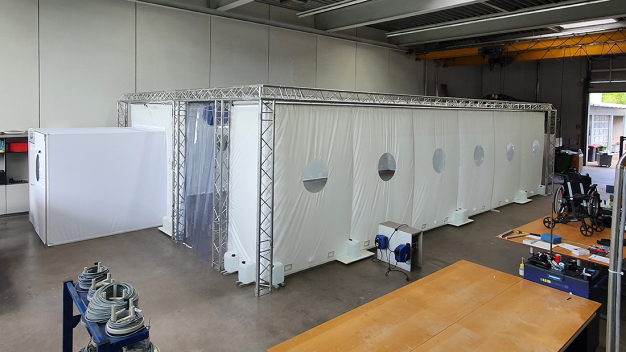
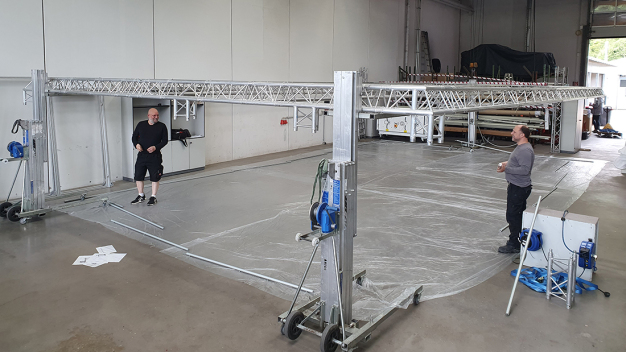
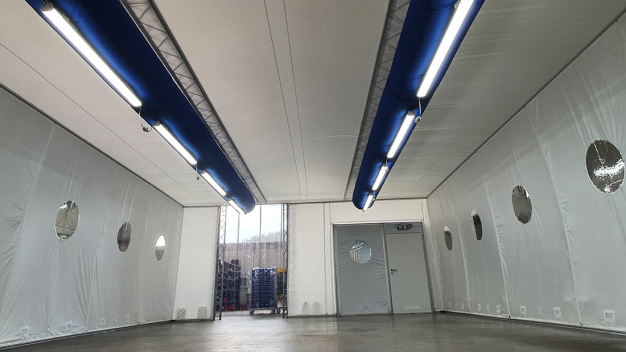
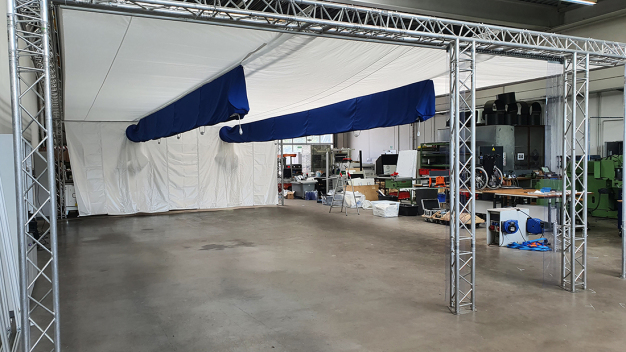
Installation of the ceiling along with the outlet
Cleanrooms are becoming increasingly popular. However, not everyone can or wants to afford one, even if they could use it. As a result, alternative utilization concepts are gradually coming into focus for investors. But renting a cleanroom? The reservations are still significant, even if unfounded.
Cleanrooms are on the rise. This can certainly be stated without exaggeration. In addition to the traditional users from medical technology and the pharmaceutical industry, new sectors have been steadily added over the past few years. On the one hand, end customers are demanding higher requirements for the manufacturing environment. On the other hand, due to increasing regulation within quality assurance, many other companies, such as those in packaging, automotive, or mechanical engineering, must operate in controlled environments to provide seamless documentation. And finally, the COVID-19 pandemic has ensured that heightened hygiene awareness has reached the general population, which now increasingly demands "clean" products. Undoubtedly, a trend that benefits the cleanroom industry. But manufacturing companies are under pressure, with multiple causes.
From the perspective of an affected party, the situation so far looks like this: "You just accept your fate to spend a lot of money on a white room made of glass and stainless steel with an utopian lead time, not knowing until the very end whether it will be too large or too small and whether the cleanliness level will be adequate." In reality, a cleanroom, despite precise planning, is always a risk because there are numerous uncertainties that are difficult to control.
So what exactly makes cleanroom planning on the user side so difficult? And could rental solutions actually clarify the problem? To answer this, we put ourselves in the shoes of a "new user," who might initially ask:
What cleanliness class do I actually need?
While experienced cleanroom users usually know the answer to this question, a "beginner" often stands confused. Often, the only help is to look at what the competition is using. Reliable data such as product or process tests in a pure environment are usually not available. It’s necessary to learn that not only must the introduced air be clean, but also to determine how much particles are emitted into the room by personnel, processes, machines, and materials. Most importantly, one must find out what these particles actually do to their own product or process. The initial question thus needs to be refined to: "How clean must the air in my room be to achieve the result my customer expects?"
Let's hypothesize an experiment: assuming one could rent a cleanroom effortlessly for a certain period, wouldn’t it be much easier to determine all the necessary figures, data, and facts and base a much more informed decision on that? Certainly, because this would allow testing all scenarios, changing filters and air exchange rates, adjusting staffing levels, and optimizing processes. Undoubtedly, under these conditions and based on these insights, it would be much easier to determine what is truly needed. The second urgent question our "new user" might ask is:
How long does it actually take before I can use the cleanroom?
It is clear: a cleanroom is not built overnight. On the contrary, it takes quite a lot of time. First, there is the planning phase, during which many documents must be meticulously prepared. Then, approval is required. Only afterward can the actual manufacturing of the countless components begin, which still need to be assembled and installed by specialists. Then comes qualification, with all the necessary measurements and documentation. Between the decision to build and commissioning, a year or two can quickly pass—assuming deadlines are met. However, construction projects often take significantly longer than planned.
During this entire period, the user still has to manage without "their" cleanroom, even though the demand has long been pressing. Production machines are often ready but cannot be put into operation due to the lack of a cleanroom. Delivery deadlines are at risk, and research and development projects are put on hold.
Continuing our hypothetical experiment: wouldn’t a flexible, rentable interim solution immediately provide relief here? Certainly, because it would allow starting on a limited basis, gaining experience, and alleviating bottlenecks. It would even be possible to operate a rented cleanroom in a leased hall while construction takes place at the original site. This would enable the new facility to be set up calmly and a seamless transition to be created.
Meanwhile, our "new user" has delved deeper into the cleanroom topic and has already learned about various approaches—further increasing their confusion. Among other things, they have also heard of rental cleanrooms. This concept initially seems highly appealing, but as a newcomer, they want to avoid "beginner mistakes." Therefore, they ask themselves:
Can I trust an innovative concept like the rental cleanroom?
The newcomer’s fear of the new is understandable. After all, there are enough "old hands" who seem to know what the industry standard is. So, it’s tempting to just do what everyone else does. But this apparent security is deceptive. While it may superficially prevent potential errors, all opportunities are also lost with this fear-based strategy. Moreover, experience shows that especially the anxious tend to buy too much, too expensive, and even incorrectly. This "more is better" mentality ultimately costs users a lot of unnecessary money. However, it should be noted that planners or auditors also prefer to stick with what they know, often overlooking innovative concepts. The newcomer therefore needs double courage to explore new paths. But the seemingly safe side is actually a massive deception for them, as it ignores the enormous opportunities to save time and money and gain flexibility. Aren’t these three criteria—time, money, flexibility—ultimately decisive?
Let’s take a closer look: rental cleanrooms are still a relatively new option in the rental sector but are gaining more and more popularity and attention. With textile-covered models, some potential users still wrinkle their noses, thinking of their first camping trip or a wobbly party tent with a zipper and frame. Unjustified, because the new textile rental cleanrooms are not only very lightweight and quick to assemble but also very robust. Nevertheless, it is understandable that most decision-makers see such a "tent" as too fragile for long-term use and too low-quality, regardless of the technical aspects.
However, at this point, the question arises whether giving in to irrational fears is not unreasonable when clear cost advantages, significantly faster delivery times, and maximum flexibility cannot outweigh the existing uncertainty in minds. So, we ask hypothetically: wouldn’t a rental solution be a good way to test the system risk-free and familiarize oneself with it, similar to a test drive? Certainly, because the "test-driving" user can only gain—either confirming their reservations and deciding against the rental system or recognizing that the textile rental cleanroom offers a good alternative with many advantages in costs, time, and flexibility.
Project business requires flexibility
The aspect of flexibility is likely familiar to our "new user" as well. After all, almost the entire industrial world is now shaped by project-based work. Long lead times with corresponding long-term utilization are a thing of the past. The time between order placement and project start has become extremely short, and project durations are often very limited. Everything is processed very intensively. Now, our hypothetical interested party needs a cleanroom that precisely matches the project parameters in terms of size, number of airlocks, cleanliness class, air exchange, etc., for such a short project duration. Buying one might be tight.
And even if they manage to acquire one: what happens after the project ends? The next project will almost certainly require a cleanroom of different size, cleanliness class, and so on. With some luck, the existing (purchased and permanently installed) cleanroom will be too large and too clean for the follow-up project. Then at least they can start. In the worst case, it doesn’t fit. Bad luck!
Again, we ask hypothetically (even if the question now sounds almost rhetorical): wouldn’t it be perfect if our interested party could rent the right cleanroom for each new project? If they could individually determine size, cleanliness class, air exchange, number of airlocks, and especially the duration of use to suit their projects? If they could even extend the rental period or vary the cleanroom parameters, such as increasing the filter class or reducing the air exchange? And if they could simply return the rented cleanroom at the end? Like a rental car…
Liquidity and cost control are crucial factors
Anyone wanting to cruise along the Riviera in a Porsche convertible on vacation wouldn’t immediately buy the luxury car but would probably rent it for a few days. Makes sense, right? And cleanrooms—like luxury cars—are very expensive. Per square meter prices of €2,500 or more are quite normal. Which company has that much free capital available for real estate? Especially startups, research institutes, or SMEs need to raise funds on the open market. While in the past, it was the local bank, today it’s often an investor providing the funds. Instead of interest and repayment, the investor wants returns and achieved milestones: Where is the project in three, six, and twelve months? Additionally, they want to see their capital reflected in the project, not in real estate.
The cleanroom property not only consumes liquidity but also must be depreciated over several years, so it usually cannot be fully expensed in the year of acquisition. If multiple departments use it for different projects, the complex allocation question complicates the accounting treatment of the expensive asset. It’s almost like company cars, which are leased rather than purchased for this reason.
At this point, the question is truly rhetorical: wouldn’t a rental cleanroom be the right solution here to preserve liquidity, enable early project start, utilize an innovative system, and at the same time avoid the risk of misinvestment? Of course! Once the user has their project order, they rent a hall (if they don’t have their own) to protect the textile rental cleanroom from weather influences. Then, they have it delivered with the probably correct parameters, run a test cycle, and adjust the values as needed until it fits. Afterwards, they successfully complete their project in a cleanroom precisely tailored to their requirements and with complete cost control.
Even though the "company car" business model is not yet widespread in the cleanroom industry (probably because it has been rarely offered so far), it is a mutually beneficial and therefore promising option. Currently, several providers already offer rental solutions. Some have defined room sizes, with little flexibility. Others rely on modular construction methods, keeping size and cleanliness class variable. Especially for cleanrooms up to 25m², there are various providers. For larger cleanrooms over 25m², the ceiling requires a stable structure for static reasons, which is costly in manufacturing and assembly. Rental cleanrooms with textile covers, on the other hand, have the major advantage that their ceilings are almost entirely supported by internal overpressure. This makes cost-effective rooms beyond 100m² possible with this technology.
Practice instead of hypothesis
After all these hypothetical questions and assumptions, it’s time to look more closely at real-world practice of rental cleanrooms. Here are two case examples:
Case Study 1:
In the first case, a severe water damage in a clinic halted production at a sterilization workstation. A 25m² GMP Class C cleanroom with a double airlock was urgently needed. As a "shelter," a conference room with a 4-meter ceiling height and a row of 230V sockets was used. Three weeks were available for redesigning this room, with a rental period set for six months. The practical implementation was as follows:
- A frame made of aluminum was placed on the floor as a support system for the fabric walls of the cleanroom tent, considering escape routes around the cleanroom.
- Certified, flame-retardant fabric walls were stretched into the support system. These textiles included windows, as well as openings for supply lines and flaps for exhaust control.
- The airlocks were equipped according to GMP standards with traffic light controls and door closers.
- To prevent "lifting" of the room due to overpressure, it was weighted all around and sealed with silicone tape, avoiding the need to drill holes into the conference room floor for fixing the support system.
- Two air handling units provided the required air volume, defined the cleanliness level, and supplied the normative overpressure. Two mobile units with HEPA 13 filters were used to achieve 20 air changes with a 30 Pascal overpressure. The advantage of mobile units is their lightweight design and easy connection to a standard 230V socket.
- The room’s air distribution was via a source outlet, which directed high-purity air into a fabric hose under the ceiling and from there into the room, ensuring extremely uniform airflow.
- The room was approved and released by the local pharmacy and a testing institute for six months, with a re-test after three months.
- Due to delays in renovation work, the rental period was flexibly extended to 12 months.
This example demonstrates that it is possible to set up an ISO- or GMP-compliant, temporary cleanroom at manageable costs in a very short time almost anywhere.
Case Study 2:
In the second case, an 85m² ISO 7 cleanroom was built in a leased machine hall. The setup was similar to the first example, but here a single airlock was sufficient. In this cleanroom, samples that the customer could directly accept on-site were produced in a controlled environment. The setup took only one day with three skilled workers. The rental period was three months, making costs predictable. After this period, the cleanroom was dismantled and reassembled the very next day in the main plant with a size of 40m², where a different test series was conducted with another machine.
It thus also shows in practice that temporary rentals are a highly effective way to use configurable cleanrooms with flexible durations under full cost control. This trend is likely to gain further momentum through a new project by Reinraum Aachen. The company founded by Dr. Simon Dietz recently decided to rent a 900m² hall directly next to the main building of the also based in Aachen Gesellschaft für Produktionshygiene und Sterilitätssicherung mbH, establishing a "cleanroom village," comparable to a co-working cleanroom space.
Based on the concept of cleanroom rentals, Reinraum Aachen will soon offer its customers the possibility to use individual cleanrooms with flexible rental periods to develop and produce their products. The GfPS can qualify these on-site and also offers consulting, training, and various other services. This offer will be available from August 2022 at www.Reinraum-aachen.de for booking.

Reinraumzelt GmbH
by Wolfgang Hassa
Rottstr. 33
52068 Aachen
Germany
Phone: +49 177 8890417
email: hassa@reinraum-mieten.de
Internet: http://Reinraum-Mieten.de