


- Translated with AI
Dr. Anne-Grit Klees
Reliable monitoring of critical areas: Requirements for instruments and disposable items

web_2Man_corr
web_heipha-044
web_MERCK009967_swab_handling_3
Pharmaceutical manufacturers place great importance on the reliability of their particle and environmental monitoring – after all, contamination can delay product delivery or even lead to recalls. Therefore, they are constantly striving to test, evaluate, and optimize procedures and products for monitoring air and surfaces in cleanrooms and isolators.
Usually, only products validated according to recognized standards (e.g., FDA) are considered. Renowned suppliers guarantee this for their instruments to save their customers time and costs. For nutrient media, they conduct studies to facilitate in-house validation for their customers.
Disposable items such as sedimentation plates, contact plates, and swabs should be manufactured in cleanrooms that meet high microbiological standards. Depending on the cleanroom class for which they are intended, the products are packed twice or three times. For cleanroom class A (ISO 5) and isolators, transparent triple packaging is ideal. To neutralize a specific amount of H2O2, typically used for decontamination, Merck Millipore supplements all culture media for use in isolators accordingly.
Optimal Dosage
Nutrient media for environmental monitoring in critical areas are gamma-irradiated in final packaging. This minimizes the risk of contamination while ensuring that the growth of microorganisms is not affected. Merck Millipore has gained experience over the years that a dose between 9 and 20 kGy, combined with aseptic production in the cleanroom, offers the optimal balance. Of the sedimentation and contact plates irradiated in 2011, none were contaminated with viable microorganisms as a result of the manufacturing process.
Since the sedimentation plates used for passive monitoring are left open for several hours, the agar gradually dries out. This can impair the growth of microorganisms. Typically, sedimentation plates are exposed for a period of 4 hours in a unidirectional airflow. The amount of water loss depends on temperature, humidity, air velocity, and possible air turbulence. Merck Millipore's sedimentation plates feature an increased fill volume to reduce the percentage of water loss.
Special Nutrient Media Additives
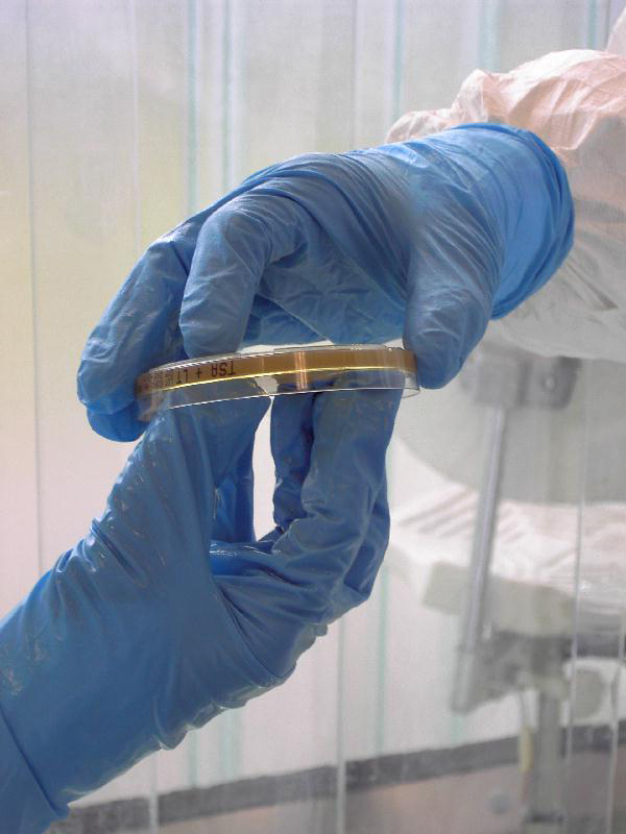
For testing surfaces such as safety workbenches, floors, gloves, and personnel, contact plates are used, with agar poured over the edge of the dish. During sampling, residues of disinfectants used worldwide for cleaning and decontamination are collected. These residues can inhibit the growth of existing contaminants. To neutralize them, inactivation agents are added to the culture media. Suitable combinations of lecithin, polysorbate 80, histidine, and sodium thiosulfate inactivate up to 80% of common disinfectants. To cover a larger spectrum, Merck Millipore has introduced contact plates with the substance mixture "Inhibitor A." Inhibitor A has successfully inactivated all disinfectants tested so far, so that the recoveries of test microorganisms are comparable to control plates without disinfectant.
Since TSA (Tryptic Soy Agar) by definition contains animal ingredients – and thus has the potential to transmit BSE/TSE – Merck Millipore has developed a medium from raw materials of plant origin that exhibits comparable growth-promoting properties to TSA. In addition to vegetarian nutrient media for environmental monitoring, Merck Millipore has also developed dry or liquid media for media fill studies.
Thoughtful Swabs
For testing dry, curved surfaces such as in corners, crevices, narrow vessels, and sampling needles, pre-moistened swabs are used. With conventional swabs, the swab is resuspended in culture medium after sampling and shaken to transfer as many microorganisms as possible. The medium is then examined, e.g., via direct streaking or membrane filtration and incubation of the filter on a nutrient agar plate.
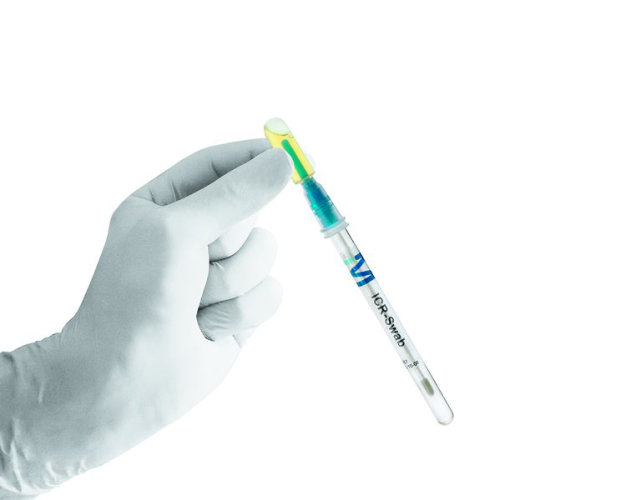
Each of these steps poses a risk of application-related contamination. To avoid opening a tube multiple times, the gamma-irradiated, triple-packaged ICR Swab with an integrated culture medium reservoir has been developed. After returning the swab, the reservoir is snapped off and squeezed, causing the medium to flood the swab. Cloudiness of the medium after incubation indicates contamination.
Instrumental Design
Instruments for active particle or hygiene monitoring draw a predetermined volume of ambient air. Air microbial samplers direct their airflow onto an agar nutrient plate or strip. However, operation or handling of the instrument should disturb the laminar airflow of the cleanroom or isolator as little as possible, as otherwise particles may more easily deposit on the housing. Air microbial samplers such as MAS-100® and RCS High Flow Touch (Merck Millipore) are specifically designed with rounded edges to minimize disturbances to the laminar airflow.
Particle counters are pre-installed in many production facilities. However, if the particle monitoring system needs to be later adjusted, it can significantly disrupt manufacturing processes. Many pharmaceutical companies therefore opt for the flexibility of portable devices. For example, the APC SmartTouch from Merck Millipore can be programmed via its touchscreen and visually display measurement points in a cleanroom, reducing the risk of operator error, and – thanks to two powerful batteries – continuously draw samples. Ultimately, it is a strategic decision whether to choose pre-installed or portable particle counters.
MAS-100 is a registered trademark of MBV AG, Stäfa, Switzerland