

- Packaging, Foil
- Translated with AI
Reduced material usage, improved recycling, optimized logistics: resource-conserving plastic products for highly regulated industries
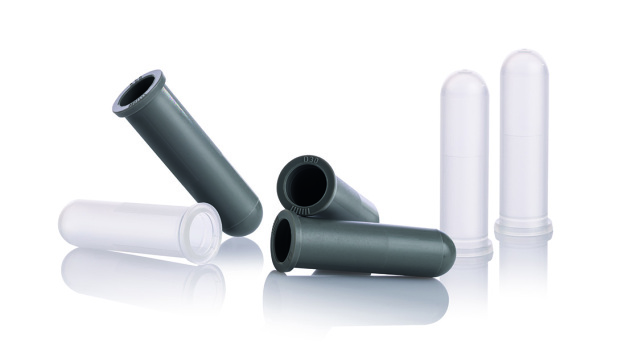
Post-consumer recycled material (PCR) instead of new products: Switching materials to more resource-efficient reagent containers. (Image: Pöppelmann)
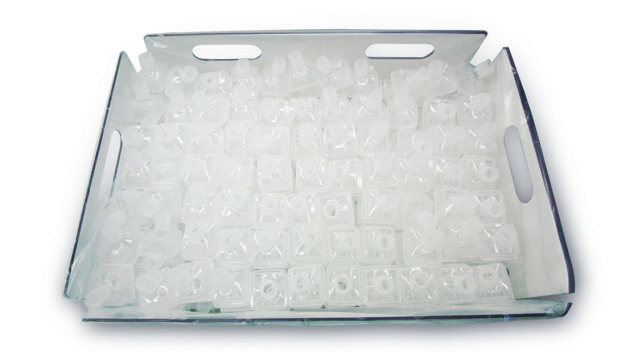
Optimized design, logistical advantages: Each transport unit can now be loaded with significantly more parts thanks to the optimized nestability of the products. (Image: Pöppelmann)
Pöppelmann FAMAC® specializes in the development and manufacture of high-quality individual parts, assemblies, and packaging made of plastic, which are used among other things in the pharmaceutical industry and medical technology. With numerous products for various customers in these sectors, the plastics specialist demonstrates that even under reliable regulatory compliance, more resource conservation can be achieved.
GMP and Climate Protection Under One Roof
Companies subject to the various guidelines for "Good Manufacturing Practice" (GMP) value the Pöppelmann FAMAC® division of the Lohner Pöppelmann Group for its absolute reliability in quality assurance, validation, hygiene management, and documentation. This has firmly established the plastics specialist as a partner in strictly regulated industries. Furthermore, customers benefit from a special expertise: Pöppelmann FAMAC® provides comprehensive support in designing plastic products resource-efficiently – demonstrating that this is also possible in the pharmaceutical medical sector.
Various Adjustment Options for More Sustainability
Under the umbrella of the PÖPPELMANN blue® initiative, the Pöppelmann Group consolidates all activities of its four divisions aimed at greater resource conservation and climate protection. Product development follows the Eco-Design principle, meaning the environmental impact of a product is minimized throughout its entire lifecycle. Under the motto "Reduce, Reuse, Recycle," product concepts are created that reduce material and energy use during manufacturing without impairing the functionality of the product. Where possible, products are designed for multiple uses or to close the material cycle through complete recycling. For example, Pöppelmann FAMAC® optimizes the design of items to reduce material consumption. Plastic scraps from manufacturing are fed back into the production process. In many cases, products are made from more recyclable plastics or even from post-consumer recyclates instead of virgin material. The plastics specialist also successfully leverages logistics optimizations, such as improved nesting of items and design adjustments, to save space and weight, thus conserving resources.
Successful Optimizations and Utilized Savings Potential
Numerous examples from Pöppelmann FAMAC®'s portfolio demonstrate successful implementation. For instance, the design of respiratory filter housings was improved to be more stackable for the customer Drägerwerk AG & Co KGaA, optimizing space during storage and transport. This also significantly reduces greenhouse gas emissions during transportation. For various customers in the pharmaceutical segment, Pöppelmann FAMAC® developed functional, user-friendly packaging. For example, by changing the product design, a lot of material was saved, and the overall weight of the item was reduced by about 20 percent. In another practical example, Pöppelmann FAMAC® created a single-material solution from PP for a three-part tablet dispenser, whose components (container, slider, and lid) were originally made from different plastics. The mono-PP tablet dispenser now simplifies recycling. For the analysis test kit provider QIAGEN N.V., the plastics specialist developed reagent containers from a post-consumer recyclate (PCR), i.e., plastic waste such as from the yellow bin. These items, used for waste from analysis samples with biological material, are produced in large quantities for the customer. They now save a lot of virgin material and help the client reduce greenhouse gas emissions by an impressive 62 percent compared to new products with more environmentally friendly extraction kits.
Pöppelmann GmbH & Co. KG
49378 Lohne
Germany