

- Clothing & Packaging / Films
- Translated with AI
Dipl. Ing. (FH) Margarete Witt-Mäckel, Dipl. Kfm. Dietmar Pfennig
Purity suitability – a challenge for practice
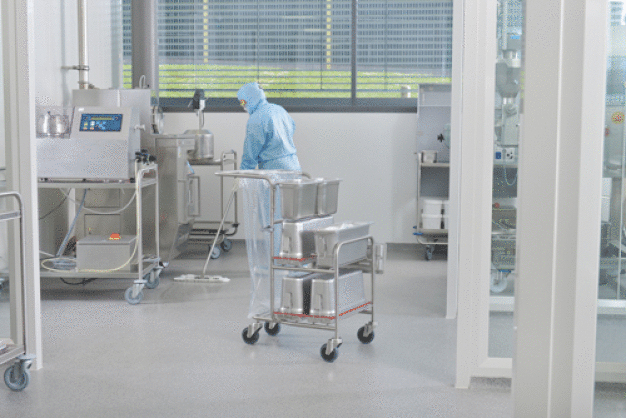
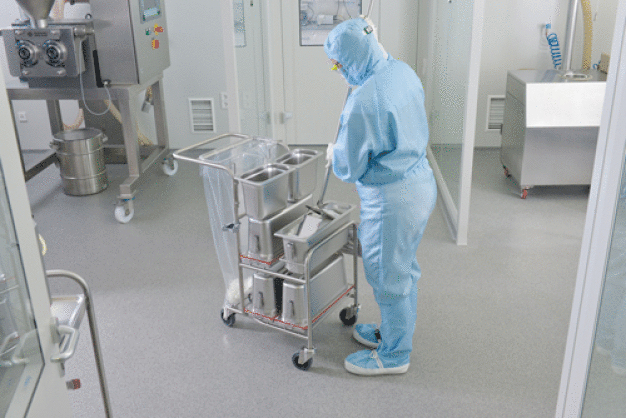
EasyMop GMP-Box: The GMP-compliant system, developed entirely based on Hygienic Design recommendations, is specifically designed for areas where no open liquids are allowed, minimal particle emission is required, and high validation capability is essential. The system must be trained, but misuse is then excluded.
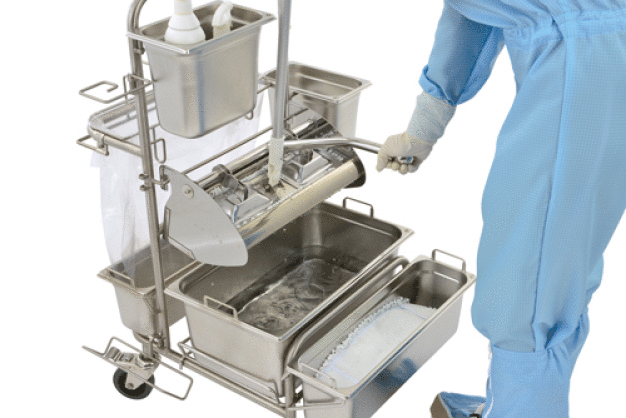
Flat press: The standard system is simple and flexible in application. However, it has disadvantages such as lower validation, higher particle emission, or a greater risk of misuse.
The current state of technology and science shows that equipment and consumables can influence cleanroom processes either directly or indirectly. The influence can be an unwanted increase in particle count in the room air, but also poor results in a contamination-critical process such as the inactivation of product-damaging or pathogenic microbes.
Assessment of equipment and consumables for their respective use in the cleanroom
It would be helpful if there were a standard in which the user, comparable to the VAH disinfection list, had a table from which they could select not only the appropriate equipment and consumables for their process but also compare products from several suppliers. Since the suitability of equipment and consumables depends on the specific operational processes, a general statement is difficult to make, and such an overview table can only serve as a guideline. Competent manufacturers of equipment and consumables will provide recommendations based on experience and investigations, which serve as a basis for the user’s selection and support them. However, the actual suitability must be confirmed by the user within their process under their specific operational conditions. This requires the user to define the parameters important for them to evaluate before selecting a suitable material and, if necessary, prioritize them through a risk assessment. Because it is not always possible to find a product on the market that meets all parameters.
Support in defining the evaluation parameters and the fundamental properties that a suitable equipment or consumable should have for a specific production area can be found in the two guidelines VDI 2083, Sheets 9.1 and 9.2.
Definition of contamination-critical parameters
Certain properties, such as increased particle emission due to abrasion or fiber release, or insufficient liquid absorption, can adversely affect a process and thus the product quality. Therefore, defining the process-specific properties is a prerequisite for evaluation. Additionally, regulatory requirements, such as the EU-GMP guidelines for pharmaceutical manufacturing or the DIN EN ISO 14644 series, must be observed.
Implementation using the example of wiping disinfection of larger surfaces in the cleanroom
The contamination-relevant process considered in this example is disinfection, i.e., the inactivation of all product-damaging and pathogenic microorganisms. System components of this process include personnel, disinfectant, equipment, and wipe cloths. Further, the equipment used for work organization, material transport, and preparation of the wipe cloths, as well as the wipe cloths themselves, are considered. For the equipment and the wipe cloths, it is necessary to define and subsequently evaluate contamination-critical parameters, i.e., properties that can influence the quality of the result.
Contamination-critical parameters
For equipment and wipe cloths, some requirements are described in various regulations, such as the EU-GMP guidelines for pharmaceutical production, the DIN EN ISO 14644 series, or the 2083 guideline series. These are partly clearly defined but also very general. These requirements include specifications for processing and design, cleanability, chemical resistance, particle emission, sterilizability, validation, and more. Since wipe disinfection is a manual activity, ergonomics and user safety must also be considered, along with other aspects such as wear resistance, efficiency, and performance. Depending on the application area, operationally specific properties such as electrostatic behavior may also be relevant.
Definition and evaluation of contamination-critical parameters using the example of a system cart for preparing cleanroom wipe cloths
Equipment used in cleanrooms for wipe disinfection must, like all other equipment, be suitable for its intended use in the respective cleanroom. For equipment with moving parts, such as a flat press, the particle emission caused by friction during mechanical movement is measured in a defined air volume and assigned to a cleanroom class. This determines the influence this device has when used in a specified air cleanliness class. Particle abrasion can be reduced through material selection for moving parts but cannot be completely avoided, as movement is necessary for pressing out the wipe cloth. An alternative would be pre-preparation of the wipe cloths without mechanical action.
Porous surfaces or corrosion generate particles and provide hiding places for contamination. Therefore, certain materials should be avoided. Similarly, corners, sharp edges, poorly processed welds, or non-draining components should be avoided for the same reason. To prevent equipment from providing attachment points for contamination, the entire construction must be easily cleanable and show no material incompatibility with used disinfectants and any residual product. It is recommended to work with the guidelines of the European Hygienic Engineering & Design Group.
Equipment must demonstrate durability and minimal change in parameters over the defined lifecycle. This durability is especially important for equipment used in sterile areas (GMP cleanliness class B), which are frequently autoclaved. Durability also means that no undesired substances, such as those released by extraction in the presence of solvents, are present. In some production areas, electrostatic conductivity is also important.
Since wipe disinfection is a manual activity, user-related parameters play a significant role. These include ergonomics, ease of handling, and the avoidance of cross-contamination through overlapping work steps. Even a perfectly designed device can lead to poor process results if the user does not understand or cannot properly operate it.
Definition and evaluation of contamination-critical parameters using the example of a reusable wipe cloth
When assessing the suitability of textiles for use in the cleanroom, some providers and market participants particularly emphasize particle emission, i.e., the release of particles and fibers from the textile. This is partly because fiber release from textiles is easily traceable, and partly because cleanroom technology and cleanliness classes provide a classification based on airborne particles, which is generally known. Statements like “ISO-5 certified cleanroom cloth” are common. However, for many processes, other properties are even more relevant, and often overlooked — what exactly is tested and claimed regarding particle emission?
Which contamination-critical parameters need to be defined and considered for a wipe cloth? Of course, first and foremost, the cleanroom suitability. As mentioned above, this involves suitability for the intended use in a specific cleanliness class by measuring particles released into a defined air volume. This measurement is usually performed with the dry textile, moved in a standardized manner. This is especially relevant when the textile is used dry and close to the product. However, wipe cloths for disinfection are used not directly on the product nor in a dry state but moistened with disinfectant solution. Additionally, the measurement describes a state at a specific point in the lifecycle of a wipe cloth.
The goal of wipe disinfection is the inactivation of unwanted microorganisms. For this, the active substances must be applied to the surface in sufficient quantities via the wipe cloth. Parameters that are more relevant for disinfection success than the dry particle emission include the liquid absorption capacity and the liquid release capacity. It is also important to consider known interactions between textiles and certain surfactant-based active substances. If the wipe cloth is used in a sterile environment (GMP cleanliness class B), it must be sterilized, i.e., irradiated or autoclaved. Not all textiles are suitable for this purpose.
Summary
The existing regulations, especially the VDI 2083 guideline series, as well as support from technically competent suppliers, do not exempt the user from considering their contamination-critical processes and defining and evaluating the possible influence of the equipment and consumables used. A true assessment of the suitability of equipment and consumables can only be made through operational testing, proper process validation, and regular monitoring of contamination-critical parameters.

Pfennig Reinigungstechnik GmbH
Heubachstr. 1
87471 Durach
Germany
Phone: +49 831 561220
Fax: +49 831 61084
email: info@pfennig-reinigungstechnik.com
Internet: http://www.pfennig-reinigungstechnik.com