



- Translated with AI
Purely clean for fail-safe systems
Purely clean for fail-safe systems
ARNOLD UMFORMTECHNIK introduces a novel cleanliness concept for fastening elements according to VDA 19
With the guidelines VDA 19 and ISO 16232, requirements for testing technical cleanliness have been introduced for the automotive industry. After all, part cleanliness is an important quality feature, crucial for the reliability and function of components. To meet these specifications, it is necessary to detect any possible contamination and quantify the particles. ARNOLD UMFORMTECHNIK's cleanliness concept, Cleancon, goes a step further and offers a process that covers cleanliness requirements from production to customer application.
Automakers are caught in the "chip trap." On one hand, electronic systems are intended to make cars safer and more comfortable. On the other hand, this creates numerous potential sources of error. Electronic failures are now considered the number one cause of breakdowns across all OEMs. Consequently, the technical cleanliness of electronic, pneumatic, and hydraulic components (e.g., in brakes, engines, and chassis) presents an increasing challenge for the automotive industry. As highly complex assemblies and modules become more compact and powerful, microscopic particles on surfaces can cause malfunctions. Simple and cost-effective solutions are needed to prevent expensive "field failures" caused by particle contamination.
One such solution comes from ARNOLD UMFORMTECHNIK – the Cleancon cleanliness concept. This allows the realization of customer cleanliness requirements for components and significantly increases operational safety. The entire process takes place in five steps:
In the customer's requirements profile, the limit values are defined, the environment is considered, surface and inspection specifications are recorded, and finally, the packaging is determined. Production is accompanied by manufacturing-related cleaning processes. Fine cleaning takes place in a cleanroom, optionally applying slip coatings, and the elements are packaged. For cleanliness analyses according to VDA 19, an adapted extraction process is used, along with investigations into particle size distribution and gravimetry. The cleanliness-appropriate packaging finally includes a layer-fixing inner packaging in the "onion skin" principle, called "Cleanpack," as well as customizable outer packaging.
No external service providers needed The offering from the fastening technology manufacturer makes external specialized companies unnecessary, which typically clean screws before installation. The commissioning OEMs and suppliers often face significant problems: sometimes the cleaning process washes away the slip coating necessary for later assembly on the screws. As a result, friction or torque moments may be exceeded, and the calculated assembly preload forces may not be achieved. Additionally, suitable transport packaging is often missing, which can cause new dirt particles during shipping due to relative movements. Finally, systems used for feeding the components can negatively influence cleanliness during individualization of the fastening elements.
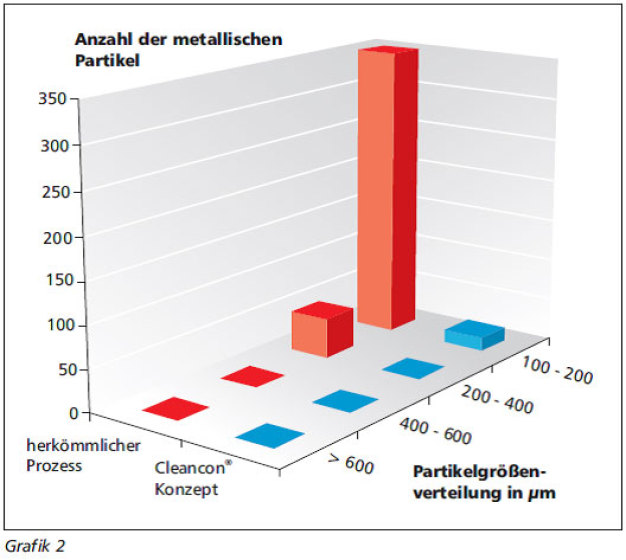
Comparing the traditional process with Cleancon yields a clear result: the number of metallic particles drops drastically (see Graphic 2). The functionality of the application remains positively sustainable. For the customer, this now ensures cost-effectiveness, as reduced wear leads to longer service life and fewer complaints. Additionally, there is improved assembly safety and the opportunity for further miniaturization of components, meaning higher power density and smaller structures.
Success factor of the new cleaning process
ARNOLD UMFORMTECHNIK is particularly proud of the specially designed cleanroom, which has conditions similar to a cleanroom environment. Here, the fastening parts undergo fine cleaning at the end of the manufacturing process using state-of-the-art equipment, followed by the application of a slip coating immediately after cleaning, and finally, cleanliness-compliant packaging in "Cleanpack." The last two steps ensure that no subsequent external process steps compromise the cleanliness values. Specifically, "Cleanpack," as a layer-fixing and anti-static inner packaging, absorbs relative movements of the components during transport – similar to bulk cargo – and subsequent particle contamination is a thing of the past.



