



- Translated with AI
Paul Jochem
Phenomena in the cleanroom!?
Particle measurement of airborne contamination in cleanrooms is embedded both in ISO standards (ISO 14644) and in pharmaceutical guidelines.

Paul Jochem
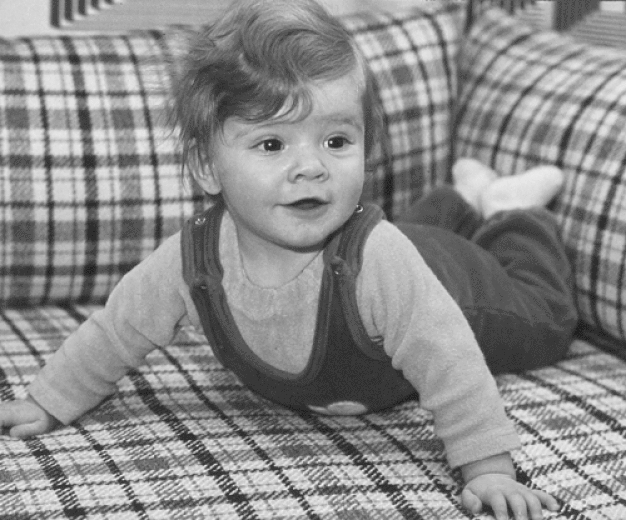
Sabrina, 10 months old, whenever she saw the camera, she smiled and posed.
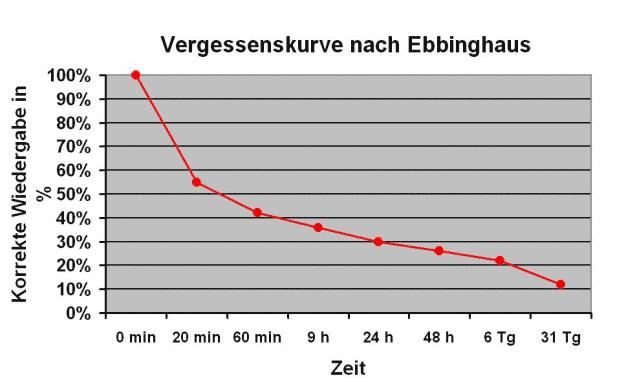
Forgetting curve according to Ebbinghaus
In the production of pharmaceutical products according to GMP (Good Manufacturing Practice) and GAMP (Good Automated Manufacturing Practice), increasingly strict regulations and rules apply, which must be monitored and documented within the framework of the quality management system.
In textbooks or study books such as those published by VDI-Verlag, e.g., "The Optimization of Cleanroom Clothing with regard to the Emission of Airborne Particles," the author writes: "It is known that many particles that contaminate processes, process media, and ultimately the products, are introduced into the cleanroom by personnel." Studies report that 80% of all particulate contaminants found in cleanrooms are brought in by people. Therefore, cleanroom personnel are considered a primary source of contamination.
This is where the imperceptible begins. Even in infancy, we gradually perceive our environment. Children need many different sensory experiences to develop and to perceive their environment and themselves. They smell, taste, touch, feel, see, and hear. The sense of touch is a fundamental sense for our physical and mental well-being. Touching promotes our individual ability to learn, supports, and fosters the development of the entire nervous system. Through the sense of touch, we receive information about the objects in our environment, surface textures (smooth, rough), consistency (sticky, hard), temperatures (hot, cold), shapes (round, angular), sizes (large, small), and proportions. Through grasping, we "comprehend." The full development of the sense of touch through various forms of tactile experiences forms the foundation for the development of all types of intelligence.
Our skin contains millions of sensors that respond to external stimuli. They inform the brain whether something feels cold or hot, smooth or rough, hard or soft. Most of these sensors are located on the hands and mouth. In young children, this can be observed; they make most of their experiences by putting everything in their mouths. They repeat this so often until they locate and understand or recognize the object.
For healthy development, it is important that all senses function well. Of particular importance is a healthy interplay of all bodily senses (sensory integration). Sensory integration refers to the organization of sensory impressions to process them consciously. The stimuli that constantly act upon us, providing information about our body condition and our environment, must be recognized, understood, distinguished from each other, interpreted, and compared with already stored information by the brain.
This illustrates our problem. When transmitting that humans introduce most contamination into the cleanroom, only the sense of hearing is sensitized during the transmission of the learning material, meaning the learner must believe that they are the source of contamination in the cleanroom. What does belief mean? Belief is an assumption—the acceptance—of a fact. In this sense, the vast majority of our knowledge is based on belief. Unlike general belief, religious faith is always based on the will to believe or on suggestion.
In philosophical and especially epistemological terms, belief means accepting one's perceptions, convictions (faith, dogma, paradigm), and conclusions, which, however, do not necessarily have to be logically compelling. This acceptance does not necessarily require objective justification and can be subjective.
In the cleanroom, we have the possibility to record and monitor the number of airborne particles using a monitoring system (particle counter). But this can only be done through monitoring, not visible to the naked eye. How is our memory supposed to process this? If stimuli are not properly perceived, the world is limited, and we simply do not understand what is happening.
If stimuli are not correctly classified or cannot be compared with previously stored information, things cannot be recognized again.
Perception means sensing and understanding something with the senses. This happens in the brain. What we see, hear, feel, smell, and touch is integrated into a whole in the brain, compared with stored experiences, and interpreted based on that.
Now, additionally, it becomes more difficult because we forget what we have learned or been taught. Many studies have shown that only 60% of what was learned can be recalled just 20 minutes after learning. After an hour, only 45%, and after a day, only 34% of what was learned remains in memory. Six days after learning, the recall ability has shrunk to 23%; only 15% of what was learned is stored permanently. The brain needs some time to store what has been learned. It must transfer from short-term to long-term memory. To do so, repetition is necessary—and to let the new information "settle." The fewer senses involved, the more difficult understanding or retention becomes.
Returning to our core topic, it should be noted that only with the support of so-called particle monitors can airborne particles be detected, as their size is in the nanometer range. Not visible to the naked eye, yet present. For me, this is a phenomenon!
What is a phenomenon? The phenomenon (plural: phenomena) describes a single event perceivable with the senses, in a broader sense, the sensory-emotional perception of an event as an active process by the perceiver.
Emanuel Kant contrasts the phenomenon with things-in-themselves. These things-in-themselves do not appear as such but are only thought of by us, the knowing subjects, as the basis underlying the phenomena.
This is where our problem begins. To maintain the quality standards of the cleanroom, contamination must be avoided. How does a normally thinking person react to this? They subconsciously suggest to themselves that what they cannot see cannot be present. From this point, the particle counter ticks without the person in the cleanroom perceiving it.
I keep asking myself: Can we teach people something so that their behavior is "programmed for contamination avoidance," even though they cannot see, touch, feel, grasp, or understand the contamination?
Is this even possible in quantity, as we often discuss in training sessions for cleanroom staff? Or is it only perceived subconsciously but not realized because it is intangible?
We need to address this. In my opinion, the most challenging part is to teach interested parties that we are talking about phenomena (non-visible airborne particles) and that avoiding them must be regarded as the highest priority, regardless of whether we can see, touch, or understand these particles. It will be a challenge to convey this to the trainees, as awareness of contamination avoidance does not activate the stimuli we use to feel, recognize, or comprehend. Humans are programmed to perceive with their senses and to recognize the significance and impact of perceptions. How do they react to effects of prolonged exposure, which they can only suspect, and which are not visible?
Perception, as previously mentioned, involves sensing and understanding something with the senses. This occurs in the brain. I believe I can assert that the term phenomenon is justified in the context of the cleanroom. How we can alter the consciousness of cleanroom workers to suppress something in their subconscious that they cannot see will demand a lot from us in the future and still requires further discussion. Because if it were so simple, we would be talking about a much lower percentage of airborne particles released by the staff in the cleanroom.
Sources:
Development of the senses by Angelika Reichartzeder, information and play suggestions for promoting sensory perception, Kreis Unna, Herrmann Ebbinghaus, psychologist,
ReinraumTechnik-Jochem
66538 Neunkirchen
Germany