



- Translated with AI
Perfection and innovation shape the future of component cleaning
28th Conference on Industrial Component Cleaning on April 4/5, 2019 in Ulm
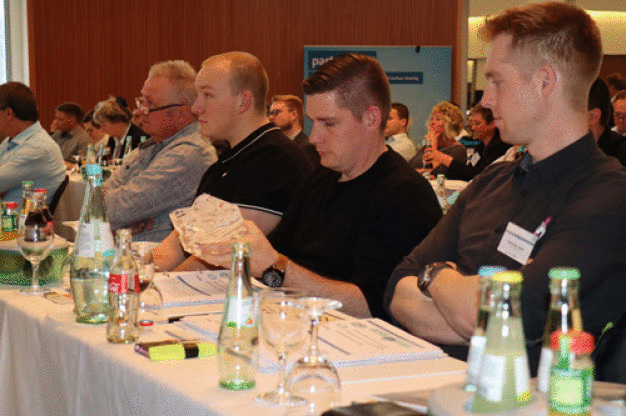
The current and practical lecture program was very well received again by the total of 116 participants. (Image: ZVO)
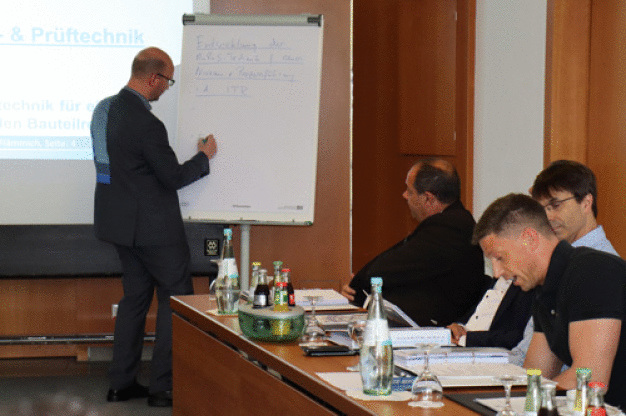
The moderation of the three roundtable discussions was carried out by the heads of the respective specialist committees at FiT, here Dr. Michael Flämmich on the topic of Measurement, Testing & Control. (Image: ZVO)
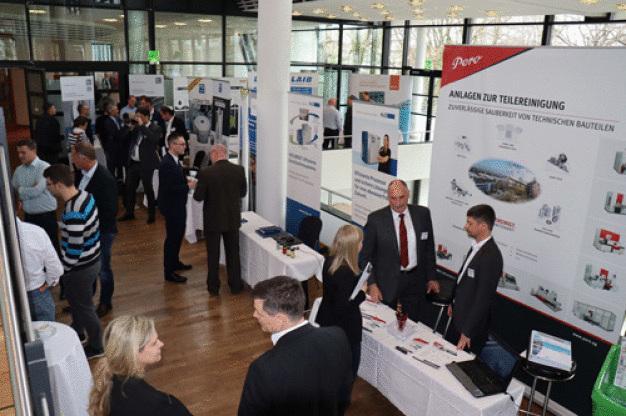
Find solutions, share experiences, expand contacts: The accompanying exhibition offered the opportunity for further professional discussions. (Image: ZVO)
Two days of expert knowledge and fundamentals of proven and new solutions in industrial cleaning, including experience exchange at round tables and in the accompanying exhibition, were hosted by the Industrial Parts Cleaning Association e.V. (FiT) on April 4 and 5, 2019, at the Maritim Hotel in Ulm. A total of 116 participants and 20 exhibitors attended the conference organized by fairXperts, which was held under the motto "Perfection and Innovation shape the future of component cleaning."
Whether automotive or supplier industry, medical technology, mechanical engineering, aerospace, fine and micromechanics, optics, electronics, or other industrial sectors – detailed specifications regarding particulate or film contamination are now commonplace for many components. The FiT Industrial Cleaning Conference offers solutions to efficiently achieve and maintain the required product and process quality. While in the past the focus was mainly on testing the cleanliness of components, FiT and its event are increasingly concentrating on mastering the entire process. This is evidenced, among other things, by the guidelines developed by FiT for quality-assuring process control in component cleaning, the checklist for planning a cleaning process, and the guideline "Controlling Film Contaminations."
This approach was consistently continued at this year's 28th Industrial Component Cleaning Conference, which received an overall grade of 1.7 from participants. It provided detailed insights into individual links or steps in the process chain.
High process and product quality through perfection
On the first day of the event, the focus was on perfect solutions for high product and process quality. After introductory words by the Deputy Chairman of FiT and conference director Prof. Dr. Lothar Schulze, Ulrike Kunz from SurTec Deutschland GmbH opened the lecture program with an overview of the fundamentals and process engineering solutions for optimal component cleaning. Using medical technology as an example, she illustrated solution approaches such as the selection of the optimal cleaning chemistry and the process chain consideration.
Following this, Franziska Link from SEW Eurodrive GmbH & Co. KG discussed optimizing the cleaning process in gear manufacturing. A series trial revealed that the system's coolant system, equipment, and cleaning medium are crucial for process capability. To increase bath service life and plant availability, initial tests with ultrafiltration systems are being conducted, and their impact on the process is being evaluated.
The focus of Jens Emmerich from BCD Chemie GmbH and Uwe Remme from CERA SYSTEM Verschleißschutz GmbH was on optimizing cleaning processes in the production of ceramic components. The various steps led to optimal process control, with efficient bath service times, increased plant utilization, and a reduction in rework rates. Ultimately, product quality was significantly improved, and supplier approval was achieved.
Markus Mitschele from HÖCKH Metall-Reinigungsanlagen GmbH and Michael Onken from SAFECHEM Europe GmbH explained in a tandem presentation the development history of solvent cleaning based on a practical example from the aerospace industry. Their conclusion: When the required technical cleanliness (film/particulate) can be achieved with solvents, it is often an economical and process-safe alternative to aqueous media.
The new technical managing director of MAFAC – E. Schwarz GmbH, Stefan Schaal, introduced the MAFAC Vektorkinematik, a new dimension in moving cleaning. Unlike a rigid or rotating spray pipe, the rotating and pivoting spray pipe of the Vektorkinematik achieves 60 percent higher impact on components, blind holes, undercuts, and spray shadows solely through movement. This leads to an optimization of cycle times. The system can be combined with spray pressure, pulsed pressure, or ultrasonic cleaning. It will be available optionally in the MAFAC JAVA and MAFAC PALMA series. An additional goal is retrofitting in existing cleaning systems.
The topic of mechanical particle filtration in cleaning wheels was addressed in Stefan Barwig's presentation from Filtertechnik Jäger GmbH. The filter, as part of the system, is often neglected. However, filtration requirements are becoming increasingly demanding. High-flow filter elements with large filter areas help make filtration processes economical and efficient. Despite their higher price compared to conventional filter bags, their use results in overall cost savings. For example, the Cora®Pleat, which has been market-ready for 2.5 years for cleaning technology, can extend service life six- to tenfold.
The theme of quality assurance was the focus of the last three contributions of the first day, before a dedicated conference section provided time for further discussions among participants, exhibitors, and speakers.
Tilo Zachmann from SITA Messtechnik GmbH discussed ensuring product quality through wetting control. He introduced a testing method or product that offers process-related wetting control via contact angle measurement. Wettability is crucial for subsequent coating processes. The threshold values must be individually defined depending on functionality.
How a capable and controlled component cleaning process can be achieved using the Six Sigma method was presented by Almut Melzer from Six Sigma TC GmbH and Dr. Michael Flämmich from VACOM Vakuumkomponenten und Messetechnik GmbH.
The closing presentation was by Christoph Tammer from Fraunhofer IGCV, who described the technical-scientific approach of the newly initiated project "UltraRein," funded by the BMWi within the framework of IGF and AiF, submitted by DGO. The project aims to achieve a new level of data collection by using an intelligent multisensor system to monitor the ultrasound effect chain, thereby transitioning from experience-based to adapted cleaning.
Innovative solutions for the future of component cleaning
The second day focused on innovative solutions for the future of component cleaning. Magnus Irion from Ecoclean GmbH kicked off by presenting the digitization of a cleaning system. The Ecoclean CareConnect, first presented at parts2clean 2018, offers an approach toward a self-regulating cleaning process.
Online sensors for continuous cleanliness monitoring of components were introduced by Dr. Sebastian Wex from RJL Micro & Analytic GmbH. He first provided an overview and outlook on methods and possibilities for contamination control and then presented a new technical concept for detecting particulate contamination through industrial imaging. Imaging is well suited for surfaces, but for corners, edges, and internal areas, the theoretical concept still needs further development.
Also about the digitization of cleaning processes, but in dry cleaning, was Dr. Günther Schmauz from acp Systems GmbH. He introduced the CO2 snow jet cleaning process quattroClean for digital transformation. The quality of the snow jet is monitored and can be converted into a digital value that can be assigned to individual components and, for example, stored in a 2D Data Matrix code.
After the technical presentations, round table discussions explored the future of component cleaning. In three specialized discussion rounds, speakers, participating providers, and users discussed aspects of chemistry & processes, plant technology, as well as measurement, testing & control. The moderators of the round tables were the respective FiT committees, which opened the sessions with impulse lectures and then invited discussion.

Fachverband industrielle Teilereinigung (FiT) e.v.
Geschäftsstelle
Hauptstraße 7
72639 Neuffen
Germany
Phone: +49 7025 84340
Fax: +49 7025 843420
email: info@fit-online.org
Internet: http://www.fit-online.org