


- Translated with AI
News from Mercury, Mars, and the Moon – the largest gathering of European planetary scientists in 2018 in Berlin
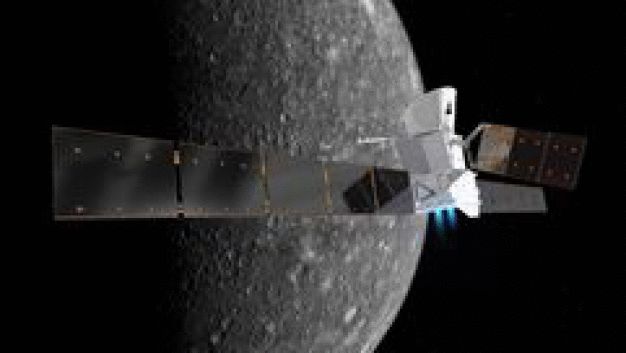
The ESA space probe BepiColombo at Mercury (© ESA)
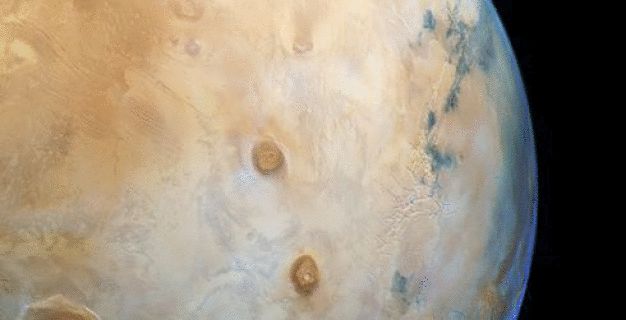
Research focus Mars at EPSC 2018 (© ESA/DLR/FU Berlin, CC BY-SA 3.0)
From September 16 to 21, 2018, the European Planetary Science Congress (EPSC) took place at the Technical University of Berlin. It is the largest annual gathering of professionals in the field of planetary research. Focus: The exploration of the planet Mercury within the most extensive European planetary mission to date, potential life on Mars, a new mapping of the Moon, and the search for planets beyond our solar system.
Over 1,000 scientists from around the world exchanged results in lectures, workshops, and discussion formats on their findings in planetary research. The internationally significant event was held in Berlin for the second time.
"Berlin has become a real 'hotspot' for planetary research over the past two decades, thanks to TU Berlin, planetary science at Freie Universität Berlin, and of course the DLR," reported Jürgen Oberst, Professor at the Institute of Planetary Geodesy and Geoinformation Technology at TU Berlin and Head of the Planetary Geodesy Department at the Institute of Planetary Research of the German Aerospace Center (DLR) in Berlin-Adlershof.
"Since the first EPSC in 2005, Berlin in 2018 has hosted the conference with the most contributions and the highest number of participants," Oberst, who is responsible for organizing EPSC in Berlin, said with pride.
The range of topics at EPSC is as diverse as the solar system itself, with its eight planets, more than 180 moons, and countless small bodies such as asteroids and comets that populate our cosmic home.
The exploration of Mercury and the search for habitats on Mars
A key focus of the conference is the upcoming launch of the space probe "BepiColombo." The European Space Agency (ESA) will send its orbiter into space in the early hours of October 20 from the Guiana Space Centre in Kourou, French Guiana, on its journey to Mercury. The spacecraft is expected to reach its destination in 2025. Scientists from DLR and TU Berlin are involved with experiments on this, the largest European planetary mission to date.
Mars was also a focus of the conference: For 15 years, the ESA spacecraft "Mars Express" has been orbiting the neighboring planet of Earth. The main experiment of the mission is a stereo camera system developed at DLR in Berlin, which scans the "Red Planet" in high resolution, in color, and in 3D. The image data creates a global digital terrain model, enabling significant progress in the geological characterization of the planet.
Results from a study of Mars' atmosphere using the ExoMars Trace Gas Orbiter were also eagerly awaited, as they will provide further insights into the planet's properties. Excitement grew around a follow-up project scheduled for launch in 2020: the "ExoMars Rover," a vehicle equipped with numerous experiments, a drill, and cameras onboard, will search for habitats of microorganisms on the surface of Mars.
Our Moon in HD and the cosmic view into the distance
Besides Mercury and Mars, the Moon remains of great scientific interest. Since 2009, NASA's Lunar Reconnaissance Orbiter has been orbiting Earth's satellite and sending high-resolution images of its surface back to Earth. Not least for the ideas of major space agencies planning to return humans to the Moon in the 2020s, this improved mapping of the Moon is of great importance.
Planets beyond the solar system will also be topics at the conference: Since the discovery of the first planet orbiting another star in 1995, powerful space telescopes like Kepler and CoRoT have discovered about four thousand so-called extrasolar planets. There is not yet a "second Earth" among these "exoplanets," but new space telescopes from ESA such as CHEOPS (launch 2019) and PLATO (launch 2026) aim to specifically search for Earth-like planets around other stars in the Milky Way.
From Berlin to space: Scientists and an astronaut report to Berlin youth
On September 19, an event titled "From Berlin to Space" took place at TU Berlin's Audimax for students in grades 9 to 12. German astronaut Dr. Gerhard Thiele, together with former director of the DLR Institute of Planetary Research Prof. Tilman Spohn and DLR physicist Dr. Ruth Titz-Weider, presented the major topics of planetary research. From current space missions, the search for planets around other stars, research on the International Space Station (ISS) in low Earth orbit, to the future of astronautic spaceflight, all were covered.
Technische Universität Berlin
10587 Berlin
Germany