



- Translated with AI
New sporicide testing of disinfectants in the human medical field according to EN 17126
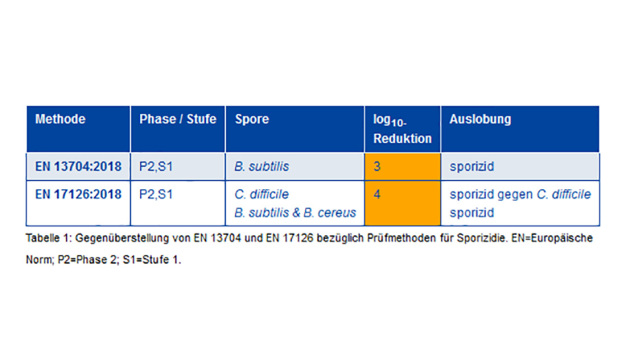
Table 1: Comparison of EN 13704 and EN 17126 regarding testing methods for spore resistance. EN=European Standard; P2=Phase 2; S1=Level 1.
Background
The effectiveness of chemical disinfectants must be investigated using standardized testing methods in order to classify a product as effective for its intended use according to its labeling. Unlike claims such as "bactericidal," "mycobactericidal," "virucidal," and "fungicidal," until recently there was no testing standard for disinfectants declared as "sporicidal" in the human medical field within European standards. The labeling of sporicidal efficacy of disinfectants has thus so far been based on the EN 13704 standard, which is intended for testing chemical disinfectants for food, industrial, household, and public facility sectors – a common approach. However, because the test conditions of EN 13704 are not adapted to the human medical field, this gap was closed with the adoption of EN 17126.
What changes with the new EN 17126?
With the publication of DIN EN 17126 in February 2019, a European standard is now available that defines the requirements for testing the sporicidal effect of chemical disinfectants in the human medical field. The testing method described takes into account application conditions that influence effectiveness in practice (e.g., contact time, temperature, test organisms, and contamination substances). The main changes compared to EN 13704 are:
- For the first time, "sporicide against Clostridioides (C.) difficile, the most relevant spore-former in the human medical field," has been included as an independent spectrum of activity.
- The sporicidal effect against Bacillus (B.) subtilis and B. cereus can still be tested, covering both anaerobic and aerobic spore formers.
- Compared to the previous EN 13704, the spore production process has been adjusted to include a reference substance, and the acceptance criteria have been increased from 3 to 4 log10 steps (see Table 1).
Compared to EN 13704, the requirements for demonstrating sporicidal efficacy are significantly higher based on EN 17126.
What does this mean in practice?
Disinfectants tested and labeled according to the then-current standard EN 13704 can still be used until their expiration date. These products have not lost their efficacy; they simply do not meet the new, higher requirements of EN 17126 yet. EN 13704 remains valid in the food, industrial, household, and public facility sectors.
The decision whether a product labeled according to EN 13704 continues to be used must therefore be made by the healthcare facility based on its own risk management. The remaining efficacy of a disinfectant is unaffected by this change, as the assessment of its efficacy against these organisms is not impacted. If the healthcare facility chooses to exclude the use of products labeled according to EN 13704, the disinfectant can still be used in areas where sporicidal activity is not required.
BODE Chemie GmbH
22525 Hamburg
Germany



