



- 3D printing
- Translated with AI
New possibilities for component manufacturing with serial material in 3D-printed tools
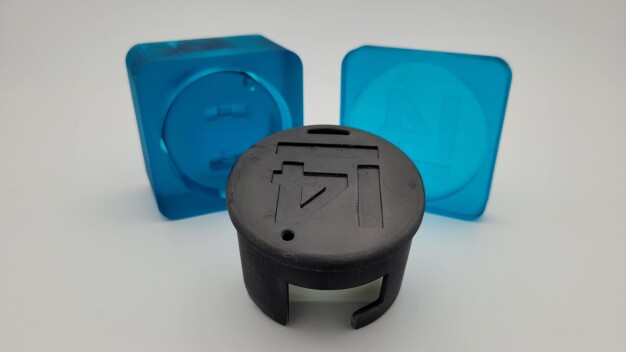
End cap for carbon tube for Int 14 boat. Customer: ar engineers GmbH. (Image credit person: SK Industriemodell GmbH)
– Numerous advantages with the use of 3D printed tools
– xMold high-performance resin from Nexa3D compatible with almost all injection molding materials
– New possibilities for research & development as well as early product development for manufacturing components with series materials
SK Industriemodell GmbH has further developed its innovative ‘Print & Inject’ process. Using the xMold high-performance resin from Nexa3D opens up new opportunities in research & development and in the early stages of product development for manufacturing components with series materials in 3D printed tools. With this advancement and an improved service offering, the company provides a future-proof solution for the production of prototypes as well as complex and delicate parts across various industries.
New possibilities for prototypes as well as complex and delicate parts
“We are pleased with the successful further development of our ‘Print & Inject’ process. The use of Nexa3D’s xMold high-performance resin has already ensured convincing tool and component quality in initial product developments,” explains Sebastian Krell, Managing Director of SK Industriemodell GmbH. Additionally, highly detailed representations and delicate geometries within a component could also be realized. “With the new process, there are almost no limits to manufacturing extremely complex or delicate parts with undercuts, as well as shaping prototypes or new components,” Krell adds. The solubility in alkali is a special feature of the high-performance resin used, which is also compatible with nearly all injection molding materials.
“Undercuts can be produced with firmer injection molding materials, and forced demolding is no longer necessary. As a result, undercuts, which previously often caused difficulties in prototype construction, can literally be dissolved in alkali. Furthermore, the alkali can be easily removed from the final product if the shape of the component requires it. It is also possible to quickly adapt the tool to accommodate the shrinkage of different materials,” Krell details.
Numerous advantages for research & development as well as product development
“The many benefits of the ‘Print & Inject’ process are enjoyed by research & development and product development departments across numerous industries, especially in plastics, automotive, and medical technology. The use of the xMold high-performance resin for manufacturing prototypes and components is possible in both single-use and reusable 3D printed tools,” Krell explains. This saves costs for users, including faster tool production and the manufacturing of complex parts with undercuts. Storage and maintenance costs for injection molding tools or spare parts are also eliminated. Additionally, prototypes and components can be produced in nearly all standard injection molding materials and in small quantities or even single units, which can also optimize spare parts inventory. “When using a single-use tool, the batch size typically ranges from 1 to 30. When using reusable 3D printed tools, the batch size can be significantly larger depending on the process and components. Furthermore, a tool can be produced repeatedly from a single data set in the future,” Krell adds, referring to a process tailored to customer needs. Prototype manufacturing can thus be offered as a service based on customer-supplied CAD data. “Additionally, we support customers on-site with a comprehensive ‘turn-key’ solution for implementing the technology. With the expanded service offering and the use of Nexa3D’s xMold high-performance resin, we elevate the ‘Print & Inject’ process to a new level and continue the success story we started together with RWTH Aachen in 2017,” Krell emphasizes.
Background of the ‘Print & Inject’ process
The ‘Print & Inject’ process was developed in 2017 by SK Industriemodell GmbH as part of research projects in collaboration with RWTH Aachen. The production of 3D printed tools created new possibilities in the field of tooling for complex components and for manufacturing parts via injection molding. With ‘Print & Inject,’ prototype construction is no longer dependent on conventional tools, enabling rapid production of prototypes and testing of parts in small quantities under real conditions at low cost. With the recent advancement and the use of Nexa3D’s xMold high-performance resin, new opportunities are emerging in research & development and early-stage product development for manufacturing prototypes and complex, delicate parts from series materials.
SK Industriemodell GmbH
52531 Übach-Palenberg
Germany