


- Translated with AI
New cleaning regime. Recognize what is affecting you! Validation of a UV lamp
New cleaning regime. Recognize what is happening to you! Validation of a UV lamp
Authors: Dominic Heckmann and James Tucker
Introduction
The Clerice UV Lamp is a unique innovation in cleanroom technology, making the invisible visible. With this lamp, critical areas can be highlighted, and through improved staff training, problems can be solved before costs arise. The lamp can be used for process optimization, for example, to indicate modified cleaning procedures necessary during transfer disinfection. Furthermore, the lamp is a valuable tool for demonstrating and teaching correct cleaning and disinfection techniques to staff. Ideally, the lamp can be used during cleaning and disinfection processes to identify risk areas and to verify the reduction of contamination.
Additionally, the lamp allows inspection of difficult-to-clean areas to rule out possible contamination. This is an important tool, for example, after spills, as it enables the user to confirm the complete removal of contamination after the cleaning process.
There are different methods to ensure that cleanrooms are kept clean. This can be done through visual inspection, microbiological and particle monitoring, residue testing, or adherence to standard operating procedures. The Clercide UV Lamp now offers the possibility to go beyond these methods, providing a sensitive and immediately visible result. This technical report summarizes the independent validation with fixed parameters to examine the functionality of the lamp.
Background
The UV light emitted by the lamp stimulates electrons in particles. These particles can only temporarily store the energy of the radiation (absorption) and quickly release this additional energy as light (emission). It is the light energy emitted by the particles that makes the previously invisible visible to the eye; "making the invisible visible".
Protocol
The lamp was tested against the effects of the following parameters to verify the visible detection of particles and the reproducibility in practice:
Particle size
Background lighting
Different background surfaces
Distance from the lamp
Fluorescence of different materials
Additionally, the validation includes proof of the effectiveness of a training concept using the UV lamp.
Particle size
To determine the detection limit, latex particles of varying sizes were diluted in water and exposed on a surface.
Background lighting
These tests were conducted with different levels of background illumination to determine at which level particles are no longer visually detectable and at which level the optimal detection of surface contamination is achieved.
Different background surfaces
Various background surfaces were used to test whether the illumination or contrast affects the visibility of the emitted light.
Distance from the UV source
These tests were performed at different distances between the UV source (lamp) and the surface to determine the point at which the source becomes too weak to detect particles.
Fluorescence of different materials
It is assumed that, due to the way the lamp works, the fluorescence of particles will depend on the density and homogeneity of the material.
Testing method
Materials:
Particles (0.7 μm / 3.0 μm / 30 μm / 50 μm)
Filtered water
Glass Erlenmeyer flask 100 ml particle-free
Glass microscope slides
Eppendorf pipette
Dry oven
Stainless steel plate 10 x 10 cm
Plexiglas plate 10 x 10 cm
Makrolon (polycarbonate) 10 x 10 cm
Pharma Terrazzo 10 x 10 cm
Hypalon (glove material) 10 x 10 cm
RODAC plate (25cm²)
LUX2 measuring instrument
Adjustable neon tube
IPA wipes
Mounting plate for the flashlight
Measuring tape
Various materials according to Table 2
Clercide UV Lamp
Particle size:
The individual particle suspensions were prepared with water in a 100 ml Erlenmeyer flask (with a concentration of 0.25 g particles in 3.75 ml). The suspensions were placed on the microscope slides and additionally fixed with a second slide. The slides were dried in a dry oven at 45°C for one hour. After the drying process, the slides were checked with the lamp for a visible recognition mark of the particles.
Optimal background lighting:
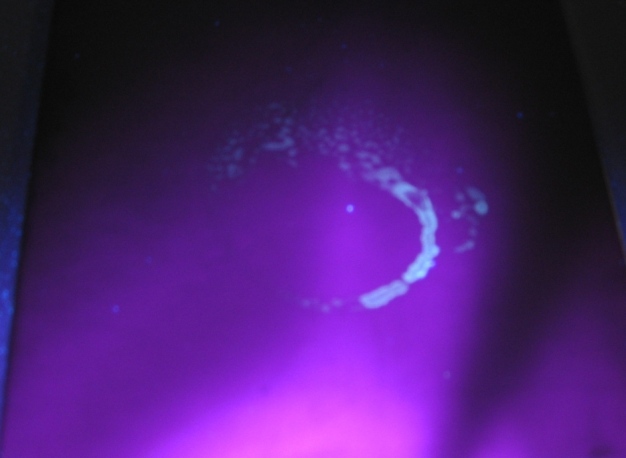
A lux detector was placed below the neon tubes to measure the amount of background light. The stainless steel plate was marked by contact with the TSA RODAC plate. The lighting level was gradually increased from 0 lux (lowest brightness level). The stainless steel plate was examined with the Clercide UV lamp at different lux levels for visible residual contamination, and the results were recorded.
The surface used for this experiment, with and without the use of the Clercide UV validation lamp, is shown in Figure 2. The results are documented in Table 1.
Background surface materials
A series of common cleanroom surface materials was prepared, on which existing particles were removed with highly pure, pre-dried IPA wipes. A 50 μm particle suspension was distributed on the surface of an LAF workbench using test sticks. The samples were dried for one hour at 40°C in a dry oven, and then the surface was checked with the Clercide UV lamp. The results are shown in Table 2.
Distance from the UV source
According to the above process, a stainless steel surface was prepared with highly pure pre-dried IPA wipes. The surface was then prepared with a 50 μm suspension. The Clercide UV lamp was used at various distances from the plate, and the visibility of the samples was checked. The equipment used is shown in Figure 3. The results are documented in Table 3.
Fluorescence of different materials
Smaller samples of various materials were attached between two microscope slides. Each sample was checked with the Clercide UV lamp, and the results were recorded. The results for the different materials are shown in Table 4.
Training
Two groups of 10 trained cleaning staff and 10 untrained workers were assigned cleaning tasks. Both groups were tasked with cleaning a "dummy" RABS (restricted access barrier system) with pre-dried IPA wipes, as shown in Table 5. The RABS was marked at 12 locations with contamination detectable by the Clercide UV lamp. Each of the two groups cleaned the RABS individually. The results are shown in Table 5. Subsequently, the cleaning effectiveness was tested. The untrained workers were trained and repeated the exercise. The results are shown in Table 6.
Results:
Visibly detectable particle size:
The 50 μm particles were clearly visible on the slides and can generally be considered as the detection limit.
Conclusion
The Clercide UV validation lamp is a unique innovation that allows the user to see what would otherwise be overlooked. The lamp enables monitoring of the cleaning process and immediate correction if necessary. The results clearly show that the lamp provides useful results under normal operating conditions. Contaminations involving numerous particles on all surfaces are highlighted.
Additionally, the parameters demonstrate the conditions under which the lamp will function. This test illustrates the significant value the lamp can play in staff training and confirms the effectiveness of training measures.
Note:
This validation study is a joint project between Roche Diagnostics GmbH and Shield Medicare. We thank Facility Monitoring Systems for providing the latex particles.
Images and tables can be found in the attached PDF file
Dominic Heckmann is a trainer in the Manufacturing Science and Technology (MSAT) department of Roche Diagnostics in Mannheim, Germany. After completing his training as a hygiene technician at the University of Hygiene in Mainz, he joined Roche in 1999. From 2003 to 2005, he was responsible for production supply in the pharmaceutical research and development sector. Between 2005 and 2009, he was responsible for aseptic filling and media systems in sterile pharmaceutical manufacturing. Since 2009, Dominic Heckmann has been responsible for training, hygiene, cleaning, and sterilization in the MSAT department.
James Tucker is the European portfolio manager for Shield Medicare – a business division of Ecolab. James Tucker worked for several years as a microbiology researcher at the Veterinary Laboratories Agency, which primarily focused on zoonoses. He studied at Westminster University to obtain a Master’s Degree in Bioinformatics. Subsequently, he focused on his "Chartered Institute of Marketing Diploma" and was appointed product manager for a diagnostics manufacturer. James Tucker has been working for Ecolab (Shield Medicare) for four years, with roles spanning marketing and new product development.