


- Systems
- Translated with AI
Monitoring in the GMP environment: 5 steps to the right alarm strategy
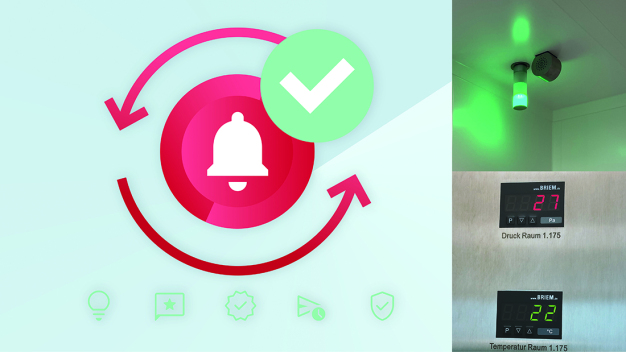
A good and well-thought-out alarm strategy is essential for the operator of a GMP cleanroom. Experience shows that this topic is often completely neglected. We explain how to develop your own, individually tailored alarm strategy in 5 steps.
Step 1 - Raise Awareness
It sounds logical at first, but in our experience, this is the most common mistake made during planning. The operator (user) does not think or only insufficiently considers this important topic beforehand. There are specifications (URS) that encompass over 300 pages, and everything is described in detail. However, what should happen in the event of an alarm — e.g., failure of an important refrigerator on a Sunday afternoon — is not specified in the document approved with 7 signatures. The risk for the operator of enormous economic damage in emergency situations increases significantly without a well-thought-out alarm strategy. Therefore, the point "raising awareness" should be the first priority at various levels.
Step 2 - Describe Scenarios
Together with process experts, the IT department, the monitoring system supplier, and other technical experts, consider what scenarios could occur. Go through all eventualities and scenarios carefully and document them.
Examples could include:
- Power outage
- Equipment failure (e.g., cooling chamber)
- Failure of IT components (switch, server, client, etc.)
- Sensor defect
- And many more ...
Step 3 - Assess Scenarios (Risk Analysis)
All these scenarios should now be evaluated together with quality assurance (QC/QM). Appropriate templates for this risk analysis (e.g., in an FMEA = Failure Mode and Effects Analysis) assist in the assessment. The goal is to determine which of the described scenarios can be accepted in each case and which must be prevented under all circumstances. For medical devices/pharmaceuticals, for example, the hazard to the product and thus to the patient would be the most critical factor and unacceptable. The risk analysis reveals which dangers need to be mitigated.
Step 4 - Define Measures
The results of the risk analysis must now be checked for technical feasibility. Depending on the measure, IT and process responsible persons as well as experts from the monitoring system are needed. In addition to technical questions, the financial framework must also be examined. For example, do the implementation costs justify the potential damages? Redundant systems (servers, power supplies, switches, sensors, etc.) are a significant safety factor but can considerably increase plant costs. It is of little use if the monitoring system is equipped with all safety extras but, for example, the pharmaceutical production control system does not have the same safeguards. Therefore, a careful review is necessary.
Most common technical measures/tools for alarm in a monitoring system:
- Alarm lights (2-/3-/4-color)
- Alarm buzzers (with automatic mute or acknowledgment button)
- Sensor with display and color change (red/green) and possibly buzzer/summer
- Client PC / Panel PC with overview plan
- Forwarding alarms via email
- Forwarding alarms via SMS
- Alarm via telephone dialer
Examples of technical measures to prevent failures/disruptions or to minimize downtime:
- UPS for monitoring control cabinet
- UPS for monitoring server
- UPS for monitoring client
- Redundant power supplies in monitoring control cabinet
- Redundant (double) sensors at critical measurement points
- Spare parts storage (sensors, PLCs, other critical components)
- Monitoring server in server cluster
Step 5 - Document the Alarm Strategy as Part of the URS
Now, the results of the joint, risk-based assessment should be documented and defined in the monitoring system's URS as an alarm strategy.
The most important questions of an alarm strategy
In your alarm concept, you should have found answers to the most important questions using the steps outlined above:
When should alarms be triggered?
In case of limit value violations? Power outages? Equipment failures? Etc.
To what extent should alarms be triggered?
Is 24/7 monitoring necessary?
How should alarms be triggered?
Via which channels should alarms be sent, and who should receive them? Alarm notifications can be via email, SMS, or phone call, for example. Ideally, the recipient of the alarms is a standby service. If not available, alarms could also be sent to the gate or a fault service.
How quickly must alarms be triggered?
Delay times? Measurement cycle times?
Conclusion
With these 5 steps, operators of GMP cleanroom facilities can develop an alarm strategy tailored to their system and process and include it in the URS. This ensures that their production and products are optimally protected and that all necessary measures are taken in an emergency.

BRIEM Steuerungstechnik GmbH
Lauterstraße 23
72622 Nürtingen
Germany
Phone: +49 7022 60920
Fax: +49 7022 609260
email: info@briem.de
Internet: http://www.briem.de