



- Translated with AI
Monitoring climate in laboratories – Standards, guidelines, and laws
Excerpt from a whitepaper by Testo SE & Co. KGaA

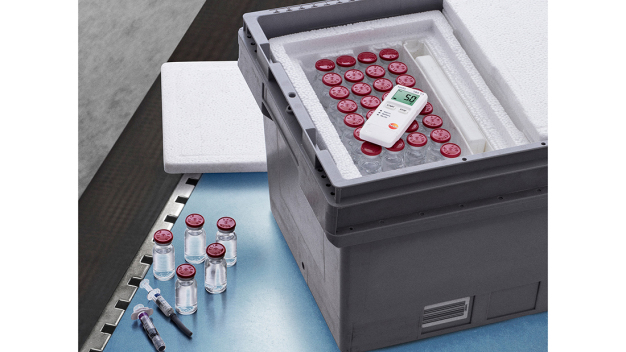
Temperature data logger Testo 184 T3 - certified according to DIN EN 12830 - for monitoring the transport of sensitive goods.
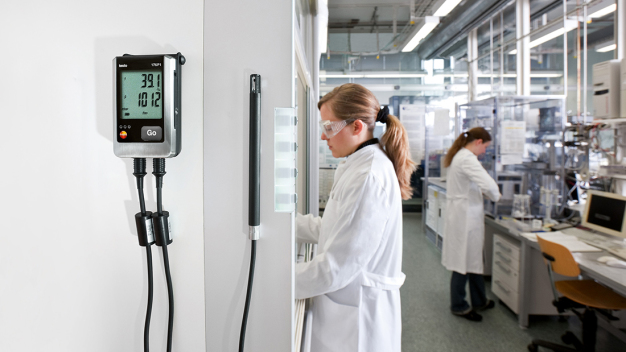
Monitoring of the absolute pressure and humidity in the laboratory with the autonomous data logger Testo 176 P1.
Whether in experiments, test series, product development, or drug testing – in medical, biotechnological, chemical, as well as pharmaceutical laboratories and cleanrooms, important environmental parameters must be monitored to ensure quality. In a new white paper, the measurement technology manufacturer Testo provides an overview of standards, guidelines, and laws for monitoring and documenting climate conditions.
Loyal companions. Standards and quality assurance.
For the various work areas of laboratories, a multitude of standards must be observed. For example, the Chemicals Act and Good Laboratory Practice – GLP – regulate (environmental) conditions and working methods in the laboratory and during test series. Since parameters such as temperature, humidity, and absolute pressure have a strong impact on the quality of the results, Good Laboratory Practice explicitly requires the documentation of climate conditions. Specifically, for medical laboratories, the standards DIN EN ISO 17025 and DIN EN ISO 15189 also apply. These guidelines specify a minimum standard of procedures, hygiene, and quality standards. Along with these requirements, the need for monitoring and documenting environmental parameters becomes clear through the demand for products and final results. Monitoring and comprehensive documentation of climate conditions in research and development facilities form the essential basis for high-quality products. Results from various scientific or technical test series can only be compared if they were conducted under uniform conditions and considering external influencing factors.
High quality standards even with external influencing factors
Especially in the pharmaceutical industry, monitoring critical quality factors such as temperature, pressure, or relative humidity is mandatory, and observing and documenting these influencing factors is essential. Deviations from prescribed temperature ranges during laboratory work, production, storage, or transport can have devastating consequences for the further processing and use of products. Since especially medicines and medical devices, but also chemicals, often have shelf life and usability linked to specific temperature ranges, temperature deviations are particularly critical. Temperature deviations are especially critical for medicines stored under refrigeration. If these substances are not stored correctly, there is a risk of quality and/or efficacy loss and, in extreme cases, costly recalls. Proteins, hormones, antibodies, and vaccines are particularly sensitive to temperature fluctuations. For refrigerated medicines and vaccines, it is necessary to maintain temperatures between 2°C and 8°C according to DIN 58345.
To store, examine, or process sensitive substances, chemicals, and valuable research materials under optimal conditions, users should regularly monitor the temperature in the refrigerator, laboratory exhaust, and working environment.
Of course, temperature in climate chambers of all kinds can also be manually monitored with a simple handheld device (e.g., thermometer). However, this method, still often practiced today, carries risks. It is associated with high personnel effort because an employee must regularly read the values, record them manually, maintain and archive the list. Additionally, this approach often leads to problems and discussions during QM audits. Errors in documentation and gaps in monitoring, such as on weekends, during vacations, or when the responsible employee is ill, are practically inevitable. In the worst case, these gaps are filled in retrospect, deviations are corrected, and necessary measures are not initiated in case of deviations. Another important point: if it comes down to it, the records do not reveal how long the preparation was above or below the cooling temperature and whether it can still be used. In case of quality issues, the laboratory cannot prove with point-in-time records that the temperature remained within the permissible window. Continuous monitoring and documentation significantly reduce the risk of product loss and regulatory violations.
In the pharmaceutical industry, strict regulations apply to the entire distribution network – from production through trading partners to pharmacies: WHO guidelines and GXP guidelines (GMP = Good Manufacturing Practice, GSP = Good Storage Practice, GDP = Good Distribution Practice). To store, examine, or process sensitive substances, chemicals, and valuable research materials under optimal conditions, users should regularly monitor the temperature in the refrigerator, laboratory exhaust, and working environment.
Valuable helpers in quality assurance
Especially in the strictly regulated GXP environment, autonomous data loggers offer a simple and cost-effective solution for monitoring climate conditions. They are designed for continuous measurement and documentation, record data at defined intervals, and securely store it on a storage medium. The devices reliably record parameters such as temperature, humidity, or air pressure and provide seamless documentation, as required for quality control in research & development. Once installed, the data logger runs automatically and reliably after a short setup phase, during which the measurement interval (between 1 second and 24 hours) is set. It only signals again when, for example, a battery change is necessary. Handling of all devices is intuitive. No special training or prior knowledge is required. Thanks to a non-volatile memory, raw data cannot be lost even if the batteries are empty. Battery life ranges from 500 days to 8 years depending on the model, and the SD card storage capacity ranges from 16,000 to up to 2 million measurements.
The data loggers Testo 175 T1, 175 H1, and 176 T1, 176 P1 from measurement technology specialist Testo are ideally suited for documenting the environmental conditions of research projects. Depending on the model, they reliably record temperature, temperature and humidity, or temperature, humidity, and absolute pressure in a tamper-proof manner. They also easily handle simultaneous measurements of different test series with variable measurement cycles.
During the transport of sensitive goods, every step of the cold chain can be monitored with the USB data loggers Testo 184 T3 and T4. The loggers reliably indicate whether temperature fluctuations have occurred inside the cooling containers and make the entire transport route transparent. For more details, simply connect the logger to a computer. A report in PDF format with all relevant data is generated immediately.
Testo offers three uniform software packages for data analysis for all autonomous data loggers, enabling efficient work. Depending on their needs, customers can choose between free ComSoft Basic Logger Software, ComSoft Professional, and ComSoft 21 CFR Part 11 software.
Read the entire white paper, including a compact overview of standards, now at:
www.testo.com/EN/whitepaper-climate-lab
Testo SE & Co. KGaA
79853 Lenzkirch
Germany