
- Translated with AI
Microbiological Monitoring in the Cleanroom
Pharmaceutical Production
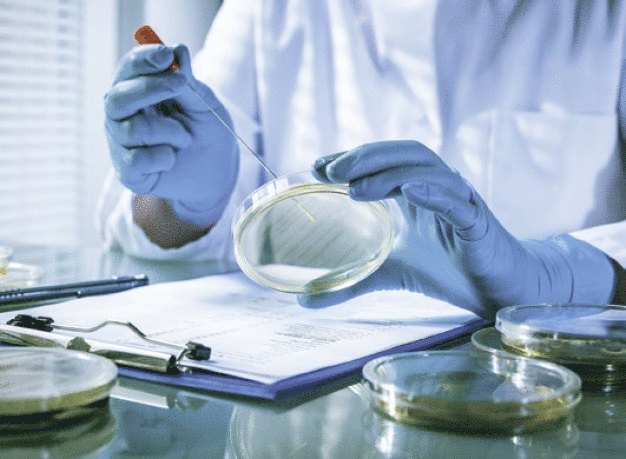
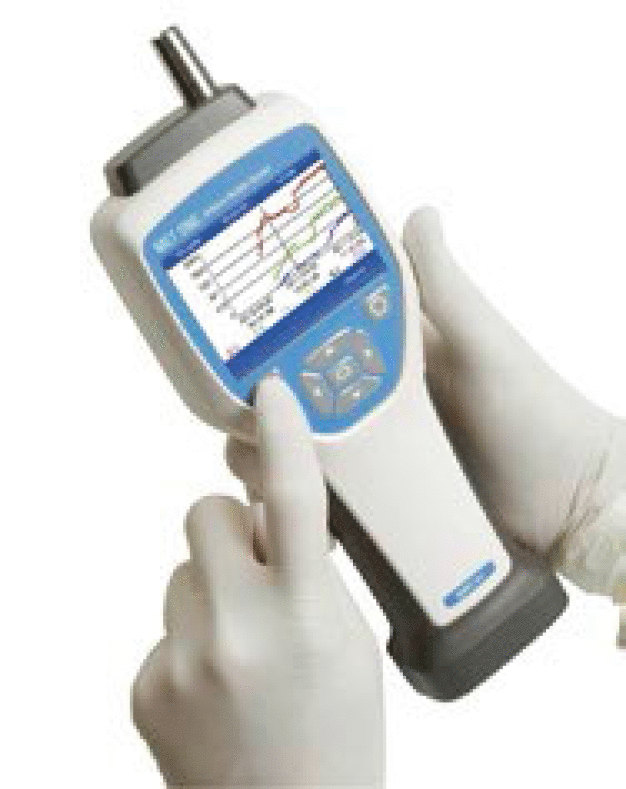
Fig. 1: Airborne particle counter HHP6+
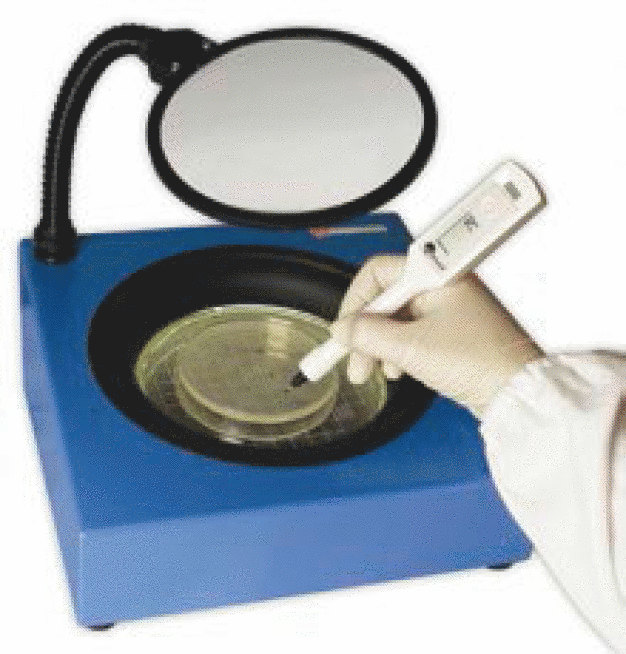
Fig. 2: Petri-Light with pen
The requirements in pharmaceutical production are subject to increasingly strict regulations; more and more manufacturing processes must take place under special, hygienically impeccable conditions. Also, the avoidance of preservatives necessitates absolutely pure production conditions. Air microbial samplers are used to monitor the microbial load in the air. The following article provides insight into the background and application details of air microbial samplers in practice.
Special devices have been developed to monitor the concentration of microorganisms in the air, which, due to their special design, can collect particles down to 1 μm. The Anderson principle has become the standard method for air microbial sampling. In this method, air is drawn in at a specific speed, and particles are propelled directly onto an agar surface, which also serves as a nutrient medium. The direct impact of microbes onto the agar-filled Petri dish is called the impaction principle. This has the advantage that no filter manipulations are necessary. The sampling process is simplified, and secondary contamination is practically excluded.
Criteria for selecting application-appropriate air microbial samplers
Air microbial samplers should be portable and easy to disinfect. Practice requires periodic calibration. When purchasing a device, it should be checked whether calibration can be performed on-site, as devices in the pharmaceutical sector are not always allowed to leave the premises. For the control and validation of cleanrooms, isolators, RABS, microbiological laboratories, biotechnology and vaccine production facilities, operating rooms, hospitals, and clinics, the DUO SAS Super 360 can also be used if time savings is an important criterion. This air microbial sampler operates simultaneously with 2 collection heads at a speed of 180 L/minute.
SAS Super Pinocchio II is designed for microbiological testing of air and other compressed gases in the pharmaceutical and food industries, as well as in other critical areas. The compressed gas is connected directly to the device. The sampling period is set so that the required total volume is reached (e.g., 1000 liters).
Air sampling and analysis in practice
Sampling:
- Place the device on a stable surface
- Open the perforated lid (with dust cover in place)
- Place the closed, agar-filled standard Petri dish onto the Petri dish holder
- Remove the Petri dish lid
- Close the perforated lid
- Position the collection head according to the airflow (the collection head can be oriented at any angle from horizontal to vertical airflow)
- Remove the dust cover and start sampling
Incubation:
The Petri dish is now ready for incubation. Depending on the requirements and questions, different nutrient media can be used. There are various media for yeasts, molds, and bacteria, which differ in composition and pH. However, the DG 18 agar is particularly recommended, a specialized nutrient medium for airborne microbes. The choice of plate type and medium is crucial for compliance with the major pharmacopoeias, ISO standards, and cGMP. Typically, environmental bacteria are incubated for 24 to 68 hours at 30°C, and yeasts and molds for at least 7 days at 25°C.
When handling the media, the instructions of the media manufacturer should be followed. Just like impression plates, Petri dishes with special media for microbiological control of air and surfaces are supplied. The sterile triple packaging allows the plates to be transported in environments with low contamination or in sterile areas (one of the three outer packaging layers is removed before entering a cleanroom).
With impression plates, there is also the advantage that the same type of plate can be used for both air and surface controls. Conversely, 90-mm Petri dishes provide a larger surface area for colony counting and are especially useful when the expected number exceeds 100 colony-forming units on the "plate".
Impression plates and Petri dishes from VWR are available with neutralizers (Tween, lecithin, histidine, thiosulfate) and with antibiotic neutralizers (penicillinase) to prevent underestimation of microbial counts.
VWR also offers particle samplers for daily testing according to ISO 14644/1. These are used for testing particle sizes of 0.5 μm and 5 μm. The main differences between the various model types are the number of channels and the particle sizes that can be counted. A charging station keeps the device upright during use, storage, or battery charging. The charging station also features data and power connections. The LCD display and the 7-button keypad on the front of the device serve as the user interface. The device stores collected data in flash memory. The data remains stored even when the device is turned off. Data can be displayed on the screen, transferred to a PC or laptop via USB cable, saved on a USB stick, or transmitted via Ethernet connection. No special software is required.

VWR International GmbH
Hilpertstraße 20a
64295 Darmstadt
Germany
Phone: + 49 6151 39720
email: info.de@vwr.com
Internet: https://de.vwr.com