

- Buildings & Rooms
- Translated with AI
Micro-implants made of plastic - new possibilities through micro-injection molding
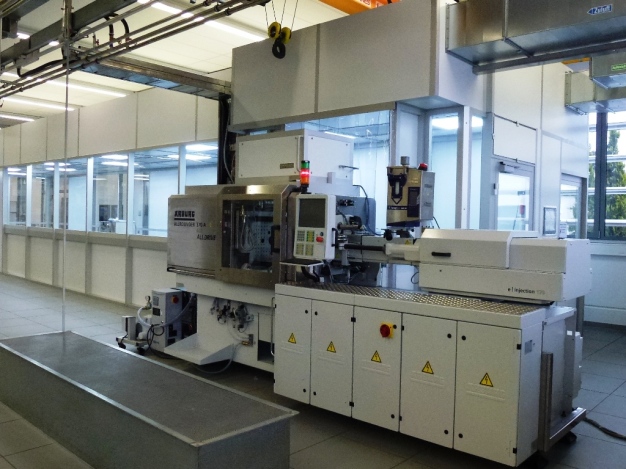
Scholz-HTIK invests in high-quality technology: The injection molding of microimplants is carried out in GMP cleanroom systems of the brand CleanSteriCell® by SCHILLING ENGINEERING
The ongoing miniaturization in plastic manufacturing is creating momentum in the field of medical technology. Innovative micro-injection molding processes enable precise and cost-effective production of highly complex micro-implants and are increasingly used in minimally invasive treatment methods. In addition to technical procedures, production in classified cleanrooms also plays an important role. Only this way can the highest requirements for product safety and quality in medical technology be guaranteed.
To succeed in this exciting and highly demanding market, the highest quality and expertise are required. The Franconian plastic processor Scholz–HTIK specializes in precision and micro-injection molding and has been increasingly investing in the development and manufacturing of micro-implants for several years. The company faces the challenge of producing tiny components with the highest precision at reasonable costs. Micro-injection molding is a promising manufacturing process in this regard. For example, an innovative middle ear implant was developed that, weighing only 20 mg, features over eight joints and can replicate the biomechanics of a healthy ear. A major advantage of injection molding for implants is the ability to implement surface structuring already during the initial mold. Microstructures down to the range of a few micrometers can be molded with high reproducibility. Tailored to the target tissue, the implants are better accepted by the body, and their functionality and durability are significantly increased.
Scholz –HTIK relies on production in cleanrooms in this sensitive area of medical technology. Manufacturing and packaging in cleanrooms not only protect the products from biological contamination but also ensure a disturbance-free production process, as even the smallest particles can cause failures in the micro range.
Mr. Dr. Hoffstetter, as Manager of Medical Devices, is responsible for the production process and has chosen the highly high-quality GMP-compliant cleanroom system CleanSteriCell® from the cleanroom specialist SCHILLING ENGINEERING: “The entire process flow of microtechnology must be perfectly coordinated. When producing medical implants, zero-error tolerance and the highest hygiene are essential. The quality of cleanroom technology plays a major role here. We have made no compromises and found a partner in SCHILLING ENGINEERING who understands and implements our philosophy. The cleanroom system provides a consistently pure production environment and operates completely trouble-free, allowing us to focus on our core competence of micro-injection molding.”
For optimized manufacturing, injection molding machines specifically designed to meet the high demands of micro-injection molding under cleanroom conditions are used. The plastic blanks are removed from the mold by a robot system and automatically fed into the production process via cleanroom conveyor belts. The subsequent inspection and packaging are also carried out in the cleanroom under controlled conditions. The finished product leaves the cleanroom in a sterile Bag-in-Bag packaging.
The cleanroom system CleanSteriCell® was optimally adapted to the highly sensitive manufacturing process and ensures a trouble-free and hygienically flawless operation with its high-quality standards. In the production facility, a cleanroom air quality of GMP Class C, or ISO 7 (EN ISO 14644-1), is achieved during operation. Laminar flow units with ULPA high-performance filters integrated into the surfaces ensure a supply of clean air. The system maintains a comfortable room climate with low air velocities. The large windows with ESG glazing are mounted seamlessly with a GMP sealing clip system, just like the wall elements, without silicone.
Additional safety is provided by the integrated control system CR Control®, which was specially developed by SCHILLING ENGINEERING for the needs of cleanroom technology. The controller manages connections to sensors that measure pressure, humidity, and temperature, as well as filter modules, climate cabinets, door and lighting functions, and other components. All essential functions are monitored and recorded, and can also be clearly adjusted and regulated via the central touchscreen.
The cleanroom system was implemented as a turnkey solution, from planning and production to commissioning and qualification, within 12 weeks, and handed over ready for production.

Schilling Engineering GmbH
Industriestraße 26
79793 Wutöschingen
Germany
Phone: +49 7746 927890
email: info@schillingengineering.de
Internet: http://www.schillingengineering.de