- Universities
- Translated with AI
Wolfgang Knerr
Micro- and Nanotechnology at the Zweibrücken Campus
Innovative training concepts in the high-tech sector
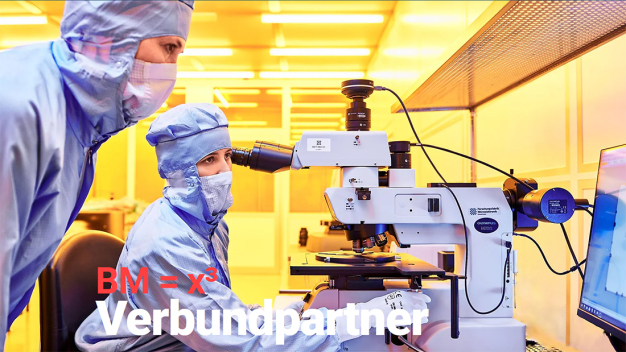
Microtechnology is considered one of the key technologies of the 21st century. Without microtechnology, modern goods of industry are unthinkable: cars, smartphones, modern industrial production, life-saving medical technology – without microtechnology, none of this would work! As part of the project BM = x³, funded by the Federal Ministry of Education and Research (BMBF) as an InnoVET project, Kaiserslautern University of Applied Sciences makes a valuable contribution with modern teaching and learning concepts to address the skilled labor shortage in the field of microsystem and nanotechnology.
Within this collaborative project, which particularly emphasizes excellent learning environments and partnerships, 19 prospective microtechnologists from Itzehoe recently learned practical fundamentals for manufacturing a piezoresistive pressure sensor at the Zweibrücken campus and carried out process steps for lithography themselves.
“At Kaiserslautern University of Applied Sciences, we have many years of experience in conducting demanding internships in process technologies of microsystem and nanotechnology. For example, at the Zweibrücken campus, there is an excellently equipped cleanroom available,” explains Prof. Dr. Antoni Picard, who heads the office of the training and further education network for process technologies in microsystem technology and the Institute for Development through Qualification (EQUAL) at the university. “Furthermore, the practical, hands-on experience on high-tech systems is supported and complemented by a web-based learning environment, the so-called Virtual Technology Laboratory,” Picard continues.
But not only students in the bachelor’s and master’s programs in micro- and nanotechnologies at Zweibrücken benefit from this excellent learning environment; cooperation partners and external participants, such as the group of trainees who are trained as microtechnologists at the vocational training center of Steinburg district on behalf of various industrial companies and research institutes, also participate.
The trainees and their supervisors were also enthusiastic about the practical experiences and teaching concepts they encountered in Zweibrücken: “The learning module on photolithography is based on a blended learning concept, where the trainees could already prepare for the practical lab course online at home using our Virtual Technology Laboratory,” explains Professor Picard. In addition to the instructional texts and multimedia presentations of real cleanroom systems and manufacturing processes, the Virtual Technology Laboratory particularly offers interactive, realistic machine simulations.
With this project, Kaiserslautern University of Applied Sciences also fulfills an important educational policy mandate: the field of microsystem and nanotechnology, in which urgently needed well-trained specialists will be required in large numbers in the future, is being strengthened, and the permeability and interaction of vocational and academic education are being promoted.
In this regard, the consortium is currently even considering a “Bachelor-Professional” and especially a master’s degree program, which could be offered in parallel with a higher vocational training in a “dual” and “transregional” manner. Consequently, there is a real possibility that some of the trainees from Itzehoe will return after completing their vocational training to Zweibrücken to pursue a scientific degree in the field of micro- and nanotechnology.
Hochschule Kaiserslautern
67659 Kaiserslautern
Germany