



- R+D & Community of Interest
- Translated with AI
Manufacturing technology for the aseptic filling of injection systems
3. Price Clean! 2018
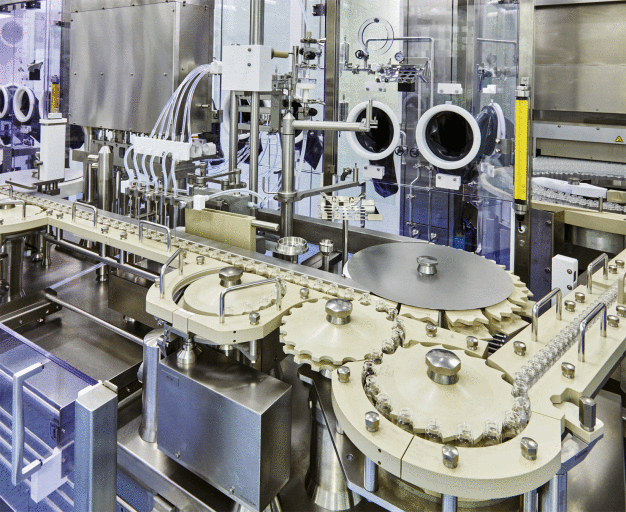
Waste disposal line with RABS technology. (Source: Vetter Pharma International GmbH, Photo: Henry M. Linder)
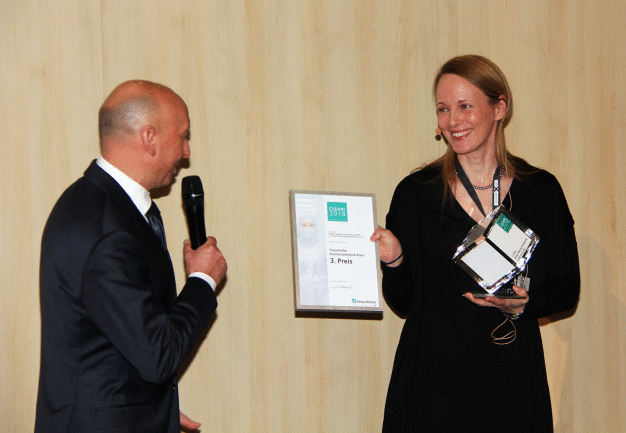
Dr. Udo Gommel, Fraunhofer IPA and Dr. Ute Schleyer, Vetter Pharma International GmbH.
Increasing requirements for the aseptic filling of medications have immediate consequences for production in cleanrooms. To meet the demanded quality and flexibility, Vetter has developed a "best practice" concept for cleanrooms: "Vetter CleanRoom Technology" (V-CRT®), which was awarded third place.
Strict regulations exist for the sterile and aseptic production of pharmaceutical active ingredients. The prerequisite for this is cleanrooms that are constructed and operated according to the guidelines for Good Manufacturing Practice (GMP). At the same time, customer and market demands regarding quality and flexibility are increasing. To meet these requirements, today mainly two alternative cleanroom technologies are in use: isolators and Restricted Access Barrier Systems (RABS).
Isolators enable high safety in preventing contamination because isolator systems consistently separate operators, product, and environment. Accordingly, the cleanrooms are fully sealed and completely isolated from the external environment. Since isolators require extensive setup and decontamination measures during product changes, they are better suited for manufacturing individual products in large batch sizes.
RABS, on the other hand, are suitable for filling systems with their greater flexibility and higher capacity, especially when manufacturing multiple products. A barrier and a dynamic airflow ensure separation between the environment and the medication. RABS offer the advantage of quicker setup, efficient product changes, and flexibility for throughput of different products.
The problem for manufacturers today: the market demands the benefits of both cleanroom technologies.
V-CRT® combines RABS and isolator cleanroom technology
V-CRT® combines the advantages of isolator and RABS technology, achieving safety and quality standards that approach the performance of isolators while still offering the flexibility benefits of RABS. A central role is played by the fully automated decontamination of the cleanroom with hydrogen peroxide (H2O2).
With the innovative, two-stage installation strategy, V-CRT® minimizes the risk of microbial contamination and enables efficient product changes through rapid decontamination with a cycle time of approximately 2.5 hours. The Vetter CleanRoom Technology thus reduces downtime, increases capacity utilization and flexibility for the customer, and exceeds GMP requirements.

Fraunhofer-Institut für Produktionstechnik und Automatisierung IPA
Nobelstraße 12
70569 Stuttgart
Germany
Phone: +49 711 970 1667
email: joerg-dieter.walz@ipa.fraunhofer.de
Internet: http://www.ipa.fraunhofer.de