



- Translated with AI
(Laser) Photons and electrons switch the silver-silver interaction and reactivity
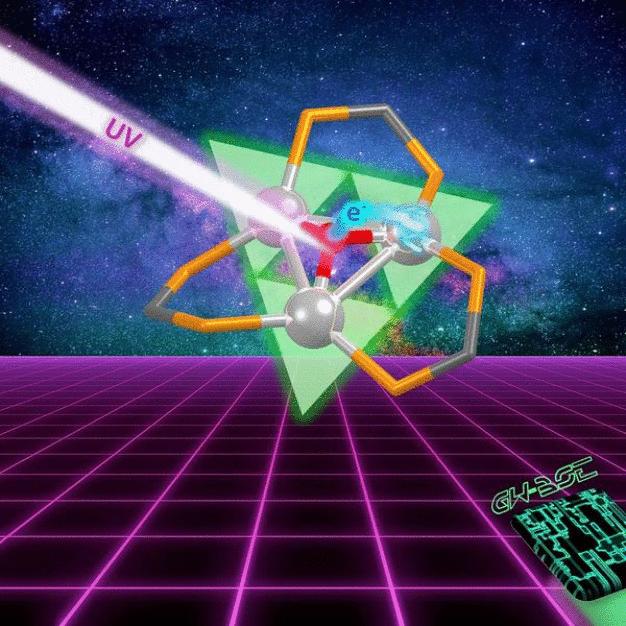
Structure of a trimetallic silver hydride complex Graphic: Collaborative Research Center/Transregio 88 "Cooperative Effects in Homometallic and Heterometallic Complexes, 3MET".
Researchers from the Transregio Collaborative Research Center "Cooperative Effects in Homo- and Heterometallic Complexes" (SFB/TRR 88 "3MET") succeeded in synthesizing a new complex compound made of silver and hydrogen (silver hydride), which exhibits interesting optical properties and reactivity towards oxygen. The work made it onto the cover of the renowned journal "Chemistry—A European Journal" and contributes to a better fundamental understanding of "metallophilic interactions," which describe the formation of bonds between charged metal atoms (ions) that are not yet fully understood.
A structural analysis of the new compound shows three silver ions arranged in an equilateral triangle with surprisingly short intermetallic distances. This unusual structure is stabilized by a negatively charged hydrogen atom (a so-called hydride), which bridges the three metal centers. Additionally, three phosphine ligands are attached to the sides of the "silver triangle," keeping the silver ions in close spatial proximity.
The key point is: using ultraviolet (UV) laser radiation, the silver cores can be selectively excited, enabling the modification and detailed investigation of metallophilic interactions. For this purpose, the scientists from TUK (groups led by Prof. W. R. Thiel (Inorganic Chemistry), PD Dr. C. Riehn, and Prof. G. Niedner-Satteburg (both Physical Chemistry), and Prof. R. Diller (Biophysics)) employed, among other techniques, photofragmentation spectroscopy, where the ionic metal complexes are first transferred into the gas phase and subsequently isolated and stored in an ion trap mass spectrometer. The stored molecular ions can then be irradiated with a laser, causing them to break apart (fragment) in a specific manner. The physical measurement parameters are the relative frequency of the formed photofragments (breakage products) and their mass-to-charge ratio depending on the wavelength of the radiation used. Loosely speaking, the ion trap is the modern test tube for physicochemists. This study demonstrated that UV irradiation causes an electron transfer from the hydride to the silver ions, which can enhance the silver-silver bond and lead to the dissociation of a hydrogen atom.
In close collaboration with scientists from the Karlsruhe Institute of Technology (KIT, working group of Prof. W. Klopper), the nature of the electronic excitations and the structure of the silver complex were calculated using state-of-the-art quantum chemical methods.
Using another ion trap technique, where an additional electron is transferred to the stored complex, the scientists observed a surprising effect: the resulting radical ions exhibit extremely high reactivity towards oxygen and can bind an O₂ molecule. This adduct could serve as a model system to investigate, for example, the mechanism of silver-catalyzed reactions. In this context, the silver-catalyzed selective epoxidation of ethylene should be mentioned. This process is an important technical method for producing ethylene oxide, which is used, for example, in the synthesis of ethylene glycol.
Within the broader framework of the "3MET" Sonderforschungsbereich, the insights gained into cooperative intermetallic interactions of such metal complexes are to be used to design, for example, optical or magnetic molecular properties or to precisely control (photo-) catalytic reactions.
Original publication: S. V. Kruppa, C. Groß, X. Gui, F. Bäppler, B. Kwasigroch, Y. Sun, R. Diller, W. Klopper, G. Niedner-Satteburg, C. Riehn, W. R. Thiel, Chem. Eur. J. 2019, 48, 11269-11284, http://doi.org/10.1002/chem.201901981
The graphic schematically depicts the structure of a trimetallic silver hydride complex, where the silver ions (metallic spheres) are held together by phosphine ligands (orange-gray arms) and a hydride ion (red) in a triangular arrangement. UV laser radiation triggers an electron transfer (e-), initiating further chemical processes. The experimental findings align very well with quantum chemical calculations (symbolized by the circuit diagram in the lower right).
Technische Universität Kaiserslautern
67663 Kaiserslautern
Germany