




- Translated with AI
Laminar flow in sight
Laminar flow in sight
Flow Sensors for LF Monitoring
Whether in semiconductor manufacturing or pharmaceutical production, the proportion of high-purity or sterile cleanrooms continues to increase because more and more production processes demand it. To limit the effort required to maintain purity, it has been decided not to declare the entire room as high-purity, but to create special "environments" that are then called mini-environments, gloveboxes, isolators, or RABS (Restricted Access Barrier System). All these cleanrooms share the fact that highly clean processes take place in a as small and protected area as possible, for example, filling liquid pharmaceuticals or conducting specialized semiconductor processes.
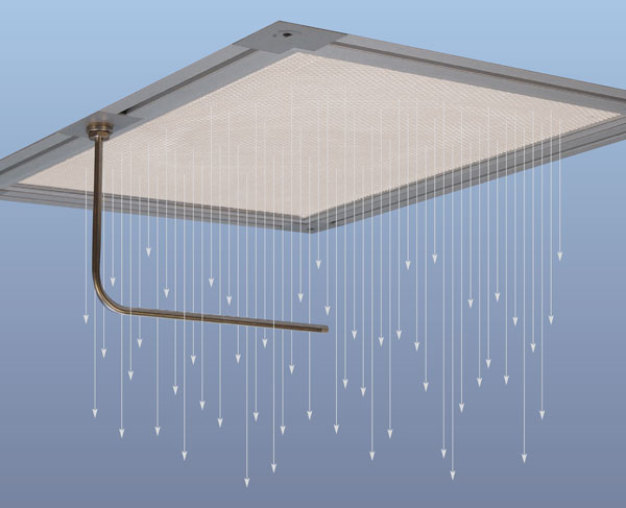
Closely linked to this high level of purity is the concept of Laminar Flow. This refers to a turbulence-free airflow characterized by a very low air velocity. One of the parameters to monitor—especially in highly sterile filling processes (so-called Zone A)—is the airflow velocity in the Laminar Flow area. The FDA's Good Manufacturing Practices (GMP) regulations specify that the airflow velocity should be maintained within a range of 0.45 m/s ± 20%. For pharmaceutical cleanrooms in Zone A, GMP requires continuous monitoring of the airflow velocity, and based on this, the term "Laminar Flow Monitoring" or LF Monitoring has become established.
It might seem like a simple task: placing a flow sensor at an appropriate location in the airflow and connecting it to the process monitoring system—done. However, this report aims to highlight the requirements posed by the FDA and users, and simultaneously demonstrate how a new sensor from Schmidt Technology meets these requirements.
Requirements for Flow Sensors for LF Monitoring
Measurement Range
Due to the monitoring range of 0.36–0.54 m/s, a measurement range of 1 m/s has become a standard. This covers all common operating conditions.
Start of Measurement Range
ISO 14644 specifies that the measurement range must start at 0.1 m/s. This requirement also comes from user needs, as it is now common practice to reduce airflow outside production times or during disinfection, leading to velocities around 0.2 m/s. Since it is well known that the measurement uncertainty of a flow sensor is particularly high at the start of the measurement range, the rule is that a sensor is more suitable the lower its measurement range start. The best sensors on the market today have a start at 0.05 m/s. For this reason, practically only thermal flow sensors are used for LF monitoring. Fan blades cannot be used at flow velocities around or below 0.2 m/s.
Accuracy
Since GMP specifies a flow tolerance of ±20%, the sensor must be better than that in any case. This initially sounds simple but is not. Because such small flows are difficult to generate in wind tunnels, measurements below 0.5 m/s are associated with relatively large uncertainties. This is reflected in the fact that sensor manufacturers always specify measurement inaccuracies as combined values, e.g., as a percentage of the measured value plus a percentage of the measurement range or an absolute value. For example, if a measurement uncertainty of 3% of the measured value plus a fixed 0.04 m/s is specified, then at a measured value of 0.45 m/s, the maximum measurement uncertainty is 0.0535 m/s, which is already 11.9% of the measured value! Therefore, you should be pleased if your LF sensor performs better than 15% of the measured value at 0.45 m/s.
Materials
Only materials that do not emit any harmful substances and withstand all cleaning and disinfection processes are permitted. The industry primarily trusts stainless steel; plastics are only accepted if they do not shed particles. For use in pharmaceuticals, resistance to alcohols and the commonly used disinfectant hydrogen peroxide is additionally required. If a sensor cannot demonstrate its resistance to the disinfectants used, it must be removed or covered during the disinfection process.
GMP-compliant Design
Requirements for sterility demand that the sensor has a as smooth and undercut-free surface as possible, which can be cleaned easily. Hidden cavities are to be avoided.
Calibration Certificates
FDA-accepted measurement results require that a calibration certificate be provided for the sensors, traceable to national standards, i.e., a traceable factory calibration certificate or a DKD certificate.
Long-term Stability
Sensors for continuous monitoring should, according to user wishes, operate for years without intervention. They are checked periodically (every 6 to 12 months) through mobile measurements and could be readjusted during these checks. However, this work is avoidable, especially since experts strongly advise against field calibration of installed flow sensors. The measurement uncertainty of such an arrangement is significantly worse than calibration in the wind tunnel of the sensor manufacturer. Consequently, sensors with the highest possible long-term stability of their measurement signal are clearly advantageous, so that no on-site readjustment is necessary.
Implementation of Requirements in the New Sensor
The new flow sensor from Schmidt Technology for Laminar Flow monitoring is called SS 20.415 and was developed for use in cleanrooms. How well this sensor fulfills the previously outlined tasks will be checked below: The sensor offers a standard measurement range of 1 m/s, but can already measure from 0.05 m/s. Each sensor is individually calibrated in a highly accurate wind tunnel, providing very good accuracy. The measurement uncertainty is specified as 3% of the measured value plus 0.04 m/s. This results in a maximum measurement uncertainty of 0.0535 m/s at 0.45 m/s, or 11.9% of the measured value.
GMP-compliant design: Only the completely smooth sensing tube (only 9 mm thick) protrudes into the cleanroom, with the sensor element housed in a protective chamber head to prevent mechanical damage. Only smooth surfaces, without hidden cavities, and easy to clean. The sensing tube and mounting parts on the cleanroom side are made of high-quality stainless steel 1.4571. Only the very small sensor head and the sensor element inside are made of other materials. Resistance to alcohol and H2O2 has been confirmed by extensive laboratory tests conducted by the manufacturer.

SCHMIDT Technology GmbH
Feldbergstraße 1
78112 St. Georgen / Schwarzwald
Germany
Phone: +49 7724 899198
Fax: +49 7724 899101
email: o.joos@schmidttechnology.de
Internet: http://www.schmidttechnology.de