



- Buildings & Rooms
- Translated with AI
Kreiskliniken Esslingen invests in modern cytostatic laboratory
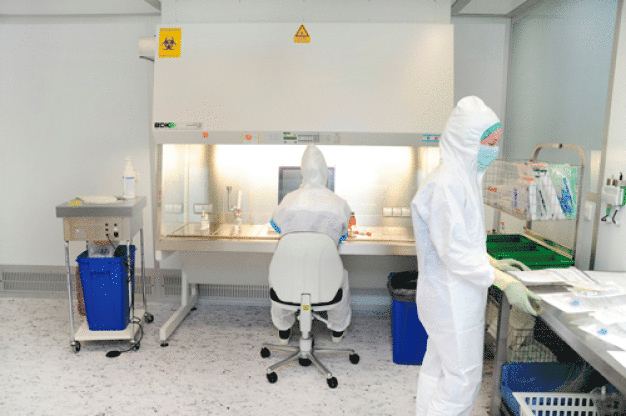
The production of the cytostatics takes place under controlled conditions in a GMP-compliant cleanroom laboratory of the brand CleanSteriCell®.
The hospital network of Kreiskliniken Esslingen possesses extensive experience and expertise as an oncology center in the comprehensive treatment and support of patients with cancer at all stages of their illness. This holistic care also includes the production of cancer medications in the hospital's own pharmacy. The cytostatics are specifically tailored and manufactured for each individual patient’s therapy. The processing and packaging of the toxic substances adhere to the highest safety and hygiene standards. Kreiskliniken Esslingen has expanded its capacity for producing cancer medications and equipped its hospital pharmacy with a state-of-the-art cytostatic laboratory.
An increase in the demand for cytostatics and stricter legal regulations required the investment in a separately designated cytostatic laboratory that complies with the requirements of the new pharmacy operating regulations and the Medicines Act. To create space for the necessary cleanroom system, an old laboratory area in the basement of the hospital pharmacy in Esslingen was largely cleared out and equipped with the latest technology. The goal was to find a safe and sustainable solution for the production of cancer medications that would continue to provide patients in the district of Esslingen with healthcare of the highest quality in the future.
Dr. Lutz Vogel, Chief Pharmacist of the Hospital Pharmacy Esslingen and Chairman of the Baden-Württemberg State Association of Hospital Pharmacists, explains the investment:
"We set ourselves the goal of providing our patients in the oncology center very promptly with individually tailored infusion solutions. Quick availability of the medications can be crucial for the healing process and improves therapeutic possibilities. Due to legal changes, we had to invest in a new cytostatic laboratory, which is spatially separated from our other labs and has separate personnel and material sluices. This ensures the absolutely safe production of the medications and prevents cross-contamination."
During construction, the guidelines for quality assurance of the production processes according to the prescribed industrial standards GMP (Good Manufacturing Practice) were strictly implemented. Materials and personnel are separately introduced into the laboratory. Multiple interconnected sluices with changing clothing for personnel must be passed through before work in the laboratory can begin with the highest cleanroom class GMP B. Directed airflow, high-performance filters, and continuous air exchange keep even the smallest particles away from the production process and ensure the highest hygiene during the assembly and filling of infusion solutions. The laboratory is operated under negative pressure to prevent the escape of toxic materials into the environment.
For the installation of this complex cleanroom technology, the company SCHILLING ENGINEERING was commissioned. The cleanroom specialist from Baden-Württemberg has many years of experience in setting up cytostatic laboratories and offers the proprietary cleanroom system CleanSteriCell®, which meets the high GMP requirements. Each laboratory is planned individually in close coordination with the customer. The new cleanroom system for the Esslingen clinics was designed with a total of 50 sqm and installed in a decommissioned, cleared laboratory area in the basement of the pharmacy. Three personnel and material sluice systems, operated with different air pressure levels and air exchanges, ensure the purity of the laboratory environment up to GMP Class B. Laminar flow units with ULPA high-performance filters integrated into the ceiling provide a supply of sterile air to the clean areas and workstations. Particle count, temperature, humidity, and air pressure in the rooms are continuously monitored and recorded for the required monitoring. All setpoints, including climate control, can be regulated and monitored via the user-friendly control system CR Control®, which is operated via a central touchscreen and, more recently, via tablet and smartphone. The modular CleanSteriCell® system can be flexibly expanded and reconfigured thanks to a patented silicone-free GMP sealing clip system. To reduce the high energy costs associated with operating a cleanroom, the system is operated by SCHILLING ENGINEERING with a particularly energy-efficient recirculation method. Much of the air exhausted from the cleanroom is circulated within the cleanroom walls and reintroduced into the cycle via the filter systems. Since this air is already cooled and particle-reduced, high costs for climate control are avoided. Additionally, the filters operate at a slower pace, significantly extending their service life. This initially more complex recirculation technology amortizes quickly through energy savings and longer maintenance intervals for the filters."
Dr. Vogel is very satisfied with the implementation of the measures and the commissioning of the cleanroom laboratory:
"We wanted to accommodate the new cleanroom laboratory within the spatial constraints of our old laboratory facilities to avoid investing in a new building. The engineers from SCHILLING ENGINEERING supported us from the initial planning and adapted the cytostatic laboratory to our wishes and spatial requirements. Despite the limited space, we found a very functional solution that enables structured workflows and complies with all legal requirements. With the new cytostatic laboratory, we have taken a forward-looking step toward ensuring safe and high-quality care for our patients."
The cytostatic laboratory was successfully qualified and put into operation after a three-month planning and construction phase.

Schilling Engineering GmbH
Industriestraße 26
79793 Wutöschingen
Germany
Phone: +49 7746 927890
email: info@schillingengineering.de
Internet: http://www.schillingengineering.de