




- Buildings & Rooms
- Translated with AI
Barbara Fischer-Reineke
Innovation needs courage – on both sides
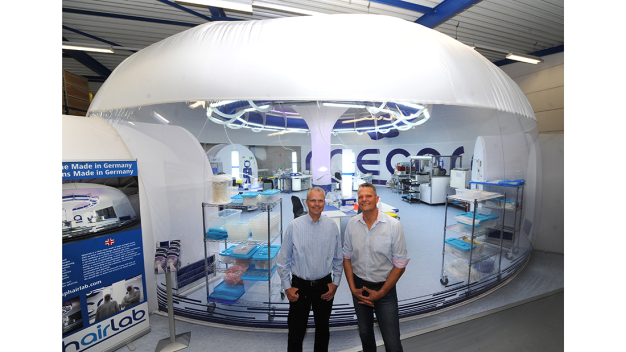
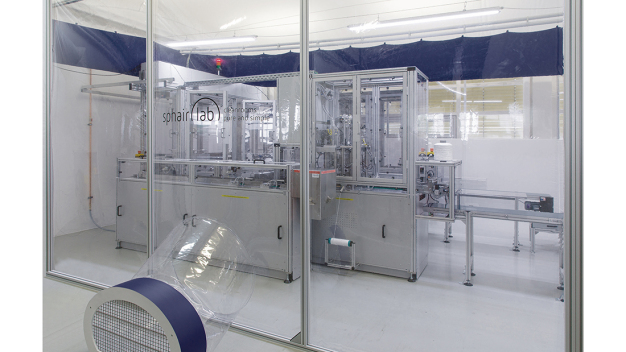
At BoschRexroth AG in Erbach, an ISO 8 cleanroom for respiratory mask production was installed in just six weeks as a model "Cube" with 65 sqm. Claus Lau, Head of Manufacturing, Operations & Engineering, says: "We act in the spirit of our company founder Robert Bosch – proactive, forward-looking, responsible, and sustainable." (Photo: BoschRexroth AG)
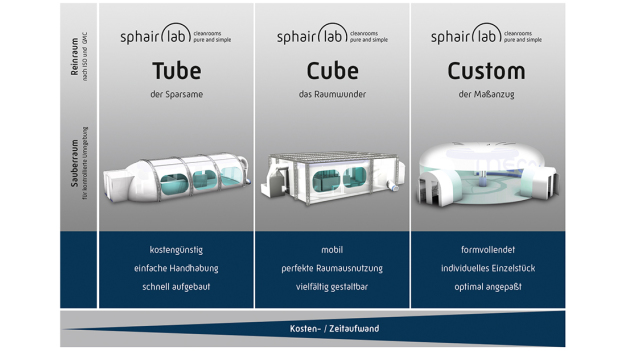
(Photo: sphairlab in three versions)
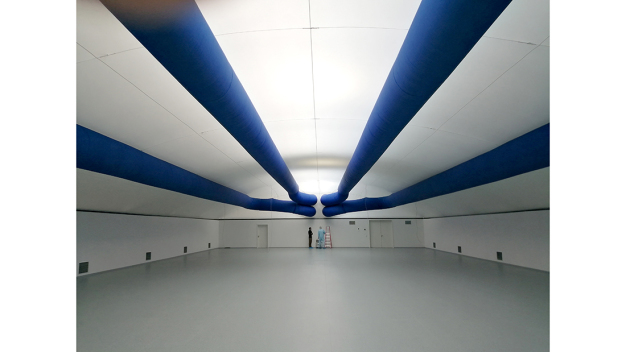
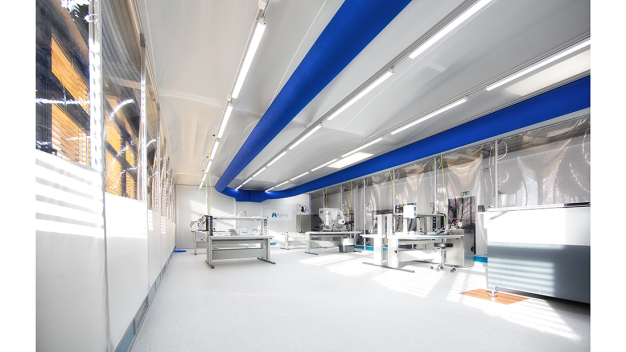
Prejudices have a bad reputation. And yet, they are widespread and influence decisions in many areas. Quite a pity, actually, finds Wolfgang Hassa of sphairlab GmbH in Aachen, in an interview with reinhraum online.
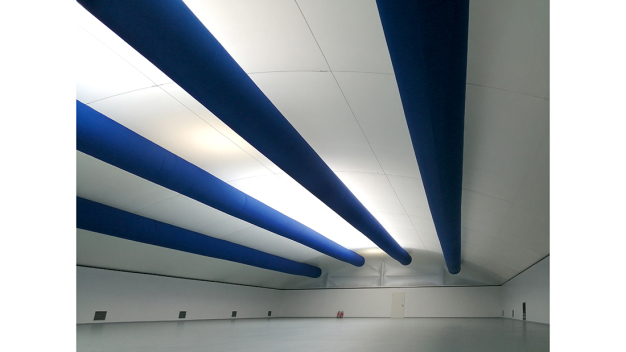
"When I introduce our sphairlab cleanroom to interested parties, I consistently receive enthusiasm," says Wolfgang Hassa. Not only does the futuristic design impress, but also the structural setup, the construction, the materials, the performance data, and not least the comparatively low costs convince the interested parties across the board, Hassa continues. Since the market launch of this cleanroom concept, built on the principle of an air-supported structure, in 2017, countless companies have shown interest in sphairlab.
Several sphairlab projects have already been realized, whether as cleanrooms or as sterile rooms. Examples include companies like enmodes GmbH in Aachen, the Institute for Applied Medical Technology at RWTH Aachen, or Bosch Rexroth AG in Erbach. Among these successful application examples, of course, the very first sphairlab cleanroom at mecora GmbH in Aachen, the actual birthplace of the brilliant idea, should not be missing.
Mecora CEO Jens Hutzenlaub was looking for a cleanroom concept in 2016 for his company's expansion in a rented hall and absolutely did not want to install a permanent cleanroom for cost reasons. So he resorted to the "crazy idea" of developing a cleanroom from high-strength textile himself, based on the principle of an air-supported structure, internally filled with air, equipped with an intelligent ventilation system including airlocks, furnishings, and lighting – all attached at only a few points on the ceiling. For this spectacular approach, Jens Hutzenlaub quickly found Wolfgang Hassa as the ideal partner. As head of the company Airworxx, specializing in textile architecture and airship construction, Hassa was extremely familiar with the material air and actually made the idea "fly" within a few months.
Going new ways as an innovator
Since December 2016, the "sphairlab" cleanroom concept at mecora has been certified according to ISO Class 7 and has been operating interruption-free from the start. When asked about his willingness to undertake this ambitious project, Hassa smiles and says: "Without courage to try new, unknown things, there can be no real innovation. And we both wanted to dare something absolutely new here because we quickly saw that it works and because we were completely convinced of the advantages for users."
These advantages are indeed quickly identified and explained. The sphairlab is:
- mobile if needed, otherwise stable for continuous use
- feather-light yet very robust
- individually configurable and produced in a short time
- quick to assemble and disassemble, with minimal storage costs when not in use
- highly efficient while being extremely resource-saving in terms of time and material
- surprisingly inexpensive, especially compared to traditional cleanrooms
- with its futuristic design, a true showcase object.
Early sphairlab users have also recognized these clear benefits and are leveraging the many advantages of this innovation as their market advantage. They present themselves as courageous protagonists of an evolution driven by true innovators. According to the "Diffusion of Innovations" theory by US sociologist Everett Rogers, already in 1962, they correspond to the "early adopters," who pave the way as early users before an early and then a late majority accept the innovation. At the other end of the distribution curve developed by Everett, a minority lags behind in progress.
In this way, the sphairlab cleanroom concept is currently approaching the early majority, but, as in marketing research, it also faces a series of psychological barriers on the buyer side. Even the economist Joseph A. Schumpeter recognized early on that innovations always encounter resistance. Psychologically, the appeal of everything new is great, but this appeal is ambivalent. New always also means change, associated with opportunities as well as risks, and is often somewhat uncomfortable. Although we have all experienced over the past decades how prosperity and comfort have grown massively thanks to technological and social innovations, humans find it hard to change their nature.
Prejudices lead to misjudgments
Obstacles to the adoption of genuine innovations often stem from people's tendency to develop mental schemas that help them evaluate situations quickly, making their daily lives more economical. These prejudices are also useful and helpful in most areas of life. However, such mental barriers are the killer when it comes to dealing with innovations. Numerous anecdotes from the tech world, which seem amusing today, prove this: For example, IBM's then-CEO Thomas Watson confidently declared in 1943 that there was a world market for maybe five computers. And Ken Olsen, founder and CEO of Digital Equipment, claimed in 1977 that there was no reason anyone would want a computer in their home.
Similarly, Ian Sharp's assessment that email was a product that could not be sold at all proved to be wrong, as did Bill Gates' statement that PCs would never need more than 640 kilobytes of memory. Perhaps the funniest reaction was from Microsoft CEO Steve Ballmer, who, in 2007, supposedly stuttered when Steve Jobs presented the iPhone: "$500?" And he continued, "That's the most expensive phone in the world. And it doesn't appeal to business users at all because it has no keyboard. So it's not a very good email machine." Human error is human after all.
This has also been demonstrated multiple times by German futurologist Matthias Horx. His assessments "The Internet will not become a mass medium" (2001) and "In five to six years, no one will talk about Facebook" (2010) now seem downright disturbing. The list of misjudgments could be extended at will, but it consistently shows that hasty evaluations were made based on traditional schemas. Henry Ford summarized this well when he said: "If I had asked people what they wanted, they would have said faster horses."
Thinking outside the box or putting in a drawer
When aspiring designers and product developers at universities are repeatedly urged to think "outside the box," and when leading designers worldwide organize in think tanks to find solutions far beyond what is currently imaginable, the initial market reaction is understandably often one of bewilderment. But that’s precisely where curiosity and human courage come into play—both are drivers to dare new things and explore the unknown. In "young" markets with highly dynamic, risk-loving target groups, it is relatively easy to establish even extraordinary approaches as "hip" and trigger a rush for the product through herd instinct. For these consumers, being part of it is everything.
What about innovation behavior in the cleanroom industry? How do potential customers in this standards-driven and safety-conscious sector of a rapidly growing market respond to innovations that leave behind proven methods? Confronted with this question, Wolfgang Hassa from sphairlab humorously smiles and says: "I think we still need to do a bit of convincing before we can penetrate the procurement decision-makers' safety mindset. They all fear they are buying a tent that will collapse at the first door slam. And yet, we have demonstrably operated 150 sqm at mecora without interruption for four years according to ISO 7, are twice as fast to set up as standard cleanrooms at the same performance level, and have installed several other excellent reference projects."
Of course, safety concerns play a major role in the cleanroom industry for obvious reasons. This applies to product development, manufacturing processes, and product use. But perhaps this widespread safety mindset also prevents innovative product developments and the use of advanced approaches. In fact, procurement professionals in this sector often demonstrate perfect mastery of all norms, guidelines, and requirements for a "proper" cleanroom. Courage, creativity, imagination, and visionary thinking are relatively rare—also for understandable reasons. It is therefore no surprise that the "light as an airship" sphairlab by sphairlab, while garnering enthusiasm for its design and brilliant idea, often falls behind in purchasing decisions due to fear of the unpredictable new.
Fact-checker in action
For this reason, we took the initiative in an interview with Wolfgang Hassa to objectively compare some of the most common prejudices—or "fear arguments"—against the sphairlab innovation with verifiable facts. Because we believe prejudices should sometimes be subjected to a factual check.
First, says Hassa, is the big prejudice that sphairlab is not a "proper cleanroom." The doubt whether an air-supported cleanroom with a textile shell can truly be effective, stable, and above all safe seems firmly rooted in decision-makers' minds. However, the mecora cleanroom in Aachen demonstrates at any time how solid, durable, functional, long-lasting, and ergonomically this innovative cleanroom concept is—and it can also serve as a sterile room.
Hassa can also dispel the fear of damage from pressure or impacts, which is often expressed as doubt. "On the contrary: the shell reacts like a rubber ball—it gives way and then returns to its original shape. It cushions instead of breaking. If skin injury occurs, it can be easily and permanently sealed from the inside," says a man who has built hot air balloons and zeppelins for years. "Furthermore," Hassa adds, "the shell is not made of simple fabric but from a high-strength HighTec material with a tensile strength of two tons per meter width—virtually indestructible."
Another common concern among potential customers is that the shell might collapse during a power outage. "This is simply not possible," Hassa assures, "because it is supported by a metal frame on the outside. That's similar to a tent and has always been helpful, hasn't it?"
Almost anything is possible
To counter the argument that sphairlab is not suitable for all applications and is too expensive for certain uses, the manufacturer has responded. In addition to the existing sphairlab shell in the shape of a donut, which can be viewed at mecora in Aachen, two more standard shapes have now been defined. These are cost-effective, quick to produce, and can be used individually or in combination for a wide range of applications.
The "Tube" model, shaped like a cylinder, is considered the "economical" one, being inexpensive, easy to handle, and quick to set up. The "Cube" model, shaped like a rectangular prism, is called the "space marvel," offering perfect utilization of space with right angles, being mobile, versatile in design, and providing plenty of light and large windows. The "Custom" variant is the "tailor-made" sphairlab, serving as an eye-catching showcase. It is optimally adapted for each application as a unique piece.
All three variants can be certified up to ISO 7 or GMP C and are thus the perfect solution not only for cleanrooms but also for sterile rooms. Wolfgang Hassa adds: "Especially from the packaging and production sectors, we are increasingly receiving inquiries. We are pleased about this and it also shows that these market participants are increasingly accepting and adopting the rising demands for clean production environments."
Adaptability is, as in many other cases, the key word here and makes for a fitting closing remark. Because innovation capability does not only mean the ability of one side to think, create, and bring new things into the world through bold creativity. It also means the ability to adapt to an environment that changes rapidly. And this adaptability is also essential on the other side, among market participants, decision-makers, ultimately consumers, so that innovation can truly have an effect. And for that, courage is simply necessary.

sphairlab GmbH
Abteilung sphairlab
Merzbrück 212
52146 Würselen
Germany
Phone: +49 163 2518059
email: info@sphairlab.com
Internet: http://www.sphairlab.com



