



- Translated with AI
Industrial Design, Clean Design, Hygienic Design – Features and Differences
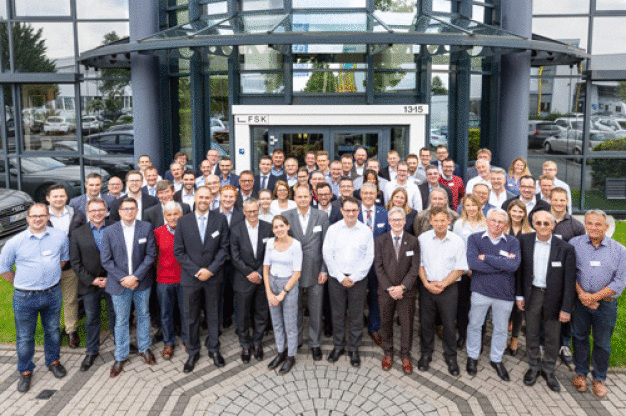
Approximately 70 participants gather for this year's EHEDG Germany Annual Meeting at SMC Germany in Egelsbach. (Photo: SMC Germany GmbH)
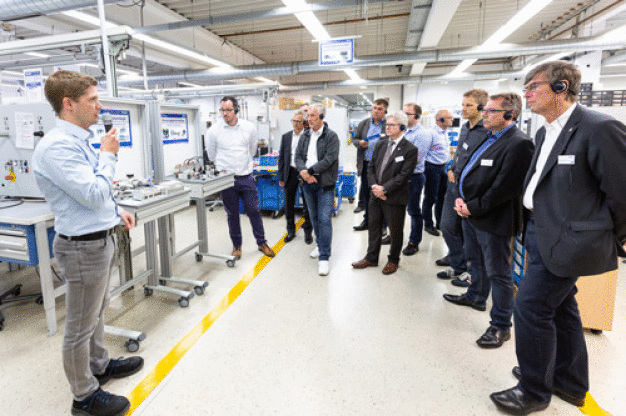
Jonas Hohmann, Production Engineering at SMC Germany, guides visitors through the highly flexible production at SMC Germany at the Egelsbach site. (Photo: SMC Germany GmbH)
On May 28, 2019, around 70 members of the EHEDG Regional Section Germany (European Hygienic Engineering and Design Group) gathered at SMC Deutschland GmbH in Egelsbach. The focus of this year's annual meeting was the exchange of ideas and experiences regarding Hygienic Design.
"What is the current status and where is the journey heading," summarizes Torsten Klein, Product Management at SMC, the tone of the event. What has been steadily gaining market share in the USA for many years is still largely in its infancy here. Machines and systems designed with Hygienic Design are still rather an exception for German and European buyers. The higher price is often cited as the main reason for the lack of acceptance. Nevertheless, the participants agreed: The advantages of Hygienic Design systems will prove themselves in the medium to long term here as well. After all, the benefits are convincing across the board: hygiene standards are met, food safety is guaranteed, energy efficiency is increased, cleaning processes are simplified, and downtime is reduced.
World Congress for the first time in Germany
In his welcoming speech, Dr. Jürgen Hofmann, Chairman of the EHEDG Section Germany, highlighted the progress of various project groups working on new guidelines. He then pointed to the EHEDG World Congress, which will be held in Germany for the first time next year. About 500 participants are expected in Munich. A committee is currently planning the content and presentations. Following this, Dirk Nikoleiski from Commercial Food Sanitation L.L.C. introduced the goals of a technical working group of the Global Food Safety Initiative. This group aims to incorporate the topic of Hygienic Design into their audit criteria. This will enable auditors to assess production facilities for vulnerabilities in Hygienic Design in the future. If the foundations are completed as planned by the end of 2020, auditors could start evaluating this in their audits from 2022 onward.
Experts share their experiences
Torsten Klein from SMC Germany used his presentation to provide a unique inventory. After a brief introduction and clarification of the differences between Industrial Design, Clean Design, and Hygienic Design, and the market perspectives associated with each, he involved the entire audience in his talk. Through many comments, a detailed picture of the current situation emerged. The attending manufacturers and OEMs openly pointed out existing problems and shared their experiences.
A clear definition is desired
The dissemination of Hygienic Design varies greatly depending on the market. In pharmaceutical systems, Hygienic Design has long been standard. In other sectors, high costs hinder widespread adoption. However, forecasts show that companies are increasingly valuing Hygienic Design. Internationally, the US market is leading. However, there is a broad lack of understanding of what Hygienic Design actually entails: while some companies consider a few screws and smooth surfaces as Hygienic Design, others set much higher standards. This also revealed a significant point of criticism. Multiple mentions during the event indicated that there is no clear definition of Clean Design and Hygienic Design. Such a definition would be helpful for both providers and users.
Tour through production and laboratory
In the afternoon, tours of the GTC Central Laboratory (German Technical Center) and the production facility were scheduled. The groups were guided through production up to final assembly. As a manufacturer, partner, and solution provider, SMC focuses in Germany on individual and specific product developments. Small batch production can also be implemented at short notice. In the GTC Central Laboratory, visitors could view various test setups, from endurance tests to customer-specific inquiries. Almost any product can be tested here.
At the end of a long day, Dr. Jürgen Hofmann bid farewell to the expert group and pointed to the next annual meeting of EHEDG Germany in May 2020.
SMC Deutschland GmbH
63329 Egelsbach
Germany



