

- R+D & Community of Interest
- Translated with AI
How Supply Chain Management Will Change by 2040
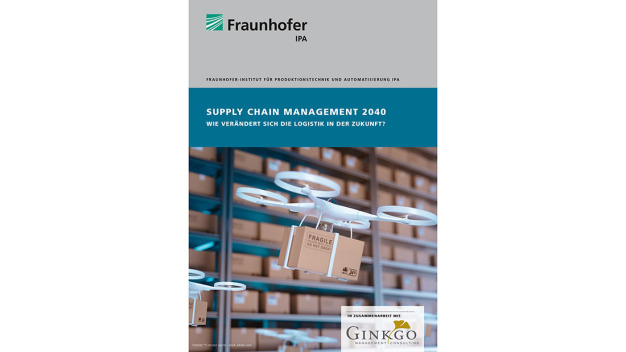
Autonomous, green, complex, faster, and more flexible: Researchers from the Fraunhofer Institute for Production Technology and Automation IPA, together with management consultants from Ginkgo Management Consulting, have studied how supply chain management will change by the year 2040.
The self-driving mother vehicle has found its way into the residential area and parks centrally. Drones unload it and deliver the packages. By 2040, this could already be everyday life. It is also conceivable that by then there will be a special pipeline system through which postal shipments cover the so-called last mile to the recipient. Such future scenarios arise from the need to manage increasing online orders and growing delivery traffic.
Researchers led by Martina Schiffer from the Department of Factory Planning and Production Management at Fraunhofer IPA, as well as Georg Pietrzak and his colleagues from Ginkgo Management Consulting, have examined in a study how supply chain management (SCM) could change by 2040. In addition to urbanization and digitalization, they identified eight other megatrends that will impact the value chain over the next 20 years.
Ten Megatrends Transform the Value Chain
Personalized products, demographic change, globalization, the growing demand for environmentally friendly and fair-trade products, changes in mobility, concerns about data security, the expanding service sector, and the shift towards a knowledge culture and information society: all these global developments will contribute to SCM by 2040
- operating largely autonomously: vehicles and machines load and unload themselves at ports, freight yards, and postal distribution centers and handle deliveries. Sensors and self-learning algorithms predict when a part is about to fail and procure replacement parts in time: humans only need to plan and monitor these processes.
- causing less environmental impact. Alternative drives become widespread, and consumers send discarded products back to the manufacturer. The manufacturer recycles them and produces new goods from them.
- no longer a chain but a network: the era of rigid value chains from raw materials to end products is definitively over in 2040. Instead, the fully digital smart supply chain, a complex network among all participants, takes its place. The number of actors increases because increasingly new goods and services are exchanged.
- becoming more fast-paced: companies grow into significant players within shorter periods but also disappear from the market more quickly.
- becoming more flexible: adapting more quickly to unforeseen events such as pandemics, wars, or natural disasters.
Study available for download
For their study, researchers led by Schiffer and consultants from Ginkgo Management Consulting surveyed a total of 164 people along the entire value chain online — with a clear focus on manufacturers who do not sell their products directly. The insights gained were then deepened through ten expert interviews with senior managers and technical experts from leading companies and research institutes. From this, they derived their insights into the future of the value chain.

Fraunhofer-Institut für Produktionstechnik und Automatisierung IPA
Nobelstraße 12
70569 Stuttgart
Germany
Phone: +49 711 970 1667
email: joerg-dieter.walz@ipa.fraunhofer.de
Internet: http://www.ipa.fraunhofer.de