

- Translated with AI
How much DIN EN ISO 14644ff is currently and in the future incorporated into an operating room in a hospital according to DIN 1946 Part 4?
The operating room in the hospital as a cleanroom – a clarification attempt; similarities and differences according to DIN EN ISO 14644ff and DIN 1946 Part 4.
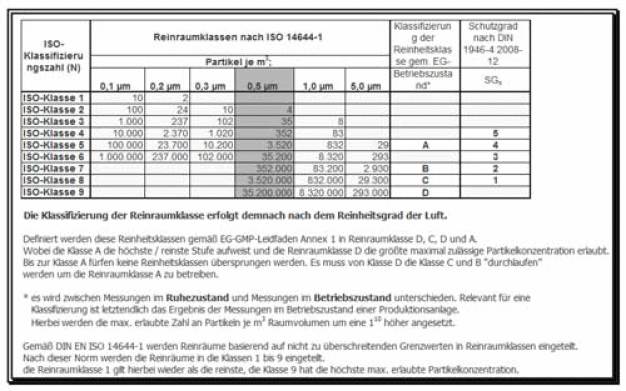
Table 1: Comparison of Room Classes from GMP, ISO, and DIN 1946-4
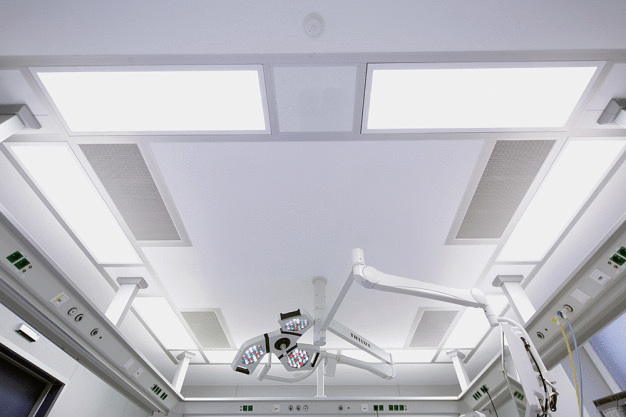
MVZ Oer-Erkenschwick TMS 3000 (Operating Room Class Ib) (Image rights: MANN + HUMMEL)
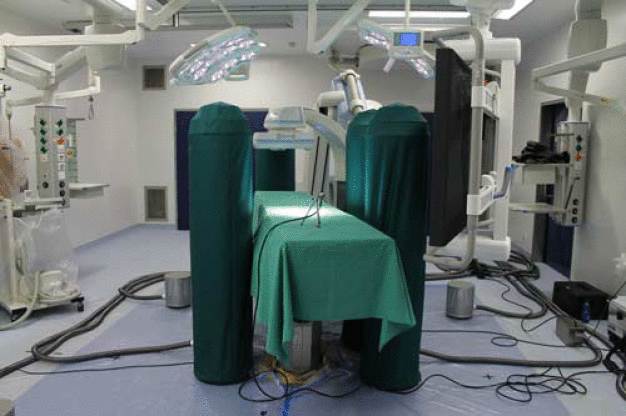
UNIKLINIKUM MANNHEIM – HYBRID-OP House 32 - Acceptance situation according to Appendix C "Protection level measurement" DIN 1946-4:2008-12) (Image rights: MANN + HUMMEL)
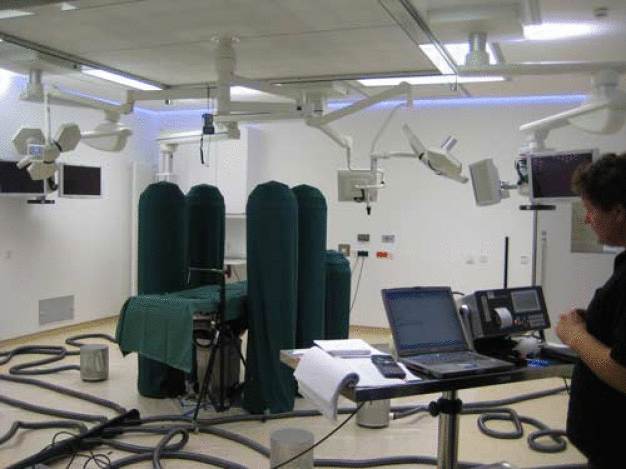
Robert Bosch Hospital Stuttgart (Operating Room Class Ia with ceiling air modules – Acceptance situation according to Appendix C "Protection Level Measurement" DIN 1946-4:2008-12) (Image rights: MANN + HUMMEL)
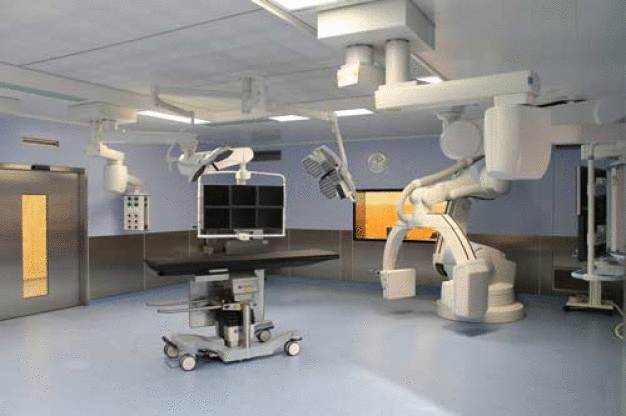
SHG Clinic Völklingen (HYBRID-OP Room Class Ia with SIEMENS Artis Zeego C-arm) (Image rights: MANN + HUMMEL)
1. Focal Points
In the field of healthcare facilities, particularly regarding the ventilation of operating rooms and sterilization departments, there is currently a reassessment of the technical regulations based on their origins in cleanroom standards and DIN ISO 14644ff. It is highly interesting to see how the various editions of DIN 1946 Part 4 have approached these areas over the past 17 years.
The approach carries both advantages and risks. Traditional ways of thinking and working in healthcare facilities, as well as their planning, construction, and operation, need to be broken through and repositioned. This involves overcoming resistance from entrenched networks and guiding the responsible parties towards new ways of thinking. Various disciplines such as hospital hygiene, surgery, specialists, hospital technicians, and professional planners, as well as numerous responsible federal, state, and district authorities and municipal administrations, must be involved and included in future regulations as so-called "interested parties." Lengthy discussions and approval procedures are included.
This contribution aims to provide insights and, through practical examples, to promote understanding of technical specifications as well as their practical implementation. Differences and similarities will be highlighted, and current discussions on room classifications will be examined professionally and without value judgments.
2. The Operating Room as a Cleanroom or a Purified Room – an Attempt at Clarification Based on DIN EN ISO 14644ff
The term "cleanroom" as such does not exist according to DIN EN ISO 14644ff. Some authors and media use this term for ISO classes 8 and 9 to communicate simplified requirements through the downgraded term.
According to "3.1 General / 3.1.1 Cleanroom"[2], this is a "space in which the number concentration of airborne particles is regulated and classified, and which is designed, constructed, and operated to control the ingress, generation, and deposition of particles." [2] This is further specified by "Note 1 to the term: The class of airborne particle concentration is defined." [2]
Similarly, "3.1.2 Pure Area" describes a "clean area" as previously defined for the cleanroom. These two points from DIN EN ISO 14644 Part 1 form the basis for defining room classes in DIN 1946 Part 4 in its revised version from June 2016.
3. What is meant by Room Class Ia/Ib according to DIN 1946-4:2008…?
In healthcare buildings, the well-known room classes I and II will continue to exist. However, for Room Class I, a new differentiation is introduced in the current draft standard. Room Class I-TAV now designates cleanrooms with a volume defined by positioning analyses as a protected area (= clean area), which exhibits turbulence-reduced displacement airflow (TAV according to DIN EN ISO 14644). This class corresponds to the previous Room Class I a.
Room Class I-TVS includes cleanrooms without a defined protected area, with turbulent dilution airflow (TVS) according to DIN EN ISO 14644. This class corresponds to the previous Room Class I b.
The main distinction in the current draft standard is now made by the definition of the protected area (clean area) and not, as before, by TAV (turbulence-reduced displacement airflow) and the associated TAV outlet. Furthermore, it remains: An operating room of Room Class I-TAV must not be constructed without a TAV outlet.
It is unfortunate that, by definition, the use of a TAV outlet in a surgical room of the previous Room Class Ib and the future I-TVS was not permitted with reduced geometric dimensions. This would have increased the possible technical variants and promoted open competition among providers. (see Table 1: Comparison of room classes from GMP, ISO, and DIN 1946-4)
What is excluded from the outset in cleanrooms in healthcare facilities: acceptance testing under different operational states of the rooms. As stated in DIN 14644-1 under "4 Classification / 4.1 Operating State or Operating States": "The air cleanliness class based on particle concentration in a cleanroom or a clean area must be established for one or more of three operating states, namely 'Ready,' 'Idle,' or 'Manufacturing' (see 3.3)." [2]
Or internationally: Ready = as built, Idle = at rest, and Manufacturing = in operation. In the operating room, measurements are referred to as "at rest." "In operation" is practically unfeasible, especially for legal and humanitarian reasons. Who would want to assume the role here and ask the first 10 patients scheduled for surgery whether they are willing to be available for a clearance test "in operation" and to hold the hospital and the OR team harmless from potential consequences (e.g., postoperative infections)?
4. How Much of ISO 14644 Still Exists in Part 4 of DIN 1946?
On the one hand, many well-established definitions from cleanroom practice are referenced to avoid linguistic confusion among users. Starting with system, functional, installation, performance, and planning qualification. Continuing with airflow types such as turbulence-reduced displacement airflow (TAV) and turbulent dilution airflow (TVS), up to the room classes I-TVS and I-TAV described earlier.
Consequently, the framework conditions for sterilization in hospital pharmacies (Table 1; 4.4) are also defined.
Since a cleanroom in ISO Class 5 and/or 7 also requires the use of HEPA filters according to DIN EN 1822, the installation, testing, and approval of the final filter systems must also be carried out according to DIN EN ISO 14644-3: "The particulate filter elements must be permanently sealed into the filter housing. Leakage tests of the installed filter system must be demonstrated by particle measurement (according to DIN EN ISO 14644-3)." [1] Furthermore: "Inspection of documentation, inspection, filter tightness and integrity testing according to DIN EN ISO 14644-3, functional testing. After each filter change." [1]
The acceptance test for operating rooms of Room Class I-TMS primarily refers to the specifications of DIN EN ISO 14644-3: "Reduction of particle concentration by 99% within 20 minutes; maximum particle concentration 3,500/m³ (0.5 μm) in standby mode."
Measurement points (number according to DIN EN ISO 14644-3), each symmetrically distributed at 1.2 m above the finished floor level within the room." [1] The different operational states of cleanrooms for acceptance are not considered, as previously described.
5. Filter and Ventilation Technology – What is in the HVAC of an Operating Room?
The filter technology used in operating rooms, especially the filter classes according to DIN EN 1822 with H13 or H14 – filters, corresponds adequately to those used in comparable cleanrooms for production purposes. This also applies to the pre-filtration stages in central air treatment, with the first filter stage in filter class M7 and the second filter stage in filter class F9 according to DIN EN 779.
In DIN EN ISO 14644ff, there are, for example, only recommendations regarding room humidity (ambient humidity): Part 4, page 39: "F.2.6 The temperature and humidity levels required for personnel comfort should be established for these special systems. A typical target range for relative humidity is between 30% r.H. and 65% r.H." [2]
In cleanroom areas, the environmental humidity to be maintained is usually project-specific and based on production requirements, to prevent electrostatic charging of components or damage to products ("e.g., vacuum tube production and tablet coating") which requires a relative humidity (R.H.) below 35% [2].
In the operating room area, the topic is "bundled" in Table 1 on page 14: "Physiological requirement for room air humidity: year-round between 30% and 60% (maximum: 11 g/kg absolute)." [1] This allows complete freedom in the planning, execution, and operation of ventilation systems. Not always in favor of patients and the OR team, as proven by the fact that excessively dry room air significantly promotes the transmission of viral and bacterial pathogens.
6. Conclusions
An approximation of DIN 1946 Part 4 in draft form to DIN EN ISO 14644ff has already been largely achieved. Certainly, there are still possibilities for further technical adjustments. However, these are limited by legal, humanistic, medical, and organizational constraints. Controlled and predefined movement and work processes, as in cleanrooms for productive purposes such as research and pharmaceutical manufacturing, will not exist in operating rooms. A surgical procedure can be well planned in its workflows, but in practice, it always involves surprises such as a collapsing patient, expanded surgical fields, and more, which quickly push the surgical team to its limits and turn the operating room into a hectic hive of activity in a transferred sense. Here, flexibility, realism, and foresight in adaptation are required, also from standards.
References:
[1] Draft E DIN 1946-4:2016-06 Ventilation systems in buildings and rooms of healthcare facilities; BEUTH-Verlag Berlin; June 2016
[2] DIN EN ISO 14644ff Cleanrooms and associated controlled environments
Part 1 Classification of air cleanliness by particle concentration
German version EN ISO 14644-1:2015
Part 3 Testing procedures (ISO 14644-3:2005); German version EN ISO 14644-3:2005
Part 4 Cleanrooms and associated controlled environments (ISO 14644-4:2001); German version EN ISO 14644-4:2001
MANN+HUMMEL International GmbH & Co. KG
71636 Ludwigsburg
Germany