



- Floor
- Translated with AI
Highest quality standards for pharmaceutical manufacturing
In cleanroom laboratories of hospital pharmacies, rubber floors provide a secure foundation for the demanding production of medications due to their resistance to media and hygiene.
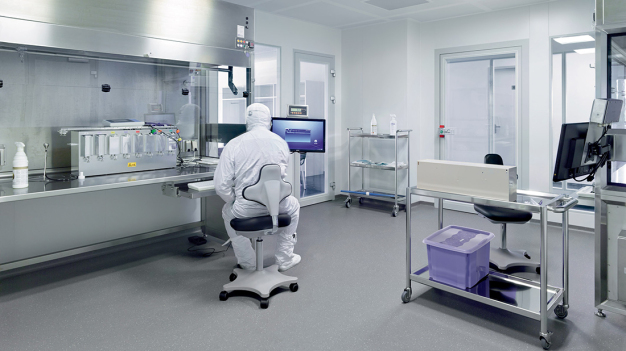
nora systems Cleanroom laboratories in clinics Ries Nördlingen © Oliver Heinemann
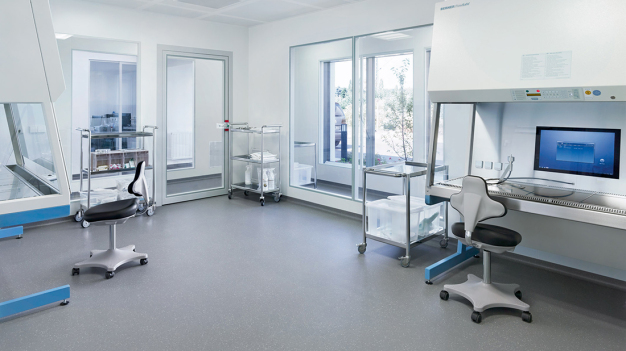
nora systems Cleanroom laboratories in clinics Ries Nördlingen © Oliver Heinemann
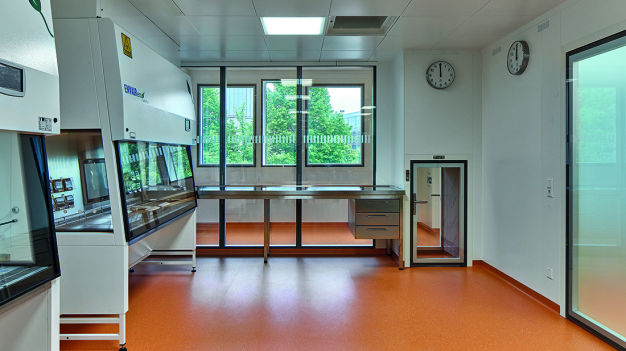
nora systems Cleanroom laboratories University pharmacy Tübingen © Jochen Stüber
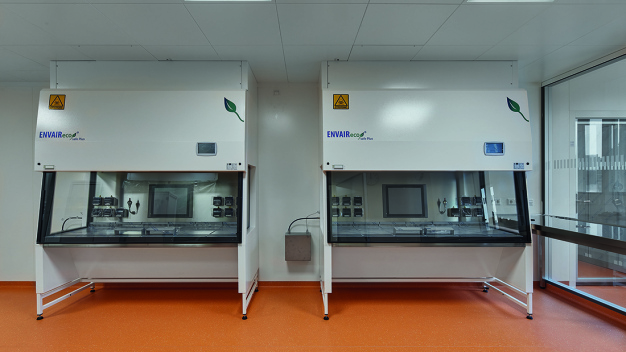
nora systems Cleanroom Laboratories University Pharmacy Tübingen © Jochen Stüber
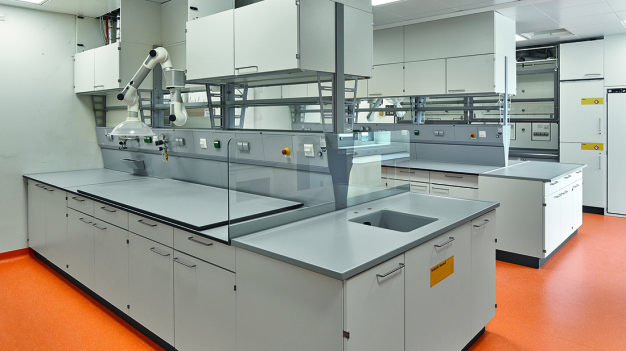
nora systems Cleanroom Laboratories University Pharmacy Tübingen © Jochen Stüber
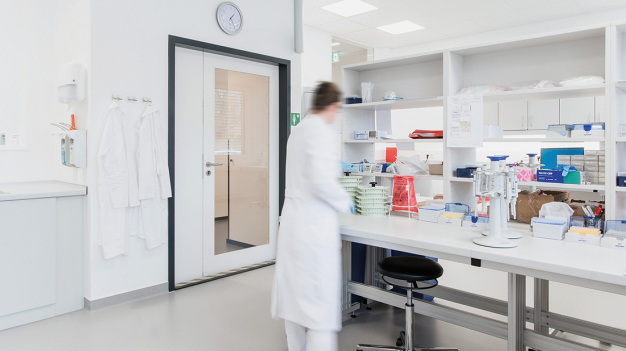
nora systems Cleanroom laboratories in clinics Hematopathology Kiel © Jelena Filipinski-Schult
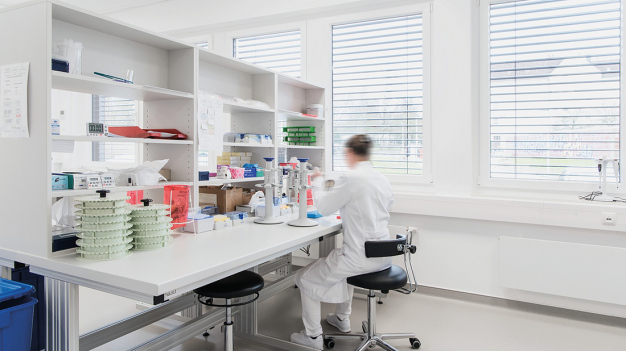
nora systems Cleanroom laboratories in clinics Hematopathology Kiel © Jelena Filipinski-Schult
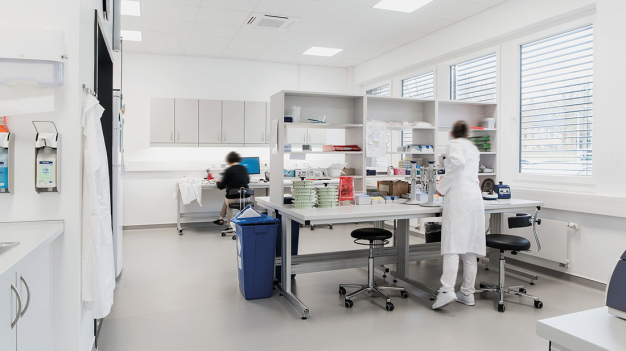
nora systems Cleanroom Laboratories in Clinics Hematopathology Kiel © Jelena Filipinski-Schult
For individual therapy concepts, especially in oncology and neonatology, they are indispensable – hospital pharmacies. Here, infusions tailored specifically to individual patients are produced, mainly for chemotherapy in cancer treatment and to improve the health status of premature infants. Other medications are also produced in the in-house pharmacy, such as anesthetics for surgeries and intensive care units or formulations for dermatological conditions. There are around 400 hospital pharmacies in Germany, more than 40 in Austria, and about 15 in Switzerland. Investing in its own pharmacy is worthwhile for hospitals, as they are less dependent on the production capacities of pharmaceutical companies and can avoid potential supply bottlenecks. This has proven to be a significant advantage, especially during the COVID-19 pandemic. The medicines are produced in cleanrooms classified according to the EU-GMP guidelines (Good Manufacturing Practice, Annex 1). This legal regulation for quality assurance of manufacturing processes for medicines and active substances specifies the requirements for designing the production environment. For the production of sterile medicines, four cleanroom classes are permitted according to the EU-GMP guidelines, which define the limits for microbiological contamination by microorganisms and the particle count in the room air: A, B, C, and D. Class A is the highest/cleanest level, while class D allows the greatest maximum permissible particle concentration. For the production of individual cytostatic preparations for oncological treatments, cleanroom laboratories from class B upwards are authorized. The flooring in these production environments must meet the highest standards, which is why many hospital pharmacies opt for Nora floors. The rubber floors have been tested and certified by the Fraunhofer Institute IPA regarding their suitability for cleanrooms and GMP areas. With their low particle emission behavior, high resistance to laboratory media, biological contamination, disinfectants, and chemicals, as well as their durability and ergonomics, they are the ideal solution for clean rooms.
Rubber floors prove themselves in long-term testing
In the new pharmacy of the University Hospital Tübingen, with its cleanroom laboratories of classes B, C, and D, Nora floors are also installed, just like in the Ries Pharmacy Nördlingen. In the Tübingen hospital pharmacy itself, Noraplan Sentica in brick red was laid, and in the cytostatics manufacturing cleanroom laboratories, the electrostatically dissipative Noraplan Signa ED in a warm terracotta. “Cleanroom floors must be very easy to clean and disinfect without residue and have a smooth, seamless, wear-resistant surface without cracks and joints,” explains Dipl.-Ing. (FH) Norbert Bias from Bias Engineering, who specializes in planning new production areas and has good experience with Nora floors: “In 2013, we equipped the new building of the Ries Pharmacy Nördlingen, which produces patient-specific cytostatic infusion solutions, with rubber floors – and they have proven themselves perfectly ever since.” In the production building's cleanrooms, the electrostatically dissipative Noraplan Signa ED is installed, providing optimal ESD protection for the sensitive electronic devices in the laboratories.
Resistant to laboratory media and cleaning agents
The special feature of Nora rubber floors is their dense, closed surface. This is particularly advantageous in terms of media resistance and comprehensive hygiene. “Nora floors are largely resistant to the laboratory media used in cytostatic manufacturing as well as to the alkaline cleaning agents,” explains Martina Hoock, Nora market segment specialist for healthcare in the DACH region. Thus, dripping substances during medication production do not cause permanent damage to the surface, nor does disinfection. Regarding cost-effective maintenance, the dense surface of the rubber floors is an advantage because they can be maintained without coatings. “By eliminating time-consuming and costly re-coatings, Nora floors are extremely easy to maintain and thus also economical in the long term,” emphasizes Hoock.
Ergonomic comfort for staff
From the perspective of the cleanroom planner, another factor speaks in favor of rubber floors: their permanent elasticity. “In cleanroom laboratories, there are almost only standing workstations, and staff often move between different work areas,” explains Bias. “An ergonomic floor covering is a great advantage here.” The permanently elastic Nora floors contribute to increased walking and standing comfort: they relieve the back and joints, resulting in less fatigue and pain when standing compared to harder floors. This, in turn, positively affects concentration, performance, and overall well-being of the employees.
Maximum functionality combined with ergonomic comfort – this makes Nora floors the perfect choice for a safe, health-promoting working environment in the cleanroom.
1 Source: Microsoft Word - Anhang1_DE_Website.doc (bundesgesundheitsministerium.de),

nora systems GmbH
Höhnerweg 2-4
69469 Weinheim
Germany
Phone: +49 6201 2743934
Mobile radio: +49 172 6330484
email: frank.baehr@nora.com
Internet: http://www.nora.com