



- Translated with AI
Hartwig Piepenbrock-DZNE Prize awarded for the fifth time
Munich Alzheimer's researcher awarded
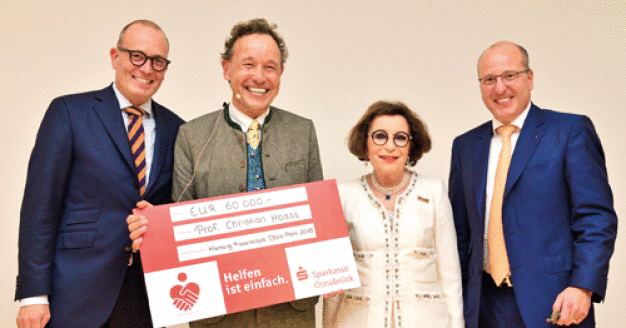
Prize winner Christian Haass (second from the left) together with Arnulf, Maria-Theresia, and Olaf Piepenbrock (from left). (Photo: Johann F. Saba)
The Munich biochemist and Alzheimer's researcher Christian Haass received this year's "Hartwig Piepenbrock-DZNE Award," endowed with 60,000 euros. The award is jointly presented by the Piepenbrock Group and the German Center for Neurodegenerative Diseases (DZNE). Haass is a professor at Ludwig-Maximilians-University Munich and spokesperson for the Munich site of the DZNE.
"The 'Hartwig Piepenbrock-DZNE Award' serves, on the one hand, to honor outstanding research achievements; on the other hand, we want to draw attention to Alzheimer's and other neurodegenerative diseases and bring these topics into public discussion," emphasizes Olaf Piepenbrock, Managing Partner of the Piepenbrock Group. "Christian Haass has significantly contributed to the development of new concepts for early detection and therapy of Alzheimer's," said Piepenbrock on the occasion of the ceremonial award ceremony in Bonn.
Full of praise for this year's awardee is also Professor Pierluigi Nicotera, Chairman of the DZNE: "Christian Haass is one of the leading experts worldwide on the molecular mechanisms of Alzheimer's disease. We owe him groundbreaking insights into proteins and immune responses involved in Alzheimer's. With his work, Christian Haass has laid the foundation for new approaches in therapy and diagnosis. He has significantly shaped Alzheimer's research over the past 30 years and continues to do so today."
Award for Top Research
Since 2011, the "Hartwig Piepenbrock-DZNE Award" has been honoring outstanding research on neurodegenerative diseases every two years. Characteristics of these diseases—including Alzheimer's, Parkinson's, and ALS—are impairments of nerve function up to the loss of nerve cells. Possible consequences are dementia and movement disorders. The Piepenbrock Group endows the award in memory of the former managing partner Hartwig Piepenbrock, who passed away in 2013 due to the effects of dementia. Prior to his death, he was actively engaged in arts, science, and society for many years. The selection of awardees is made by an international committee coordinated by the DZNE. This year marked the fifth time the award has been presented.
About Christian Haass
Born in 1960 in Mannheim, Christian Haass studied biology in Heidelberg. He then conducted research in the USA at Harvard Medical School and eventually became an assistant professor of neurology there. This was followed by a professorship at the Central Institute of Mental Health in Mannheim (University of Heidelberg). In 1999, he became Chair of Biochemistry at Ludwig-Maximilians-University Munich (LMU) and head of the Metabolic Biochemistry Department at the LMU Medical Center. Since 2009, Haass has also been the spokesperson for the DZNE Munich site.
In the early 1990s, Haass began studying the protein "Amyloid Beta Peptide." In people with Alzheimer's, this molecule clumps together and deposits as "plaques" in brain tissue between nerve cells. Contrary to the prevailing view at the time, Haass demonstrated that amyloid is not necessarily a component of pathological processes but also occurs in healthy brains. Today, it is believed that in Alzheimer's disease, the production or breakdown of this protein is disrupted. Haass later discovered how genetic mutations associated with rare, early-onset forms of Alzheimer's cause overproduction of amyloid. As a result, this protein accumulates in the brain, leading to the formation of characteristic plaques. Haass's research provided important insights into how amyloid is produced from a larger molecule (amyloid precursor protein) under the influence of specific enzymes (secretases). His work and that of other scientists ultimately led to the formulation of the "Amyloid Cascade Hypothesis," which suggests that amyloid not only plays a crucial role in inherited forms of Alzheimer's by triggering a chain reaction that ultimately results in nerve cell death but also in the much more common sporadic variant of the disease.
Christian Haass thus paved the way for therapeutic approaches aimed at preventing the formation of amyloid aggregates or promoting their breakdown. So far, clinical studies based on this concept have not been able to halt the decline in memory performance — however, it is suspected that these treatments were initiated too late, as they targeted individuals who already showed symptoms of dementia. Brain damage, however, begins many years earlier — long before symptoms become noticeable. Therefore, therapies targeting amyloid will continue to be pursued as a potential strategy against Alzheimer's.
In recent years, Haass expanded his research to other aspects of Alzheimer's disease, investigating the role of brain immune cells: microglia. He found that, especially in the early stages of the disease, a molecular switch (the TREM2 protein) prompts microglia to clear amyloid deposits. Haass developed a novel therapeutic concept: by influencing TREM2, this approach aims to promote the breakdown of amyloid aggregates by microglia. This approach is now being researched in collaboration with industry partners. Furthermore, Haass discovered that the concentration of TREM2 in cerebrospinal fluid increases when microglia are activated. Consequently, TREM2 could serve as a biomarker to help detect Alzheimer's early, even before the onset of dementia symptoms.
Christian Haass has been honored multiple times for his research — including with the Leibniz Prize from the German Research Foundation and most recently in 2018 with the Brain Prize, the world's most prestigious award for brain research.
Piepenbrock Dienstleistungen GmbH + Co. KG
49084 Osnabrück
Germany