




- Translated with AI
Green algae decompose plastic
Student team from TU Kaiserslautern scores in international competition
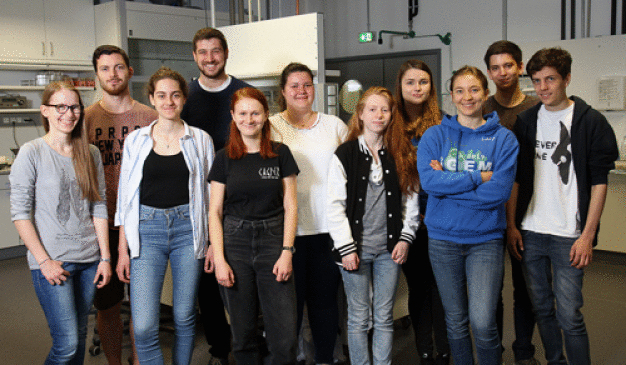
The team from Kaiserslautern was very successful at the competition. (Photo: Koziel/TUK)
A student team from the Technical University of Kaiserslautern (TUK) convinced the jury with their plastic-degrading green algae at an international competition in Boston, USA. At the iGEM competition (international Genetically Engineered Machine), they secured third place in the "Undergrad" category. Additionally, the students won in the categories "Best Plant Project in Synthetic Biology," "Best Wiki," "Best Poster," and "Best Environmental Project." The competition focuses on projects in synthetic biology and targets young scientists.
At the Massachusetts Institute of Technology, MIT, the team from Kaiserslautern had to present their work. Over the past few months, they developed a green algae that breaks down plastic. The main focus is on PET plastic. The abbreviation stands for Polyethylene Terephthalate. PET is the most commonly used plastic worldwide.
For green algae to break down PET, they need two specific enzymes that split the plastic into two basic components. Japanese scientists discovered these enzymes a few years ago in bacteria that had decomposed plastic on a landfill.
The Kaiserslautern team introduced both genes into the genome of the green algae. The algae decompose the plastic in a bioreactor. The two substances into which PET is broken down—terephthalic acid and ethylene glycol—can be reused. These substances can, for example, be used for the renewed synthesis of PET. With this, the students of TUK have created a closed recycling system where no plastic ends up in the environment. It is conceivable, for example, that this technology could be used in wastewater treatment plants.
The team consists of twelve members, all are undergraduate students, mostly studying biology, two in bio- and chemical engineering, one in computer science, and one in biophysics. The competition took a lot of time. Not only does the project in the lab count, but also a series of other tasks that the teams had to complete beforehand. This includes, among other things, convincing sponsors of their idea, managing finances, and documenting all expenses. They have to finance their work themselves, relying on financial and material donations. The team successfully ran a crowdfunding campaign in the summer, raising enough money for everyone to participate in Boston. They also did extensive public relations work, for example, to raise awareness about genetic engineering.
In total, 375 teams from around the world participated in the competition.
The students also received strong support from the Department of Biology, such as from Professor Michael Schroda, Junior Professor Felix Willmund, and Professor Nicole Frankenberg-Dinkel. Additionally, eight doctoral students advised the team. They were also allowed to use a laboratory space for their experiments.
Questions answered by:
iGEM team of TU Kaiserslautern
Email: igem@bio.uni-kl.de
Technische Universität Kaiserslautern
67663 Kaiserslautern
Germany