




- Systems
- Translated with AI
GMP Monitoring: Advantages and Disadvantages of a Radio System

For a GMP monitoring system for environmental conditions in cleanrooms and equipment (such as refrigerators and freezers), a high degree of flexibility in sensor selection is often required. Refrigerators, for example, are occasionally moved to a different location, or an additional freezer is needed. Often, the rooms and devices to be monitored are widely dispersed and sometimes located in different buildings.
To meet this flexibility, location-independent measurement systems offer several advantages over a traditional, fixed-wired solution. The primary focus must always be GMP compliance. This means that despite all flexibility, the requirements for GMP-compliant recording and documentation must be met.
This comparison examines a fixed-wired solution versus a wireless system, evaluating the GMP compliance of both solutions.
Comparison: Wireless vs. Fixed Wiring
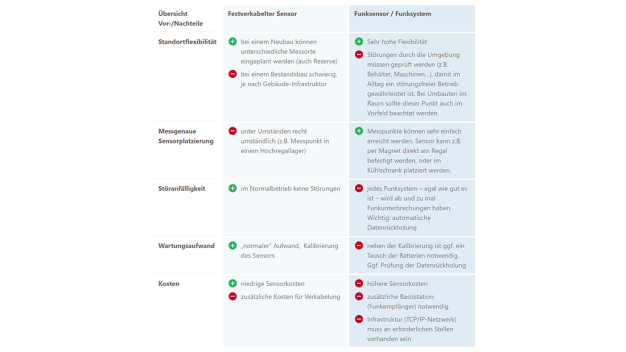
The following compares a fixed-wired solution with a wireless system, in which each sensor transmits its measurement data via radio to a base station, forwards it via TCP/IP (customer network) to the central system, and the measurement data are processed from there.
As can be seen from the table, a wireless solution, besides the significant advantage of location independence, also has some disadvantages compared to a fixed-wired solution.
Risk Assessment
Briem recommends always conducting a risk assessment in advance. This should at least include the following points:
– How important is 100% data transmission? Can the risk be accepted that a measurement value might be missing or transmitted only later? (e.g., in a high-bay warehouse, this might be considered less critical than in a refrigerator)
– Is there a network infrastructure at the necessary locations for the base units?
– Has a meaningful assessment or radio coverage analysis been carried out to ensure a reasonable number and placement of base units?
Effort – Benefit – Cost – Comparison
Subsequently, a "effort – benefit – cost" comparison of the two solutions can be performed. For a wireless system, automatic data retrieval must be guaranteed and sufficiently tested in terms of GMP compliance during qualification. Data integrity should also be examined in advance.
Conclusion
At BRIEM, the motto is: "If possible, use cables." Where a wired solution is not feasible or would be disproportionately complex, a wireless system — especially for sensors that are not highly accessible — offers an excellent supplementary solution.

BRIEM Steuerungstechnik GmbH
Lauterstraße 23
72622 Nürtingen
Germany
Phone: +49 7022 60920
Fax: +49 7022 609260
email: info@briem.de
Internet: http://www.briem.de



