- Furnishing & equipment
- Translated with AI
Ergonomics in the Field of Tension Between Cost Pressure and Demographics
Prevention Day at Opel in Rüsselsheim
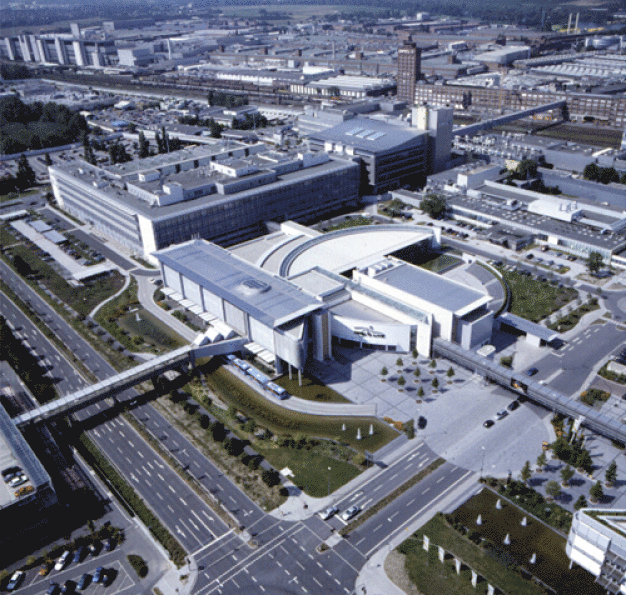
The factory premises of Adam Opel AG in Rüsselsheim. (Photo: © GM Company)
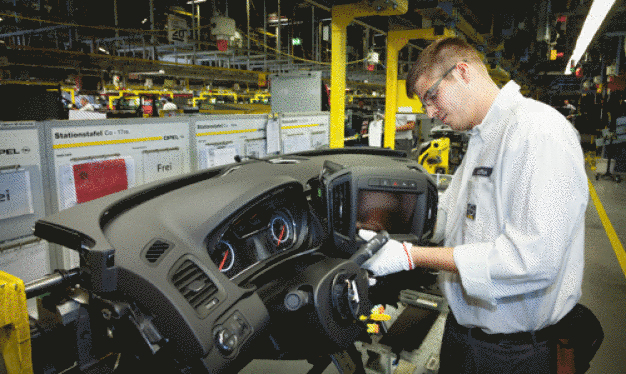
Modern workplace design at Opel AG in Rüsselsheim. (Photo: © GM Company)
Thanks to modern medical care, good nutrition and housing conditions, as well as improved hygiene and working conditions, humans are living increasingly longer, at least in Europe. According to the Federal Statistical Office, out of the 80.8 million people in Germany, about 49 million are of working age between 20 and 64 years. By 2060, it is expected that the total number of employed people in Germany will decrease by 23 to 30 percent depending on immigration, down to approximately 36 million people. This will also shift the age structure. Demographic change results in generally older workforces within companies. These changing framework conditions must already be addressed by companies today to retain employees long-term and to design workplaces that promote health and secure business success in an age-appropriate manner. The holistic approach of New Ergonomics plays a special role in shaping future-proof work environments.
Businesses must face important challenges: securing skilled workers, supporting reintegration, and consciously counteracting demographic change through preventive measures. To benefit long-term from the performance potential of their employees, companies need to set the necessary course early on. For the workplace, this means minimizing all performance-reducing factors as much as possible. Merely aligning with existing laws, regulations, accident prevention guidelines, as well as German DIN standards and international ergonomic norms, would certainly fall short here. These can only describe minimum standards.
The human being and their needs are always at the center of all considerations and measures. The central prerequisite for work ability is human health. An investment in the physical and mental health and well-being of employees, through awareness campaigns, ergonomic workshops, fitness activities, continuous training programs, and active use of Occupational Health Management (OHM), pays off twice for the company. By involving employees in ergonomic optimization processes, not only is the production process improved, but also identification with the company and employee motivation are sustainably promoted. Employees, as experienced knowledge carriers, receive recognition and appreciation from supervisors and colleagues. In the long term, this reduces days of incapacity for work, lowers healthcare costs, improves individual employee performance, and increases overall productivity.
Ergonomic workstations increase productivity and well-being into old age
An ergonomically optimized workplace design significantly contributes to preventing physical complaints and maintaining the health and performance of workers over the long term. However, considerations in this regard must be long-term: the goal is to preserve each employee's ability to work throughout their entire working life. Responsible parties must think early about age-appropriate design of the workplace and environment. That means designing work in such a way that the needs of an aging workforce are met and that it contributes preventively to the avoidance of chronic diseases. Some companies already use a so-called "age simulation suit" during planning, redesign, or optimization of workplaces to make the altered perception of older people through limitations in vision, hearing, strength, and tactile sense tangible. Employees must be made aware of ergonomics and use this knowledge for themselves and their workplaces.
Experts impart knowledge on optimal workplace design
Representatives of New Ergonomics therefore always consciously focus on humans. This includes companies such as Dauphin HumanDesign Group GmbH & Co. KG, ITEM Industrie-technik GmbH, and Herbert Waldmann GmbH & Co. KG – each an expert in their field and always committed to developing products and services tailored to the needs of (working) people. The manufacturers agree: an ergonomically and user-appropriate designed workplace has a lasting positive impact on employees' health and performance, increases reliability, and leads to productivity gains, even into old (working) age. This also involves educating employers and presenting appropriate furnishing and workplace solutions in administrative and production areas.
In this context, on March 15, 2016, the "Day of Back Health," an independent cooperative event organized by Dauphin, ITEM, and Waldmann under the patronage of Aktion Gesunder Rücken (AGR) e. V., will take place at Adam Opel AG in Rüsselsheim. The event targets production planners, operations and manufacturing managers, health managers, occupational safety officers, and occupational physicians in companies. The goal is to prepare participants for the challenges of demographic change and demonstrate how practical (workplace) solutions and measures can be professionally and future-proof implemented.
Physiotherapist and ergonomics consultant Susanne Weber from Dauphin HumanDesign Group will lead the full-day event. Her daily work with companies gives her insight into ergonomic issues that may arise and how to find appropriate solutions. Participants can expect interesting and practical presentations from Prof. Dr. Martin Schmauder and Ulrich Kuhnt. The two experts will explain what matters in setting up and ergonomically optimizing workplaces and how measures can sensitize employees to health-preserving behaviors. Prof. Dr. Martin Schmauder, Professor of Occupational Science at the Technical University of Dresden, will discuss "Ergonomics at the assembly workstation," covering fundamentals and case studies on the proper design of industrial workplaces and assessment methods for body postures. Sports scientist Ulrich Kuhnt will present his practical lecture "Ergonomics in Production," highlighting the importance of ergonomics for the development of musculoskeletal complaints and the synergy of behavioral and environmental prevention in corporate health promotion, with practical examples. Afterwards, ergonomics and workplace experts from Adam Opel AG will explain the ergonomic process in production and guide through the final assembly of ergonomic vehicle seats.
The full-day informational event will take place on March 15, 2016, at Adam Opel AG in Rüsselsheim. Interested parties can register immediately at www.agr-ev.de/OPEL-Expertentagung and find out more details. Participants can look forward to interesting and practical presentations from various experts. The number of participants is limited to 100 persons, and the registration fee is 60 euros per person. The registration deadline is February 29, 2016.

Dauphin HumanDesign® Group GmbH & Co. KG
Espanstraße 36
91238 Offenhausen
Germany
Phone: +49 91 5817514
Fax: +49 91 5817701
email: info@dauphin-group.com
Internet: http://www.dauphin-group.com