

- Translated with AI
Dr. Gero Beckmann
Compounding - When it really hits hard
- The case of the American company NECC from a microbiological perspective -
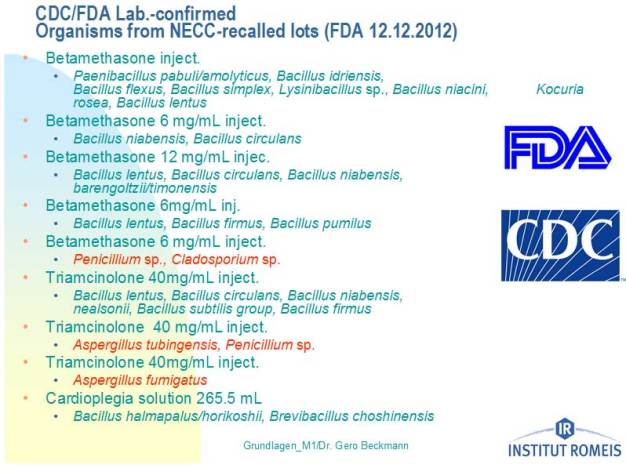
Table 1
Pharmaceutical microbiology – compared to other areas of life – is not exactly rich in spectacular cases. On the one hand, this speaks for the high standards, but on the other hand, it inevitably raises the question of whether the efforts are appropriate. When German pharmaceutical microbiologists are asked about remarkable microbiological incidents in recent years, the term "Mainz University Hospital 2010" occasionally comes up. Here, there were regrettable deaths on the premature baby ward 3 after infusions contaminated with Escherichia hermannii and Enterobacter cloacae. Unfortunately, the case was not accompanied by official investigation reports, so the final explanation was that a glass vial had developed hairline cracks. Neither the manufacturer nor the hospital pharmacy detected the causative germs. This sparse result of follow-up investigations is regrettable given the significant efforts undertaken in the field of pharmaceutical microbiology and quality assurance. The obvious human tendency to downplay, suppress, and cover up should have been countered by the collective desire that, for reasons of drug safety, the highest degree of transparency be demanded. Thus, the opportunity to "learn from mistakes (of others)" in the GMP environment was missed and continues to be missed.
Even more incomprehensible is the limited media and professional attention that the case of the US company New England Compounding Center (NECC) has triggered here since autumn of last year:
After administration of methylprednisolone acetate (unpreserved, 3 batches), formulated individually for patients and administered intradurally, meningitis occurred in at least 19 US states. Initially, two molds (Exserohilum rostratum and Aspergillus sp.) were identified as causes.
To date, more than 700 cases have been registered, with 54 deaths! This is roughly comparable to the EHEC wave in 2011 (BECKMANN 2011). Follow-up investigations of various batches revealed, besides molds, various Bacillaceae indicating serious hygiene deficiencies (see Tab. 1).
After the case became known, the FDA and CDC (Centers for Disease Control) were involved, and numerous inspections were initiated. Detecting the cases is challenging due to the long latency period until the appearance of rather nonspecific symptoms. Therefore, a significant underreporting is also assumed.
Interestingly, NECC had been under surveillance by authorities since at least 2006. At that time, a warning letter was even being prepared – as shown by interviews with FDA chief Margaret Hamburg before a US Senate committee – but was halted by the FDA's legal department, partly because they wanted to wait for the adoption of an FDA guideline for so-called compounding centers and feared liability. This is reminiscent of the delayed closure of the Freising bakery Müller-Brot in early 2012. It had become known that authorities (LGL, Bavarian State Office for Health and Food Safety) had been aware of pest problems for several years. Well-informed sources reported that the company's legal team also prevented faster action here (keyword: official liability and consideration of whether a partial shutdown of the affected company could be an alternative, ANONYM 2012).
Accordingly, the FDA expanded investigations to other products from NECC as well as other compounding centers. Due to the large number of similar facilities (about 2,800 in the USA), this was only done by sampling. Similar deficiencies were found, confirming the FDA's intention to establish its own guidelines. An aerial view of the affected facility shows a location directly neighboring a recycling operation (!) and shipping companies with open container storage (note by D. Müller on 23.01.2013). Subsequently, 7 more recalls were initiated.
The FDA inspectors found the following deficiencies:
• Poor microbiological controls
• Poor air management
• Detection of foreign particles in products (black particles)
A significant note at this point: in the USA, it is expected that non-sterile products are free from "objectionable organisms," i.e., unwanted germs (CFR 211.113, 211.165). This includes not only specified microorganisms but also all that, for example, are associated with drug use or could cause difficulties. Here, as well as within the scope of the European Pharmacopoeia, microbiological data are expected to be critically evaluated. Risk assessments are required for this (SUTTON 2006; BECKMANN 2010).
It is a fact that the intradural application of a glucocorticoid that significantly reduces local immune defense allows even the most harmless germ to cause an infectious disease. Therefore, sterility is particularly critical and must be guaranteed, which is also reflected in good medical practice for such invasive procedures.
The legislation in the United States is now responding: a registration requirement for compounding centers is to be introduced. The FDA guideline will also be adopted.
To an authority that we in Germany usually face with a bowing posture, the statements of the FDA chief seem almost revolutionary:
"I wish we had acted earlier"
The FDA wouldn't be the FDA if the expected announcement didn't come right away:
"I wish we had been more aggressive, and I can assure you, that we are being more aggressive now."
References:
Anonymous: Message from 14.11.2012 to the author.
Beckmann G (2010): Risk assessments of microorganisms. A special challenge for pharmaceutical microbiology. Pharm. Ind. 72, 332-336.
Beckmann G (2011): EHEC – relevant for the pharmaceutical industry? SWISS PHARMA 33 (7/8), 16-17.
Sutton S (2006): How to determine if an organism is "objectionable". Pharmaceutical Microbiology Forum Newsletter 12, 2-9.
www.scientificamerican.com, accessed on 15.5.2013.
www.CNBC.com, accessed on 15.5.2013.
www.bostonglobe.com, accessed on 15.5.2013.
Correspondence address:
Dr. Gero Beckmann,
Head of Hygiene and Consulting at
Institut Romeis Bad Kissingen GmbH
Schlimpfhofer Str. 21
D-97723 Oberthulba
Tel. 09736-7516-20
Email: g.beckmann@institut-romeis.de,
www.institut-romeis.de
Note: In the context of the seminar "Sterile Manufacturing in the Pharmacy" on January 15, 2014, in Heidelberg, the author will discuss the microbiological background and, additionally, speakers from authorities and pharmacies will present the European and German recommendations and guidelines that aim to ensure the quality and safety of patient-specific preparations in pharmacies.
Additional note for interested readers:
Implementation of Norms Established by the Council of Europe for Quality Assurance and Safety of Medicines Prepared by Compounding Pharmacies Can Prevent Serious Incidents with such Medicines in Europe.
There is no doubt that preparing medicines in pharmacies is indispensable for accommodating the individual needs and medical conditions of patients in Europe and beyond, especially if an appropriate medicine does not exist or is unavailable on the market. The standards for quality assurance and safety in pharmacy compounding are not harmonized across Europe and fall under the national competencies of individual countries.
Following the conclusions of a 2008 survey conducted by the Committee of Experts on Quality and Safety Standards for Pharmaceutical Practices and Pharmaceutical Care (Council of Europe), supported by EDQM, a significant gap was identified between respondent countries regarding quality assurance and standards for pharmacy-made medicinal products, as well as a gap in quality assurance between pharmacy preparations and industrially produced medicines.
The Committee of Experts proposed standards for harmonizing quality and safety standards for pharmacy preparations of medicinal products across Europe in the form of a draft resolution.
The Committee of Ministers adopted Resolution CM/Res AP(2011)1 on quality and safety assurance requirements for medicinal products prepared in pharmacies for the special needs of patients and recommended that member states adapt their legislation accordingly.
Notably, the resolution marks a major breakthrough in protecting patient safety and preventing quality and safety gaps between medicines prepared in pharmacies and in industrial settings by outlining key elements of quality assurance in preparation processes. An innovative approach, such as a decision-making aid for determining the required level of quality standards, is included in the resolution.
The resolution is available to authorities and pharmacists to help prevent incidents with medicines prepared in compounding pharmacies – let's make use of it!
Further information for interested readers:
- Proceedings of the expert workshop on "Promoting Standards for the Quality and Safety Assurance of Pharmacy-Prepared Medicinal Products for the Needs of Patients" held on September 24, 2009, at the European Directorate for the Quality of Medicines & HealthCare (EDQM), Council of Europe, in Strasbourg.
http://www.edqm.eu/site/Proceedings_Expert_Workshop_24th_September_2009pdf-en-30628-2.html
- Survey report published in Pharmeuropa (October 2010)
http://www.edqm.eu/site/Abridged_Survey_Report_on_Quality_and_Safety_Assurance_Standards-en-30786-2.html
- Council of Europe Committee of Ministers Resolution (CM/Res AP (2011)1) on quality and safety assurance requirements for medicinal products prepared in pharmacies for the special needs of patients
https://wcd.coe.int/ViewDoc.jsp?Ref=CM/ResAP(2011)1&Language=lanEnglish&Ver=original&Site=CM&BackColorInternet=DBDCF2&BackColorIntranet=FDC864&BackColorLogged=FDC864

CONCEPT HEIDELBERG GmbH
Rischerstraße 8
69123 Heidelberg
Germany
Phone: +49 6221 844415
Fax: +49 6221 844464
email: info@concept-heidelberg.de
Internet: http://www.gmp-navigator.com/