

- Workplace
- Translated with AI
cleo® care
Sterile cleanroom work documents for safe cytostatic preparation
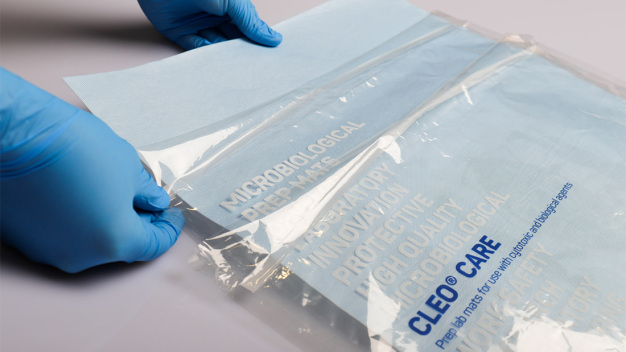
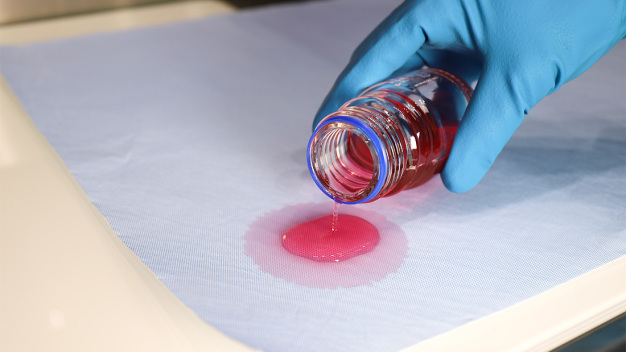
Handling cytostatics and biological working materials requires the avoidance of contamination and substance carryover as a central requirement in the pharmaceutical and medical environment. Cleanroom work documents play an important protective role for personnel, product, and environment. With the new cleo® care documents, Berner offers a specially developed solution that, through triple foil packaging with easy peel-open function, high absorbency, and good permeation values, makes a significant contribution to process and work safety. This article explains the product characteristics in the context of applicable regulatory requirements and demonstrates how cleo® care can be used as a practical working tool in cleanrooms and safety cabinets.
Introduction
The manufacture and application of medicines with carcinogenic, mutagenic, or reprotoxic properties (CMR substances) require special protective measures. In aseptic preparation, especially when handling cytostatics, work documents play a key role in avoiding surface contamination. National guidelines and technical regulations, including the Technical Rules for Hazardous Substances (TRGS) 525[1], the recommendations of the Professional Association for Health Service and Welfare (BGW)[2], as well as the guidelines of the Federal Pharmacists' Chamber (BAK)[3] and the Federal Association of German Hospital Pharmacists (ADKA)[4], consistently demand the use of absorbent and liquid-impermeable documents. These are intended to ensure a safe environment during transport, preparation, storage, application, and disposal by absorbing leaking liquids and preventing penetration into underlying surfaces. The cleo® care work documents were developed to meet these high requirements while combining user-friendly features such as sterilization, easy handling, and slip-resistant application.
Material Properties and Functionality
The work documents cleo® care consist of a three-layer structure designed for maximum functionality and safety. The top layer made of a structured PE mesh ensures even distribution of liquids and simultaneously contributes to minimizing particle release. Beneath is an absorption layer made of air-laid paper capable of absorbing up to 719 milliliters of liquids per square meter. For a sheet size of 560 x 410 mm, this corresponds to an absorption capacity of up to 166 milliliters, and for a size of 420 x 260 mm, 79 ml. The bottom layer is a dense PE film that prevents contamination of surfaces and the carryover of toxic or infectious substances. cleo® care has been tested according to DIN EN 374-1[5] and DIN EN 16523-1[6] for permeation against the cytostatics Carmustine and Fluorouracil. No breakthrough was detected even after 480 minutes. This corresponds to the highest performance class 6.
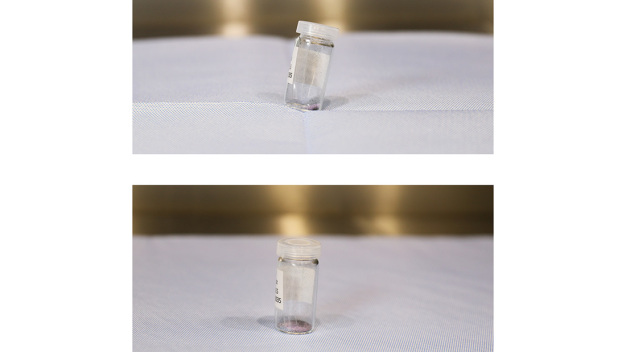
Thanks to their smooth, unfolded design, the documents provide an even working surface on which even light and small utensils such as vials can be securely placed. The antistatic property of the materials additionally prevents particle attraction, which is particularly important in highly pure work areas such as safety cabinets of cleanroom class A or ISO 5. Sterilization is carried out via gamma radiation, ensuring high microbial safety.
Another significant advantage of cleo® care is its innovative triple foil packaging, which allows contamination-free insertion into the cleanroom according to ISO 14644-5 requirements. This packaging solution enables the outer layers to be gradually removed in different cleanroom zones without compromising the sterile inner packaging. This significantly reduces the risk of cross-contamination during insertion—a crucial safety aspect, especially in cleanrooms of class A/ISO 5. The packaging thus meets the requirements for cleanroom compatibility and supports compliance with hygiene standards according to GMP Annex 1[7] and DIN EN ISO 11607[8] for the packaging of sterile medical devices.
Regulatory Requirements and Application Context
Numerous guidelines emphasize the importance of suitable documents when working with cytostatics. The Technical Rules for Hazardous Substances (TRGS 525) require the use of liquid-absorbing documents on defined work surfaces to prevent the carryover of dangerous medicines.[9] The Professional Association for Health Service and Welfare (BGW) specifies this requirement in its 2019 recommendation, indicating that liquids-proof documents or spill trays should be used during the preparation and storage of cytostatics. They also play an important role during application and subsequent disposal, as contaminated materials such as gloves, swabs, or heavily soaked work documents must be disposed of as hazardous waste.[10]
The guideline of the Federal Pharmacists' Chamber for aseptic manufacturing (as of 2024) and the ADKA guideline for hospital pharmacies (2025) explicitly require that ready-to-use parenterals with CMR properties be stored on liquid-proof documents or in removable spill trays. This protects the interior of refrigerators and facilitates cleaning in case of leaks.[11] cleo® care fully meets all these requirements and is therefore suitable for use throughout the entire process chain—from preparation and intermediate storage to application and disposal.
Discussion and Evaluation
The development of cleo® care work documents is a consistent response to the increased safety requirements in the preparation of cytostatics. Unlike conventional absorbent mats, which often lack permeation proof or are not produced under sterile conditions, cleo® care combines modern material technology with regulatory compliance. Its high liquid absorption capacity and tested barrier function against toxic substances significantly contribute to reducing surface contamination. Additionally, the antistatic and slip-resistant design of the documents enhances application safety. Notably, the tested protective duration of over eight hours against permeation—especially for permeation-critical cytostatics—is a performance feature currently fulfilled by only a few products on the market.
Conclusion
With cleo® care, healthcare facilities have a modern, reliable, and legally compliant work document that significantly increases safety when handling CMR medicines. It supports adherence to current guidelines, minimizes the risk of unintentional substance carryover, and helps maintain aseptic conditions in the cleanroom. Its application can therefore be regarded as a quality-relevant component of a comprehensive safety concept.
References:
1 TRGS 525 – Protective measures when working with hazardous substances in healthcare, 2014.
2 BGW – Cytostatics in healthcare. Professional Association for Health Service and Welfare, 2008.
3 Federal Pharmacists' Chamber (BAK) – Guideline for aseptic manufacturing and testing of ready-to-use parenterals, 2024.
4 ADKA – Guideline for aseptic preparation and testing of ready-to-use parenterals in hospital pharmacies, 2025.
5 DIN EN ISO 374-1:2024-05. Protective gloves against dangerous chemicals and microorganisms – Part 1: Terminology and performance requirements for chemical risks (ISO 374-1:2024); German version EN ISO 374-1:2024. Berlin: Beuth Verlag.
6 DIN EN 16523-1:2015+A1:2018. Determination of material resistance to chemical permeation – Part 1: Permeation by liquids under continuous contact; German version EN 16523-1:2015+A1:2018. Berlin: Beuth Verlag.
7 European Commission. (2022). Annex 1: Manufacture of Sterile Medicinal Products. EudraLex – Volume 4.
8 DIN EN ISO 11607-1:2020-03. Packaging for terminally sterilized medical devices – Part 1: Requirements for materials, sterile barrier systems, and packaging systems (ISO 11607-1:2019); German version EN ISO 11607-1:2020. Berlin: Beuth Verlag.
9 TRGS 525 – Protective measures when working with hazardous substances in healthcare, 2014.
10 BGW – Cytostatics in healthcare. Professional Association for Health Service and Welfare, 2008.
11 ADKA – Guideline for aseptic preparation and testing of ready-to-use parenterals in hospital pharmacies, 2025, Federal Pharmacists' Chamber (BAK) – Guideline for aseptic manufacturing and testing of ready-to-use parenterals, 2024.

Berner International GmbH
Werner-von-Siemens-Straße 19
25337 Elmshorn
Germany
Phone: +49 4121 43560
Fax: +49 4121 435620
email: info@berner-safety.de
Internet: https://www.berner-safety.de