

- Systems
- Translated with AI
Cleanroom: Downtime operation as a component of a sustainability strategy
By reducing the air exchange rates or changing the boundary ranges of an air temperature/humidity control system, the operating costs of a cleanroom can be significantly reduced.
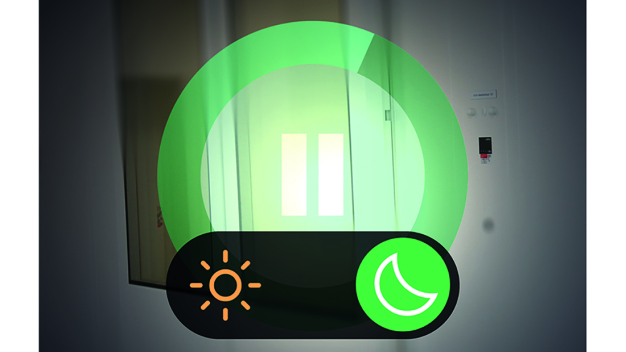
To produce energy efficiently, cleanroom operators need to primarily implement an intelligent, efficient air management system. Significant savings potential lies in the intelligent reduction of air exchange rates or by adjusting the boundary ranges of temperature/humidity control. A cleanroom monitoring system helps operators implement the reduction operation safely and GMP-compliant as part of their sustainability strategy.
What needs to be considered when implementing a reduction operation (e.g., night setback)?
Profile switching for night setback in cleanroom operation
Before deciding on a reduction operation (night setback), several points should be clarified in advance. First, it must be ensured that GMP-compliant operation of the cleanrooms during production times is guaranteed and that no contamination risk arises from the reduction operation. Furthermore, it is necessary to assess (risk analysis) whether the technical prerequisites are met for the ventilation system/air handling system. Afterwards, it is important to review the non-production times and evaluate whether a reduction operation makes sense there. Especially the lead time until the cleanroom is ready for production again should be carefully considered. If all points can be answered with "Yes," detailed planning and implementation can begin. It should not be forgotten during planning that the process of reduction must be validated.
Reduction operation via a monitoring system
A modern monitoring system helps the cleanroom operator implement the reduction operation safely and GMP-compliant. The system records every switch-over seamlessly. Necessary pressure differentials between rooms can be verified, as well as the particle concentration in the room or in the production environment through appropriate particle measurements. The readiness of the rooms for production can be indicated through alarm elements (e.g., signal lights in the black zone).
- Every profile switch is documented seamlessly
- Verification of necessary pressure differentials between rooms
- Verification of particle concentrations in the room or production environment through particle measurements
- Production readiness of the rooms can be signaled
Alarm management
During a reduction operation, it is also necessary to review and adjust the system's alarm management. Alarm thresholds can be adjusted or possibly deactivated. For example, regarding room temperature. The same applies to alarm delay times. A prerequisite for this is a monitoring system with flexible alarm management.
Profile switching
The status information "reduction operation" or "production operation" must be provided by the ventilation or air handling system or can be stored via time control schedules. The monitoring system switches to the corresponding profile based on this information. Through lead times (time delays), additional time can be allocated to the room before the monitoring system is fully "armed" again.
It is important that only "affected" sensors of the monitoring system are switched into the reduction operation. Unrelated areas, such as refrigeration units or storage areas, should be excluded.
The parameters to be set in the reduction operation within the respective system profile of the monitoring system are determined based on a risk analysis. The primary goal must be: to minimize contamination – in accordance with the EU-GMP guideline, Annex 1.
Conclusion
By reducing air exchange rates or adjusting the boundary ranges of temperature/humidity control, the operating costs of a cleanroom can be significantly lowered. Additionally, this supports cleanroom operators in achieving necessary sustainability or energy-saving goals. A risk assessment for defining parameters (sensor selection, threshold values, delay times, etc.) is essential and must be designed to prevent any contamination during the reduction process. Furthermore, the reduction process must be validated.

BRIEM Steuerungstechnik GmbH
Lauterstraße 23
72622 Nürtingen
Germany
Phone: +49 7022 60920
Fax: +49 7022 609260
email: info@briem.de
Internet: http://www.briem.de